Bubbly

As with most sporting events, the Tour de France is best seen on television. To experience the Tour, though, one has to come to France and stand on the side of the roads to cheer the riders on.
I finally attended a TDF finish on the Champs Elysees yesterday. We watched from the friends of Jean-Marie Leblanc section. Apparently Jean-Marie has a lot of friends, many of them tall. Saddled with a cough and sore throat, I felt light-headed most of the day and couldn't find the strength to fight my way to the race barrier.
Most stores and restaurants near the Champs Elysees are closed Sunday, especially on race finish day, so food was difficult to find. I ended up having to settle for a bare hot dog (the bun would have cost 3 euros) and some bland frites (french fries).
I've been riding 50 to 60 miles a day, much of it up massive cols, yet standing all afternoon was almost more draining. By the end of the day my feet and back ached. Fortunately, the weather was near perfect. Sunny, on the cool side.
We observed most of the race on a giant screen. As usual, the riders soft-pedaled most of the stage, allowing Lance and his team to form the ceremonial line across the road for a stretch. Only Simeoni attempted to ruin the festivities by breaking away to try and reach Paris first. Tradition is to allow the team of the race leader to enter Paris first. US Postal shut that down quickly, and indeed, they led the first lap around the Champs Elysees, wearing ceremonial blue jerseys with yellow stripes.
When Lance ascended the podium and held the yellow cap to his heart as they played the Stars and Stripes, I thought back on his six consecutive victories and how they overlapped almost perfectly with my near seven years in Seattle. I started cycling and following cycling intently almost immediately after he won his first Tour, though it was because of a need to rehabilitate my knee after ACL reconstruction. Lance's story, his comeback from cancer to capture his first Tour in 1999, riveted me because I had just lost my mother to cancer in 1998.
So I wanted and needed to be here this year for this, his sixth.
The evening was not over. Our Breaking Away group went for an evening boat ride down the Seine. Then I grabbed dinner with Guillaume, Richard, Jim, Angela, Kathy, and Oleg. Guillaume was one of our tour guides, the quintessential Frog, as he calls himself in jest. Everytime I hear a male French voice, I think it's Guillaume, so archetypal is his French accent. Richard and Jim are two Kiwis, traveling through France. Angela is Richard's partner and Kathy is Jim's wife, and I met them for the first time that evening.
Oleg has been my riding partner for most of the trip, though he usually drops me about halfway through each ride. He and I share similar vices: fine dining, high end home theater equipment, and of course all things cycling. He lives on the coast of San Diego, and I expect I'll see him again once my parents move out there. Oleg is a caterer/chef, and his description of the kitchen he has at home is so over the top that I absolutely have to visit him once, just to see it for myself.
After a Middle Eastern dinner, we cruised over to Barfly after midnight to celebrate Richard's birthday with a bottle of champagne. Barfly is chic, one of those places beautiful people go to be seen by less beautiful people like myself.
Then it was on to the OLN party at the top of an office complex on the Champs Elysees. Guillaume's brother Tibo (or Thibeault, I suspect) works for OLN and just seems like one of those genial socialites about town. The balcony had a gorgeous view of the Eiffel Tower, lit up in a fiery hue until a concluding ten minute shimmering light display at 2:00am. Oleg and I got the greatest kick out of meeting Frankie Andreu, Phil Liggett, Paul Sherwen, and Kristen Gum.
Speaking of OLN, I missed a lot of their coverage since I was over here, but the EuroSport coverage is excellent. They show entire stages here in Europe, from start to finish, and each evening at 10pm they broadcast an hour recap on two channels, one in French, one in English. The English commentary is provided by David Duffield, Sean Kelly, and Christi Valentine-Anderson (wife of former pro Phil Anderson). Christi in particular is excellent; she's like a Mary Carillo for cycling, extremely knowledgeable and astute. Good on her for carving out space in a predominantly male field.
I'm still staggering a bit this morning, champagne on the breath, some virus still beating up my already sore and weary body. But the overcast streets of Paris call me out today, as everyday.
I adore Paris. Someday I'd like to live here for a year or so. Last night I tried to think of another city that exceeds the Paris for sheer beauty, and I could not.

Lance, le patron du peloton

Many of us arrived in France concerned that the race was turning into a rout, but now, a week later, I couldn't be happier having watched Lance dominate. He has won an unprecedented four stages in a row in the mountains (broken up only by a stage victory for Gonzalez in the flat stage 14 to Nimes), and today he was a human bullet in capturing the long, final individual time trial. Our entire group watched Stage 17 on a projected screen in a hotel conference room, and we were screaming our lungs off as Landis led Armstrong over the Croix de Fry and then as Lance screamed past Kloden in the final sprint. It may be the most exciting stage victory I've ever seen Lance capture.
When I arrived, Lance was in blue. He zipped past me in Villard-de-Lans, in a turn in the final leg of stage 15, still in blue...

...but just a few minutes later, he was in yellow.
That's the color he was wearing when he streaked past me on his way towards the base of Alpe d'Huez in the stage 16 uphill time trial.

I would rank this as Lance's most dominating Tour victory of his six. He has the form he had in 2001 along with by far the strongest team, superior even to than the original Train Bleu of 2002. With the exception of time trials and the later mountains in the long mountain stages, Lance has been flanked by a sea of blue riders. It's a beautiful thing to watch, as in this shot of US Postal passing me on the Col du Glandon.

Tomorrow, we'll watch the race finish on the Champs Elysees from a special viewing area reserved for friends of Jean-Marie LeBlanc.
Cycling trips that follow the Tour de France are both exhilarating and exhausting. The logistics leave little time for lying around unless you're content to sit in the hotel and watch the race on television. Instead, everyday we're riding and then watching the race, and every other day we're packing for van transfers to the next hotel, chasing the peloton around the country. It's a breakneck pace.
I haven't slept much. Early on it was the result of jet lag, and more recently it's been due to our tight schedule. The morning always start early, usually with a breakfast at 6:30 to 7:00, and we're out on our bikes by 8:00 to 9:00. The ride usually finishes two to four hours later, with lunch at whatever town we've arrived at. It's similar to the schedule almost all the bike tours adopt, similar to the regimen of the last two Tours I've attended, but for some reason I'm more fatigued this year.
Yesterday, Oleg and I left for a 100km ride to Lons le Saunier from our hotel in Macon. Almost as soon as we departed into the French countryside, the rain began to fall. The severity of the storm spiked quickly, and soon the sky was being split by forks of lightning every ten to fifteen seconds, the wind whipping the stalks of corn this way and that. The booming gongs of thunder added to the soundtrack of terror. We had nowhere to hide.
I put on my rain jacket, but soon it simply clung to me like frozen saran wrap, weighed down by water. Both of us started shivering, and without glasses, I could barely see. I tried squinting, but several times I simply opened my eyes quickly and then shut them and rode several seconds at a time blind, hoping Oleg wouldn't brake ahead of me. After 24km, we finally found an abandoned farmhouse with an overhang to hide under. Eventually Mitch rescued us, and an hour or so later, the storm passed and we rode the remaining 50km to the race finish in Lons le Saunier. Today I'm sick as a dog, my throat on fire, but at the time, I felt like a tough guy.
I rode Alpe d'Huez again this year. It was tougher than I remembered it being last year. Cyclists use "epic" to describe certain races, stages, and climbs. Alpe d'Huez is a mountain that earns that adjective. In addition to some lesser known climbs, we also ascended the Col du Glandon and Les Deux Alpes. The descent down the Col du Glandon was incredible, long and just straight enough to achieve warp speed. I reached 76 km/hr, while Oleg, thanks to a leadout from a gendarme, hit 87 km/hr! Achieving that while sharing the road with other cyclists and automobiles moving in both directions is a knuckle-whitening exercise.
A few times during the descent, I contemplated various ways I might meet my end: brake lock-up in a switchback, launching me across the road into the path of an incoming vehicle; cyclist ahead swerving across the road and clipping my front tire; missing a switchback and launching myself off the road into a ravine; front tire blowout. Despite all that, I couldn't stop grinning the whole way down.
Without a doubt, there are more Americans at the Tour this year than ever before. Lance has single-handedly tripled or quadrupled the number of American tour groups. During the Alpe d'Huez time trial, nearly a million people must have been camped out in town and all the way up the road, through all twenty-one switchbacks. That must be one of the largest live audiences to witness any sporting event.
Other memories I'll carry away from this Tour: the courage of Thomas Voeckler, the new French hero, who dug deep to retain the yellow jersey in stage 13 despite being dropped on every climb. His face was almost always frozen in a look of pure suffering, yet somehow he hung on to the white jersey until today. I'll remember the strength of the US Postal Team: not only did they stay out front and control the race, but a rider like Azevedo retained enough energy to hold 5th in the overall classification. I'll also remember this as the coming out party for the next great American hope, Floyd Landis. It was looking bleak for the future of American cycling post-Lance, but Floyd's performance up Croix de Fry in stage 17 was an instant legend. He set such a hard tempo that only Sastre could attack, and he quickly blew up. Then, today, Landis had the time trial of his life. Either he or Azevedo are looking at assuming the team leader position post-Lance.
I'll remember how relaxed and happy Lance has been this entire Tour. It's a stark contrast to his stressful race last year. He has owned this race from the Prologue on. He is the strongest, toughest, most well-rounded and prepared rider in the peloton, and his preparation and focus are second-to-none. His success has allowed him to surround himself with perhaps the best team in TDF history. We're seeing all sorts of new tricks from Lance, from winning tactical sprints to asserting his role as le patron by chasing down Simeoni and forcing him to back off the breakaway in stage 18 (because Armstrong is a GC contender, the peloton would not let him stay in the breakaway, and that would condemn all the riders in that group. Lance backed off only after forcing Simeoni to fall back with him, thus allowing the others in the break to stay away and try for the stage victory, won by Mercado. Armstrong and Simeoni have a long history, and currently the Italian is suing Lance because the Texan called him a liar.)
More later--I'm half conscious and the party on the Champs Elysees awaits in just over twelve hours. Six TDF victories, it's history unfolding, the coronation of the greatest Tour de France cyclist ever. Hemingway called the Tour de France the greatest sporting event in the world, and after three years of witnessing the race live, I understand his sentiment.

Blue Crush

Now this is the Lance Armstrong of 2001 and the U.S. Postal Team of 2002, put together. I watched EuroSport highlights of Stage 12 on my hotel television last night. The broadcast was in German, for some reason (Corinna, where are you when I need you?!). To me, it sounded like, "Ich bin eine ich bin eine Lance Armstrong ich bin eine ich bin eine Jan Ullrich (yaan oool-reeq) bin eine kleine natchmusik."
But the video spoke volumes. Amazingly, what promised to be one of the most thrilling Tours in years may nearly be over already, barring accident or misfortune. The U.S. Postal Squad reeled in a vicious attack, then set hard tempo at the base of La Mongie. By the time the final booster of the rocket known as Le Train Bleu fell away (Jose Azevedo, the new and improved Armstrong mountain lieutenant taking the place of Roberto Heras), Hamilton, Ullrich, Heras, and Mayo had cracked, their remains broken and scattered along the roads somewhere. The slope of the mountains act as a multiplier, magnifying every disparity in form, and La Mongie, the heat, Col d'Aspin, they all spread out the peloton like so much Nutella on the baked baguette of pavement that was the stage 12 route through the Pyrenees. It's starting to look as if 2003 was just an anomaly, a year that Lance came back to the field, rather than vice versa.
Thanks to Ivan Basso, though, we still have a race. He looked just as strong as Armstrong at the end, even if his stage win was a bit opportunistic as he hung on Lance's wheel most of the final stretch. I expected Ullrich to struggle early; the course is not set up well for him, and only the final long individual time trial offers a great opportunity for him to attack. But I was surprised that Mayo never attacked since he had promised to try and go for the win, and Hamilton's early troubles all day were shocking. As he said, "I didn't have the legs today."
I feel like Bill Murray from Lost in Translation. I woke at 3 in the morning and lay in bed, staring at the luminescent glow from the neon signs of all the other Charles de Gaulle airport hotels as it filtered through the curtains. I made it to breakfast as it opened, at 6:30am, and it was a banquet. France makes the best bread in the world, hands down.
In a bit I hope to assemble my bike. The roads around here are not conducive to riding, so perhaps I'll try and open my legs up in the fitness centre. And then more German broadcasts on EuroSport at 2:00pm. I've ridden to Plateau de Beille, and it's a bastard of a climb. More fun fun fun in the Pyrenean sun. Wish you were here.
P.S.: Wherever I travel, I'm haunted by the Geoffrey-Rushian looks and maniacal voice of Richard Quest. I look forward to replacing him in my mind with some of the TDF podium girls.

Gatwick

I had to follow today's stage on this Internet terminal in Gatwick Airport. It took me ten minutes to type this sentence. 200 pounds of pressure required to depress each key. Instant carpal tunnel.
Lance did great. Doesn't look like anyone can challenge him this year.
I'm exhausted. Ooh. There's my gate assignment. On to Paris.
Oh, wait. Flight delayed an hour. Bollocks. Must stay awake. So many times I've been in this situation--waiting for a gate assignment in an English airport, jetlagged into some other dimension, fighting to stay awake.

Separation

I thought I'd never finish packing, and without some yeoman's work from Sang, Wade, and Eric, I never would have. Nothing is more appreciated than those who will help you with the dreaded and thankless task of moving heavy stuff on into the night. For a week straight, I couldn't avoid things that required packing, everywhere I turned in my house. It nearly drove me insane, and a few times I secretly wished to be robbed of everything. But every item discarded or packed felt like one ballast or rope cut loose from a hot air balloon, and now I'm finally light enough to fly.
Today I'm a visitor in Seattle, not a resident. In a few hours, I'll be chasing the TDF peloton down in a 747, then a van, and finally on my bike. I've never been so thankful to climb aboard an airplane, even if my back feels like it's been double tied into one giant, dead knot.
By the time I land in Paris tomorrow, the Tour de France will have seen its first true and significant separation. It's the first mountain stage where the race contenders will attack, and for many, it's the day the race really begins, if the hundreds of miles the peloton has already covered can be dismissed so lightly.
It's also the first day I'll have achieved significant separation from the city I've lived in for nearly seven years now. I'm looking out on the city now, draped in sunlight, and remembering that first day in 1997, when I woke up on a friend's sofa and listened to the voices of strangers outside the window.

Bill and Lynn

Bill and Lynn were married two weekends ago at Sleeping Lady just outside Leavenworth, the faux Bavarian town in eastern Washington. Great weather, and a Bill-Lynn brandworthy locale. I wish I had time to post photos from the weekend, but packing has consumed me, and now I've run out of time. My photos are on a portable hard drive, in a storage bin somewhere.
But I do have a Quicktime movie of the slideshow (22MB--it's fat) that played at the wedding. Pic selection by Bill Carr, photos snapped by Misc, music selection by Bill Carr, music editing by Pete Hilgendorf, and assembly by yours truly. iPhoto doesn't have a feature whereby you can specify that you want a song to start on slide X and end with slide Y, with a cross-fade into the next song with the next slide. Some of the photos were older prints scanned on a flatbed and didn't look so hot rendered by iDVD, so the whole music/slideshow meld was much more painful than it needed to be. The result turned out fine, though (of course, some of Bill's pants selections from his youth might look better blurred).
Bill and Lynn are kind and decent folk, and I miss'em already. All congrats to the Outdoor Life Network couple, scuba diving like a pair of Cousteaus in Fiji.

Dissenting opinions on the Koolhaas library

Derek forwarded me this article from Project for Public Spaces that offers a dissenting opinion on the Koolhaas library in Seattle. Their primary complaint is that the building interacts with the environment around it in a very artificial manner (i.e., reflections of the street in the glass exterior, the slight overhang on 4th Ave.).
Dissent is always good, and I'd agree that the building could present a more welcoming set of entrances and walls on all sides, except perhaps the side with the parking entrance. The overhang on 4th, which puts that entrance in the shade most of the time, might be more welcoming if it actually receded back and allowed sunlight to grace that entrance. Then add some outdoor seating, perhaps a cafe, and the 4th Ave face of the library would be much improved.
My main gripe with the library, which I still admire as a building, is that the book selection is lousy. I created a book hold list of some twenty books, and over a month later not one has shown as available. I requested books across all genres, some classics, some new bestsellers. Without a decent book selection, the Koolhaas library is an expensive Internet cafe.
Hopefully my donation of over two hundred books during my recent moving downsizing will find their way to the Koolhaas library shelves. Many I'd never read, so perhaps someday I'll check one of them out to read.

Seattle neighborhoods

When I first moved to Seattle to work at Amazon.com, I received an orientation packet which contained a humorous overview of all the Seattle neighborhoods. While packing today, I came across it and flipped through it. I'm not sure who wrote it, but here are some of the descriptions:
  • Madison Park: Blue-blood. The place for you if you drive a BMW or Mercedes, are named Buffy, or Buf, and wear pastel plaid. Martha Stewart devotees move here. Honestly: A beautiful part of town, but don't expect a mixed cultural experience here.
  • Belltown: Used to be the art section of town, now it is run over by mid/late 30-somethings with too much disposable income. Good restaurants so at least you won't go hungry. Awesome bus routes to work. Invest in pepper spray futures.
  • Montlake Cut: Established. You had better garden, or have a gardener. Built on a mud flat, so the neighborhodo lullaby is the sound of basement pumps.
  • Phinney Ridge: Your basic neighborhood. The Zoo is there. Families have been seen there (that is the neighborhood, not the zoo). Quiet, good views. No bullshit.
  • Wallingford/Fremont: Daily sightings of Jerry Garcia. Irreverent, putting on a hip attitude. Debate over the coolest thing is split between the statue of Stalin [Note: it's actually Lenin], the 30-foot tall troll, and the god-knows-how-man feet rocket. More junk stores than you can count. The best margaritas in town. Every store in the central corridor has a dog.
  • Capitol Hill: If it ain't pierced or tattooed it ain't allowed. God knows why they let me live there (maybe it's the fact that I used to have 1" long red, or orange hair) [Note: hmm, a clue as to the writer's identity, though that described lots of early Amazonians]. Philosophically, the gay pride parade begins and ends here. The best coffee in town (no joke).
  • Laurelhurt: Bill Gates' home town. You get charged for each time you breathe. Most common operation is a nose job, to ensure that they can look down their nose.
  • Mt. Baker: Not for the politically incorrect, diplomats only allowed. One of the few culturally mixed parts of town. Good, beautiful walks, dogs galore.
  • Greenlake: Everyone owns a bike, everyone rollerblades. Everyone met their spouse when walking around the lake. The path around the lake is currently being renovated, from two lanes to three. One for bikes, the second for walkers, and the third for people to talk about their relationships.
  • West Seattle: Crusty, old, California wanna-be types. They commonly mistake their mold for a tan.
  • Ballard: (With a Swedish accent) Ya sure ya'betcha. Stockholm was my home town. I have a boat. I love to fish. I eat many fish. Daily sightings of Leif Erikson.
  • Mercer Island: Good schools. Must own large, expensive yacht. Average taxes paid per household greater than third world country budgets.
  • Magnolia: Just slid into the sound (so much rain this year). The only reason I have ever heard of anyone ever going there was to buy expensive Italian silver. Good estate sales
  • U-District: Fast food joints galore. Joints galore. College students pretending to be homeless. Many homeless. Dreads seem to be the most popular hairstyle.
  • Queen Anne: Primary Thursday night activity is going to Larry's (a grocery store) to pick up a date. Post-college bar and coffee-shop scene. Highest Saab per capita in Seattle. Western slope is family oriented and completely ignores the eastern slope. DM zone is Queen Anne Ave.
  • Downtown: New York style rents, but you will get 201 sq. feet so things are not bad. Tons of new condos going up which leak in the rain and wil be renovated starting this spring. Most popular activity is checking out the weekly pun on the Marquee of the Lusty Lady. Amazing Bombay Sapphire Martinis, if you are into that sort of thing.
  • Pioneer Square: few females will go there alone at night. Bar scene. Band scene. Most popular rape scene.
Some of those no longer hold true, but most do.
Do I ever loathe packing. It's mind-numbing, soul-sapping. The landlord chose today of all days to send over several dozen workers to strip out the insulation in the attic, so it was snowing fiberglass all day. I probably contracted asbestos. I'm in a surly mood, especially since many Craig's List buyers are complete flakes and never show up when they say they will.
Also because I've been on the phone half the day with customer service reps, waiting to update my mailing address. Worst hold time? AT&T Wireless. Friendliest rep? The lady from Geico, who said "all righty then" 14 times.

Omakase at Mashiko: a Seattle foodie's treat

July 1, Eric, Christina, and I went to Mashiko in West Seattle for their omakase dinner. Christina, my most passionate Seattle foodie friend, had heard good things. Her word is gospel to me, so we cruised over for a late dinner. An omakase dinner basically means chef's choice. You pay a flat fee like a prix fixe and wait to see what the chef sends your way. The omakase at Mashiko costs $35.00 a person.
Chef Hajime noticed us from behind the sushi bar because I had just received my new Nikon D70 digital SLR that day, and I'd brought it along. He came over when he noticed me snap a photo of one of our first dishes and asked if I'd mind taking some photos for him to use on a new rev of his website.
No problem, I said. It turned out to be a good trade, because Hajime proceeded to send some twelve or thirteen courses our way, and all were uniformly divine. Some of the highlights...

The sushi was some of the best I've had in Seattle
(from left: scallops, mackerel, squid, salmon, tuna)

The green tea tiramisu was incredible

An innovative sushi dessert

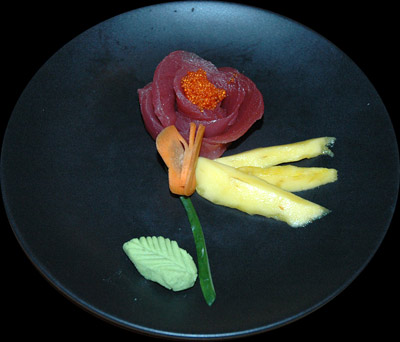
Hajime even created some edible art pieces

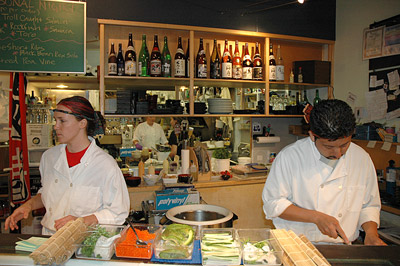
Chef Hajime is at the right, working on one of our courses.

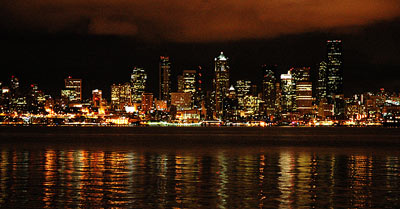
By meal's end, I could barely walk, drunk on culinary bliss. As it was possibly one of my last visits to West Seattle, we stopped on the way home to gaze at the Seattle skyline at night.

I highly recommend this meal for foodies, especially Japanese cuisine lovers. It's the best omakase meal I've had in Seattle. If you're want more and larger photos, I've posted all my pics from the meal to a massive web page.
I've been Christina's foodie wing man on many occasions here in Seattle. She's the scout who finds out where the good places are, and Eric and I tag along. I'll miss having someone like her near once I've moved away. We had one last meal together at Lark last night. It wasn't as amazing as the first meal I had there, but it was still excellent.
Christina's about to embark on a family vacation, and a grand meal was a fitting way for us to bid each other farewell.

More Seattle Essentials

  • Cinerama - probably the finest theater I've ever seen a movie in. The bathrooms are almost fully automated. If you could wave a hand in front of the door to the men's bathroom and have it open, I don't think you'd need to touch a single thing in the bathroom. Well, except...oh never mind. We can simply agree that automated public bathrooms are a really good thing. Decent candy selection, and of course the sound system and video quality are awesome. The two downsides to Cinerama are that it's difficult to find affordable parking and the seats are in serious need of renovation. The seatback spring tension needs a dose of Viagra, or Levitra, or Cialis (hey, those TV commercials work! I remember all three brand names). If you are tall, you will have the seatback in front of you resting on your knees during the entire movie.
  • Cedars - I wish I could remember who first recommended this Indian/Middle Eastern restaurant to me, because it's a place that gets passed down from one Seattlite to another, like an heirloom. Cedars is cheap, and the food is dreamy. A real tandor (clay oven) produces fabulous chicken tikka, naan, and paratha. Cedar's chicken tikka masala or malai kofta are canonical in my mind. If you haven't overdosed on sugar in the constantly refilled chai (service is snappy), owner Mohammed Bhatti nearly always sends a free dessert. In the seven years I've been in Seattle, Cedars has never been less than packed on weekends. That's staying power. My last meal there was with Rich and Christina and Eric and Christina, a fitting last supper since they are some of the devoted acolytes who I was happy to introduce to the restaurant.
  • Summer weather - Seattle's summer climate is the nicest of any major city in the U.S. There, I said it. Not too hot, not too cool, and dry. Many days, the temperature outside is so neutral I don't feel anything at all, neither warm nor cool. There are no mosquitoes, and because Seattle is so far north, it's light out from 5 in the morning until 9:30 in the evening for a good few months.

Line of blue

I love watching the team trial. The formation of riders, rotating in a long loop while flying over the road, is hypnotic. Teams couldn't hold pristine pace lines today because of the weather and rough roads, but despite the conditions, US Postal rode the third fastest TTT ever in average speed to capture the stage. If the roads had been dry and the skies clear, I'm certain they would have set the record.
Lance rode a 56 tooth chainring in front while the other Posties rode 55's. My quads cramp just seeing the number 56. US Postal rode a single pace line, while some teams opted for a double. Lance claimed that riding a double paceline would be a tactical error, and perhaps he was right. US Postal finished strong while other teams faded towards the finish. The blue train looked to hold the cleanest lines throughout the course while other teams' formations were scattered and messy.
What if Phonak hadn't waited for Gonzalez? We'll never know, I guess. Anyhow, the name of the game is just to stay upright and close until the mountain stages create true selection. It would be great to see George Hincapie pick up yellow, if possible, though it would be extremely difficult to hand it back.
It's my sole daily respite now, watching the Tour in the morning and eating brunch. Then it's off to pack for the move.

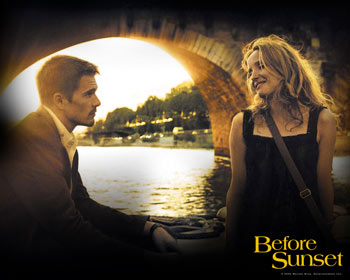
Review: Before Sunset

I saw Before Sunset at SIFF at the Cinerama and never found a moment to put my thoughts down. But I see it's out in theaters now, and so I wholeheartedly recommend seeing it in theaters.
Before Sunrise is one of my favorite romances, and Before Sunset is its unexpected real-time sequel (Before Sunrise came out 9 years ago, and Before Sunset is set 9 years after the events of that movie). The timing works; no makeup is needed to see that Jessie (Ethan Hawke) and Celine (Julie Delpy) have aged physically. They're still attractive, but Hawke sports patches of grey, and both of them are leaner, not so much ravaged by time but perhaps hardened. Or are have they been starved for something they once thought possible?
The plot consists of their reunion in Paris, nine years after that magical day they spent together in Vienna. They have much less time this time; Jessie's plane home to America leaves in an hour and a half. Fortunately, they spend it strolling through Paris, perhaps the most endearing pedestrian destination anywhere. Hawke and Delpy blur the lines between reality and performance by ignoring them. Hawke plays an author in the movie (as he was in real-life), and Delpy speaks of having spent time in NYC (she did, as a film school student at NYU). These characters have become as much theirs as Linklater's, and all three love Jessie and Celine in a way that no fan of the first move need fear the taint of a financially motivated sequel. Yet this is a sequel that risks even more than its predecessor, and that's a rarity.
As with most Richard Linklater movies, much of the movie consists of dialogue. Not just any dialogue. This kind of conversation sounds more genuine than the usual theatrical rhetoric and yet it dances from topic to topic with an emotional honesty and intellectual curiosity that holds our attention until we step back and see the brilliant tapestry that Linklater, Hawke, and Delpy have woven. Linklater fans love to hear his characters walk and talk. Neither Jessie nor Celine is as young and impulsive as they once were, and yet they find themselves grasping for something they hope isn't simply nostalgia for a day that sparked on physical attraction. We sense it isn't; their minds flirt on streams of dialogue. And if it their conversation is at times pretentious (as when they discuss the environment and other such current events), it's no more so than when we hear it from our more crusading friends. Without revealing any major plot points, we come to realize why they are so desperate to preserve this moment they have with each other.
The real-time feel of the movie works wonderfully, for the most part. We feel the urgency of Jessie's impending flight time because we sense it will end not only their encounter but the movie. That's why the ending is so perfect. When it arrives, unexpectedly, we feel that our two heroes have managed to stave off the tyranny of the clock and carve out a space in time for themselves. The final images as the screen fades to black are enough to hold us until what would be a welcome next chapter in a new type of franchise: the romantic walkie talkie.

Breakfast in the bean bag

[Sigh] I think I think I'm in love...

After finally conking out at 4am last night, getting up at 6 to watch the Wimbledom ladies final was ugly. But damn if Sharapova's attacking game wasn't a 6 foot 1 glass of espresso. She was fearless and plays like Natalie Coughlin swims (great bio on Coughlin in this week's New Yorker), that is, all out aggression from the opening bell. I've never seen anyone take it to Serena Williams like Sharapova did today, it was just awesome.
Then a small group gathered to watch the Tour Prologue Time Trial. Lance looked superb, putting some early time into Hamilton, Ullrich, and Mayo, but the day belonged to Fabian Cancellara. He averaged 33.3mph around the 3.8 mile course (try going out and doing that around your neighborhood, that's obscene).

Review: Spiderman 2

[Minor spoilers ahead in the form of some high-level plot synopses; no more than you could infer from the trailer, though]
Spiderman 2 is the type of exhilarating summer popcorn blockbuster that seemed like a momentous happening when I was a young boy. Maybe there is an age when I'll outgrow that, but I suspect that some of us will always enjoy a movie like this, and others never could. Thank goodness, too, because the first Spiderman was a letdown, and Peter Parker is the superhero for the geeks of the world. A science nerd, shy, clumsy around women, oppressed by bullies, who one day gains not only superpowers but also some mysterious magnetic charm over babes like Gwen Stacy and Mary Jane Watson, one whose clever mind finds outlet in witty repartee while sparring with assorted villains with costumes and names as ridiculous as his own. [I stood in line for a long time next to some of these thirty-something geeks tonight, and while we share some common interests, I'm glad to say I dress better and shower more regularly]
Most superhero comic book writing is patently absurd and childish. Literature is no different. The best superhero stories give us heroes who have human emotions and problems. If you can empathize with the man behind the mask, your sense of fantastical uplift is that much greater when the hero is doing the superhuman. Peter Parker is the easiest of the major superheroes to empathize with. He's a teenager trying to make ends meet, in love with a girl, struggling to fit in socially, rather than a superhuman from another planet (which is why Christopher Reeve's vulnerability was pitch perfect for the Superman movies) or a billionaire (Bruce Wayne has two alter egos, his wealthy playboy side and his sadistic vigilante side; the lonely orphan is repressed out of existence. He'd make a great Freudian subject.). He wants to do good, but out of a sense of loyalty to family and friends. In the comic books, Mary Jane is the supportive wife who supports her husband in his career aspirations while seeking work of her own. They're urban DINKs.
The first half of the movie gives the characters and narrative some real heft, something the first movie lacked. Peter's double life as Spiderman is taking its toll on his schoolwork, love life, and freelance career as photographer and pizza delivery guy. In an interesting twist on the mythology, Peter's frame of mind is closely tied to his powers; where there's a will, there's a web.
What keeps the movie fun is that the screenwriters, director, and actor sprinkle the movie with audacious humor. In-jokes (listen for the theme song from the old cartoon and watch for the appearance of several characters from the Spiderman mythology), guest appearances (Elvis is alive!), one-liners, freeze frames (one particularly memorable one), and even a musical interlude set to Raindrops Keep Falling On My Head. It's a level of confidence in the material that wasn't in the first movie (except for one moment when Willem Dafoe took off his shirt to climb onto a metal platform and uttered, "Ooh, that's cold!" when metal straps were placed over his chest), and it liberates the movie creator's joy and love for the material.
The movie has a refreshingly utopian view of Manhattan. Spiderman has to take an elevator in one scene in this sequel, and the way the other person in the elevator reacts to him is true to New York City; celebrities find the anonymity granted by others in Manhattan soothing. In another scene, as in the first Spiderman movie, Spidey receives assistance from his fellow New York City citizens against his foe.
Peter goes through one day that's so bad it achieves a comic-book feel, campy and iconic. Each depressing episode flashes one after the other like frames in a comic strip. It feels more like a comic book than some of Ang Lee's more explicit imitation of that art form, such as the split frames. Even certain camera angles, like an extreme upward shot of Tobey Maguire, his fists clenched, recall the visual dynamism of comic book panels.
Among many competing themes, it's primarily a love story. Tobey Maguire's Spiderman isn't as much of a smart-ass as the Parker of comic books. He's more sullen, mopey, and doe-eyed; a quiet romantic. It's an interpretation that flows from Maguire's minimalist acting style, and it strengthens the on-screen love affair. A wounded heart that yearns plays sweeter than a smart aleck who covets. Kirsten Dunst looks younger than the Mary Jane Watson in print, and that's a good thing. Dunst's MJ is a model, yes, but one with teenage crushes and insecurities of her own. She quiets her face, droops her eyelids, and hunches her shoulders when she's feeling doubt or sadness. This MJ is a creation all her own, and theirs is the Romeo and Juliet romance of pop fiction.
The superpowers and supervillains then serve as amplifiers to push the human problems in the movie up to life-or-death heights, like MSG in takeout Chinese food. Unrequited love is much grander when the girl you love is a model, plans to marry an astronaut, and finally needs you most when she's kidnapped by a mad scientist with four metallic arms.
In the one scene that feels hokey, if such a thing is possible in a superhero movie, Tobey Maguire converses with his dead Uncle Ben in a car floating in a sea of white nothingness. Were they in the Matrix? I thought perhaps Morpheus would show up to ask if Peter wanted the blue or red pill. It's a metaphor played too visually literal. But other than that, the screenplay has a clean, classic structure, one reason the trailer was a model of clarity.
The special effects are improved from the first movie, though the movement and look of Spiderman in the long shots when he's soaring through the city still lack weight and realism. In closeup and medium shots, when Tobey Maguire is in costume, or when he's being tossed against solid objects, the sound and textures and human-executed physical movements contribute to a sense of realism. Doc Ock's mechanical arms look and move like real metallic appendages when viewed up close. In contrast, the CGI Spiderman who swings from building to building moves too quickly. If the camera would just stay still for a second and lock the background in place, Spiderman would look more realistic, but perhaps that would also expose flaws in Spiderman's texture. The other problem in the long shots is the lighting. When he is swinging dozens of stories above the ground level through a pastel-colored CGI city, Spiderman's form seems immune to shadows, and that flattens his figure. No DP can light a scene that high in the air, but it's an area for improvement in visual effects.
Perhaps this will be the last movie I see at Cinerama. If so, it was a good movie to end with. I've seen all sorts of movies at Cinerama, from experimental movies to arthouse movies to grand epics like Lawrence of Arabia to SIFF entries, but what I'll remember it for are the big summer blockbusters, the Star Wars and LOTRs. I won't miss the now flaccid seats or the hours spent waiting in line alone, but I'll miss the arrival of friends just before being let in, the smell of butter popcorn just inside the entrance, the fully-automated bathrooms (if the doors could be opened by a wave of the hand, the only thing your hands would have to touch in the men's bathroom would be your own zipper), the massive screen, and the digital surround sound system, and the whooping and cheering and palpable energy of a fired-up opening night crowd. When the lights would go down, it felt like re-entering a womb, except one with an impeccable A/V system.

Da girl can crush

I'd heard much about the "next Anna Kournikova," 17 year old Maria Sharapova, but I'd never seen her play. Then, during lunch today, I caught the last set of her match against Ai Sugiyama.
Wow. Not only is she gorgeous (blonde, 6 feet tall, seemingly two thirds of that are her legs; she wore designer earrings during her match), but more importantly, she can flat out play. It seemed she couldn't miss that last set, pounding rockets off serve, forehands, backhands, volleys, overheads. During matches, her face always conveys her fierce determination and competitive spirit, and she screams everytime she bludgeons the ball. After every winning point, she pumped her left fist.
Once the match ended, she melted and became a little girl, smiling, clutching her face in disbelief, and blowing kisses to the crowd. Okay, can Siberia really be all that cold? Sharapova's about to go supernova.
The women's game is healthy. I haven't watched much tennis in a long time, but with the Williams sisters, Capriati, Henin-Hardenne and Clijsters, Sharapova, Myskina, Davenport, Mauresmo, and Dementieva, there's a ton of depth at the top.