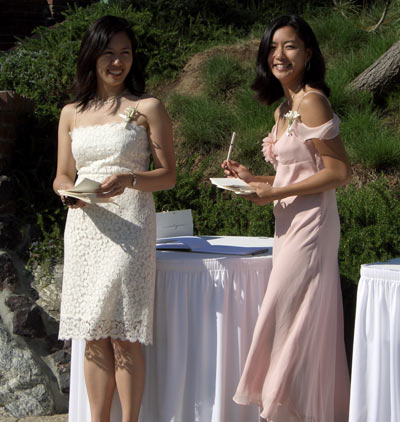
Taiwan glamor shots

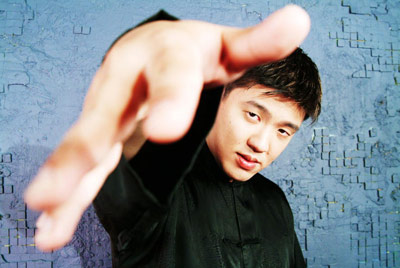
The popular thing to do when traveling back to Taiwan? Pose for glamor shots. Apparently they're inexpensive back there, and it sure beats sitting in front of a pulldown autumn leaf background at Sears while wearing a cowboy outfit. My sisters both have a Taiwan glamor shot portfolio, and now Alan and Sharon and Ryan have them, too. They're the type of photos you claim to be embarrassed of but secretly love, and you bring them out at every occasion. I'm feeling left out. Why wasn't I informed of this while I was back in Taiwan?
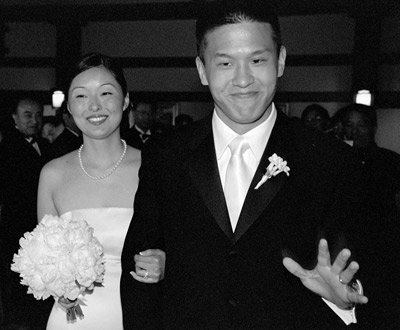
We heard about them during James and Angela's wedding, and Alan even did this pose for us, but it was only after we all finally received the photo that we understood the true awesomeness of his work. I'm not even sure I'm allowed to post this, but I can't resist.

I'm going to hold a contest among my family to caption this. There are more where this came from, but I'm not sure the world is ready for them.

James and Angela

James and Angela were married June 12. It was a fantastic weekend in San Diego. Gorgeous weather, family and friends all gathered together in the same city, just good times all around. We outlet shopped at Carlsbad Company Stores, played No Limit Texas Hold'Em with poker chips purchased at Target, watched the Will Ferrell Architect spoof speech from the Matrix Reloaded DVD about 74 times, walked along the beach, and showered Ryan with attention.
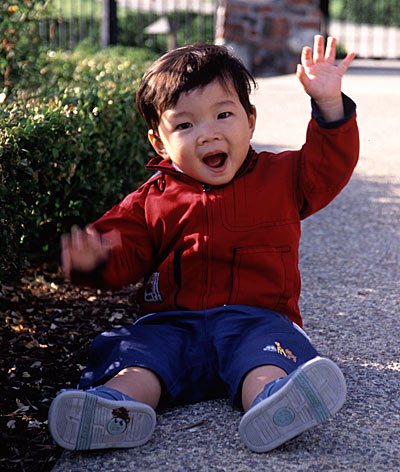
Ryan is the first baby to enter our family, and so we all love to spoil him rotten. It doesn't hurt that he's ridiculously cute. He had a whole new arsenal of tricks with which to break us down. First, he can walk now. But when he prepares to run, he first gets down in a modified sprinter's crouch...

He can also do the fist pound now (the move where two people bump fists gently, a variation of the high five or handshake). Just hold out your fist and say, "Pound pound!" and you'll get some love.
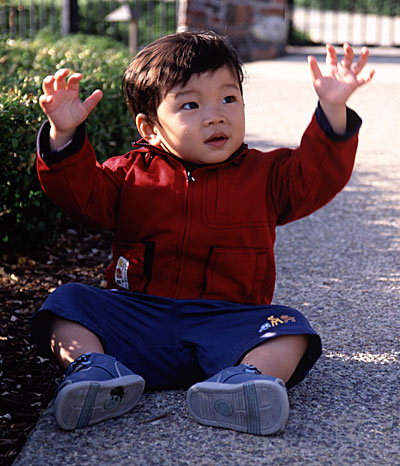
Ryan has also learned some moves from Eric Carle's From Head to Toe Board Book. For example: "Ryan, what does a monkey do?"

"Ryan, what does a bear do?"

We could go on and on, believe me. Gorilla, elephant, you name it.
Ryan also knows where his head, ears, and nose are. If you ask, he'll point them out. And he's nailed the major baby sign language moves: more, please, thank you. They didn't have baby sign language back in my day. Now, when you do something to make a baby happy, they start giving you the "more" symbol. It's mind-blowing.
I played a round of golf on Torrey Pines South Course with Sharon's parents and one of my stepmom's family friends. That course hosts the Buick Invitational each year, and it will host the 2008 U.S. Open. The course sits on the cliffs that run along the Pacific Ocean. The course is difficult primarily because it's very long, the rough is impossible to hit out of, and there is sand all over the place, protecting every green, waiting halfway down fairways to swallow errant drives.
It was my first full round since removing the cast from my pinky, and my swing was shaky. By the end of the round, I started to feel better. On the par 5 18th, I hit a driver and 5-wood about 500 yards and had a sand wedge over one of the only lakes on the course to reach the green. The pin was tucked around 70 yards away with water in front and sand immediately behind it. I tried to finesse my sand wedge in.
Plop. In the water. I dropped and swung again, a bit harder. Plop. One more time. This time I hit the green, but my ball spun back into the water. Straight out of Tin Cup Finally I made it on and one-putted, ending up with a 104 for the round. Sigh.
Later in the week, all of James brothers and brothers-in-law had to decide whether or not we'd follow through on a goofy idea I'd tossed out at Christmas last year. My thought was that the four of us (Alan, Mike, Jeff, and yours truly) could perform a dance at the rehearsal dinner. It was just the type of goofball public humiliation that James would appreciate.
Karen choreographed a dance for us to Smooth Criminal by Michael Jackson. We rehearsed a bit at Christmas after James had left, but nothing in between. So it was looking dicey when we arrived in San Diego, especially with Jeff and Alan not arriving until Friday afternoon.
But the bonds of family run strong, and late on Friday night, after the rehearsal dinner, Karen showed us the new routine, and we practiced in our hotel room until the wee hours of the morning, bleary-eyed, with Smooth Criminal playing from my Powerbook speakers. The next morning we found some fedoras at a costume shop near Mission Bay, and unless one of us blew out a knee during the ceremony or chasing down one of the appetizer waiters during cocktail hour (mmmmm, baby lamb chops) we had no more excuses.
The wedding itself was gorgeous, right outside the Torrey Pines Lodge, overlooking the 18th hole. The only distraction came from a golfer who missed his putt and shouted, "Damn it!" during the ceremony. From there, it was on to dinner and dancing. We danced, and then we did THE DANCE.
I have a whole new admiration for those who dance for a living. First we rehearsed outside again in the dark on the Torrey Pines practice green. But under the heat of the spotlights with an audience cheering, it's hard to remember your moves. A few times my mind just went blank. But we pulled it off...I think. Maybe someday I'll be able to watch the video.
Most importantly, James and Angela became husband and wife. James is my stepbrother, but our family is so tight we just refer to each other as brothers. He's the funniest guy I know; I think every other sentence out of his mouth is a joke of some sort. He is also a master magician, a vice president at a private equity firm in NYC, and as charismatic a guy as you'll meet.

Angela and James complement each other perfectly. Where James is animated, Angela is polite, sweet, and courteous. She is also extremely neat and organized. Her multi-page wedding schedule/itinerary was so detailed it blew us away. The wedding coordinator called Angela the most organized bride she'd ever worked with.

They're the hip, stylish, young Manhattan couple, and hopefully soon they'll be my neighbors.
I think of all these things now because I'm in the midst of the stress of moving, or at least packing up to go homeless for a few months. It's sweaty, time-consuming, and thoroughly unpleasant.
But the thought of being closer to family puts everything in perspective. Recently, I've had several friends lose fathers to cancer. I'm in the midst of a string of weddings. My college friend Polly become a mother to Emily Katelyn just last Saturday. All the workings of the world feel amplified.
My immediate family is like the Brady Bunch--how often does one get along perfectly with all of one's in-laws, step-siblings and parents, uncles and aunts, nephews and nieces? Our family rocks and rolls. It's a miracle and a blessing. I made a DVD of photos and video clips from our Christmas together in NYC and from the wedding in San Diego, and when all this packing gets me down, I pop it in and laugh. Good times.


et cetera

James sent me this link to a page that will render any webpage Doggy style. Fairly straightforward, it adds "know what I'm sayin'" to the end of most sentences. I enjoyed the Snoop version of Dubya's famous "Fool me once" quote, now getting serious playtime in Farenheit 9/11: "There's an old saying in Tennessee - I know that shiznit's in Texas, probably in Tennessee - that says, fool me once, shame on - shame on yo' ass n' shit. Fool me - yo' ass can't get fooled again."
I knew there was a reason to keep a cactus around the house.
The Atkins diet may decrease women's fertility. But their men can counter by chewing khat.
Russians change the weather for a Paul McCartney concert. Bill Gates must be so tempted to do this for his backyard BBQs in Seattle.
Current U.S. administration revises count of deaths from international terrorism in 2003. Turns out we're not winning the war on terrorism after all.
Robots turn on us. Body implants that run on body heat/electricity. Everything in The Matrix is coming true!

The modern garage sale, run by Craig

My stress level spiked sharply yesterday when I realized I had just a few weeks left to vacate my place. I immediately rushed frantically around the house, photographing things with a digital camera. Then I built a Moving Sale web page, threw the first batch of stuff up, and posted it to Craigslist. I saw dozens of listings so I didn't hold out too much hope.
I received e-mails back within minutes of submitting my post, and within 12 hours a lot of it had sold. This Craigslist is pretty nifty.
Now I'm committed to spending a few more days photographing everything. The house will soon resemble just a giant product photo studio.
On the one hand, preparing for a move is stressful. The balancing flip-side is the zen peace of mind one achieves from detaching from one's material goods. My goal is to leave Seattle with as little as possible.

Farenheit 9/11 sets box office records for a documentary

Playing on only 868 screens and rated R, Farenheit 9/11 still won the weekend box office crown by pulling in $21.8 million and in the process became the top grossing documentary of all time.
It could have opened on more screens and tried to bank more business before the Spiderman 2 onslaught this weekend, but I suspect the movie will benefit from strong word-of-mouth.
I'd be surprised if Spiderman 2 doesn't shatter all the weekend box office records over the July 4 weekend. They cut an awesome set of trailers and commercials, and unlike Farenheit 9/11 Spidey will show up on a bazillion screens Wednesday.
In front of one of them I shall be.

Flying Wheels, sort of

I rode the Flying Wheels century today. It was a bit of a last minute decision, but I needed the mileage. I hadn't ridden anything close to a century this season, and organized rides are so much more fun than solo training rides.
I ended up alone for much of the ride anyway. I was searching for a pace line that would average about 24-27 mph in the flats, 12-15 mph uphill, and for some reason I couldn't fine one. There weren't many pace lines at all, and the ones I did find were either too fast or too slow.
By mile 75 my legs were wobbling. A few years back, I rode this with Bill as training for the 1-day STP, and I felt so strong at the finish I raced the last 20 miles in. Today I was just happy to finish.
At least the weather was gorgeous, and I have that pleasant soreness in my legs now.

Review: Farenheit 9/11

Those desperate to see George Bush defeated in the November elections must have hoped that Farenheit 9/11 would put a dent in his seemingly impervious polling numbers. In this polarized political environment, where Democrats and Republicans turn their backs on each other to whoop up their respective choirs, it would take a documentary nearly free of bias and charged rhetoric to kick-start any true dialogue.
Michael Moore is not that type of documentarian, nor does he profess to be. Moore can't resist any opportunity to ridicule his prey, to get in the cheap shot or the easy jab, or to project himself into the picture to push buttons when he should be behind the camera. And God bless him, all democracies need their populist rabblerousers, though in this year of all years I wish he could have resisted the urge. It would have strengthened the persuasiveness of his message, though how could Moore resist a target like Bush? Charlton Heston in Bowling for Columbine was senile and evoked a reflexive pity; Bush is dangerously smug in his convictions for someone who most believe to have the intellect of your typical fraternity president.
The first two-thirds of the movie are edited for maximum humor: Bush on vacation, Bush golfing, Bush clowning around. Moore shows Republican leaders being primped for television interviews and speeches, including Paul Wolfowitz licking a comb before running it through his hair. Is that to imply Republicans are vain? It's a weak jab, especially as Democratic politicians must go through the same process.
Other bits are hilarious. I've seen the last clip of Bush several times ("There's an old saying in Tennessee - I know it's in Texas, probably in Tennessee - that says, fool me once, shame on - shame on you. Fool me - you can't get fooled again." ), yet it never fails to delight. Moore edits clips together in sequences that put Bush and his staff in as foolish a light as possible, and the accompanying music is a hammer onto itself. Moore has never used music to better effect.
Many in the packed opening-night crowd I saw the movie with were whooping and hollering at various Bush gaffes and verbal slips. I admit to feeling a cathartic glee at jeering Bush with a partisan audience, as if Moore were providing a channel to release nearly four years of pent-up frustration and indignation. It's the same feeling as when I'm derisively cheering the error of a Cardinal with 40,000 fellow Cubs fans at Wrigley.
Which is to say it's just more of the same, and that may not be enough. Bush has been the object of scorn and the butt of jokes for years now, and yet he still polls either neck and neck or ahead of Kerry. It's a challenge. We love our gadflies to sting hard, and with defiance, and nobody does that like Moore. It feels so liberating to skewer the White House. But in these times, Moore may only further polarize the country.
Moore also can't stay behind the lines and leave good enough alone. He narrates most of the first half of the movie, and he appears in many of the clips. He also pulls several more of his patented first person stunts, like renting an ice cream truck to drive around the hill reading the Patriot Act over a loudspeaker because many of the Congressmen had failed to read it. He accosts other Senators and House Representatives on the street to ask if they'll enlist their own children to serve in the military in Iraq. Not only are these stunts childish, they border on unseemly self-promotion. At times, Moore is like the boor who expresses your own opinion in such a vulgar manner that you're somewhat embarrassed to have him on your side.
It's a shame, because when Moore lets his material speak for itself, he's very effective. The footage of George Bush reading to schoolchildren for a good seven minutes after the two planes had crashed into the World Trade Center are shockingly bizarre. A montage of House Representatives, mostly minorities, refusing to concur with the Supreme Court's decision to hand the 2000 election to Bush, standing to protest only to be silenced by none other than Al Gore, the head of the Senate at the time as the exiting Vice President. It's a passage that both maddens and saddens. Footage from Iraq shows innocent Iraqis killed and maimed by the war, very little of which was broadcast by the U.S. press, another group Moore turns a spotlight on for giving Bush and his cronies a free pass on too many issues. Not much of the material will be new to those who have listened to the liberal chorus these past three years, but stitched together one after the other, it's an eye-opening refresher as to how not just liberals but much of the world views our current government.
And about two-thirds of the way through the movie, a hero emerges. Lila Lipscomb gives the movie a moral gravity and heart that anyone, Republican or Democrat, can feel. Her grief over losing her son in the war in Iraq and her subsequent reversal in sentiment towards the war convey, in just a few short scenes, what those on the fence about Bush need to know. Her outrage emanates off the screen with an energy that silenced the audience in the theater.
There's meat in this movie, if you are willing to search for it beneath the excess of sauces and garnishes and sides. It's a movie that I hope has long legs and that I wish had more poise.
[Footnote: Farenheit 9/11 sold out all over Seattle, and I've never seen that for a documentary. It will clearly surpass Bowling for Columbine as top-grossing documentary of all-time, and it's per-theater averages this weekend will be through the roof. It's the type of energy I usually only feel with opening night crowds for action blockbusters like Star Wars or Lord of the Rings. It's one movie whose coffers I have no problem contributing to.]

Review: Secret Window

When I saw the trailer for this movie, I immediately formed a theory in my head about who the John Turturro character was. Unfortunately, the movie bore me out.
Secret Window was adapted from a Stephen King short story, and it shows. The movie feels like a single conceit stretched out to feature movie length. The director and screenwriter stuff the story full of plot tissue to give it a chest, but its flimsy. Johnny Depp, as interesting as he is, has a difficult plot gimmick to act out, and even he can't help the movie to earn the ending.

Fahrenheit 9/11--sold out

A group of us were going to try and see Fahrenheit 9/11 tonight, but the two West side theaters showing the movie here in Seattle sold out all prime time showings yesterday. That's quite surprising for a documentary, a movie that isn't something like Lord of the Rings or Spiderman. Controversy is good business.
I wonder if it's selling out in more Republican regions of the country?

Review: Dodgeball

After seeing the awful trailer for Dodgeball, I had low expectations. They were met--in fact, the movie did the limbo and shimmied below my expectations. How could so many professional movie critics praise this? The movie tries so hard to be funny (at least to a twelve year old) that it creates its own idiotic characters and situations to lampoon. That's harmless enough, but the movie also contains a few mean-spirited, mildly offensive homophobic and racial jests; they're like flies on the dog dropping.
The lone redeeming moment in the movie comes when a sports star I'm a huge huge fan of shows up unexpectedly for a short cameo. He almost lends enough class to the entire enterprise to validate it, but by movie's end I was hoping the he had washed his hands on the way out.
BTW: adults playing dodgeball? Not cool. Not funny.

Shocking scoring error helps knock Venus Williams out of Wimbledon

I had Wimbledon on in the background just now, and Venus Williams lost to Karolina Sprem 7-6 7-6. The shocking thing is that in the second set tiebreaker the chair umpire made a scoring error, calling it 2-2 when it was actually 3-1 in favor of Venus Williams. The players didn't say anything and kept playing, and Venus went up 6-3 and should have won the tiebreaker (the score should have been 7-2). Instead, Sprem came back and won.

Motorola V600

I've had the Motorola V600 cell phone for a few months now, and I love it. Bluetooth, integrated VGA camera, vivid color screen, polyphonic speaker, sleek metallic look, and a strong antenna. It's available now for just $99.99 after rebates from Cingular, which acquired AT&T Wireless a few months back. While I travel around, my phone often reads Cingular now instead of AT&T. One would hope the merger of their two networks would improve overall coverage, and thus far it seems to have fulfilled that to a minor degree.
The v600 handles the basic functions of a cell phone well, and that's most critical to me. I've also decided after using all the various form factors that I prefer flip phones. Sure, Verizon probably provides the best nationwide coverage, but why do their cell phones have to be so damned unattractive?


The Simpsons - Season Four on DVD

I finally received my copy of season four of The Simpsons on DVD, and I've been playing it in a spare window on the computer all night.
Brilliance, just sheer brilliance. The show is still decent, but season four is the show at the peak of its powers. Phil Hartman was still alive, and the sheer density of clever pop culture references is staggering. If you wanted to own only one season of the Simpsons on DVD (poor you), then this is your box set.
Now that Seattle is working on finishing its monorail, the episode "Marge vs. the Monorail" is satire that strikes particularly close to home. I'm crying. The British may be the masters of comedy, but The Simpsons may just be the epitome of American humor, a balance of optimism and indiscriminate skewering chock full of references that draw from culture both high and pop (America has no highbrow or lowbrow culture, just a democratic soup).
Speaking of The Simpsons, is there any badge of cultural distinction greater than appearing as a guest star in an episode?

John Gaeta and Christopher Doyle

I attended a talk by John Gaeta at Microsoft today. Gaeta, as most everyone now knows, was the visual effects supervisor on the Matrix trilogy, and he's most well-known for bullet-time and virtual cinematography. After showing a montage of all the amazing visual effects clips from all three Matrix movies, Gaeta emerged in a patterned silk shirt, with hair and sunglasses straight out of Zoolander.
Gaeta attended NYU film school back when it had just opened its graduate program, and he lived in Greenwich Village. After working at several different companies after graduation, Gaeta got a job as a production assistant working for the legendary Douglas Trumbull in western Massachussetts, at a visual effects facility Trumbull built in an old textile mill. This was an experimental lab from which Trumbull developed technologies like Showscan (60 fps projection) and pioneered simulation rides (he built Back to the Future...The Ride). This sounded like a movie geek utopia. Employees rode mountain bikes to work and spent all day building robotics and camera systems.
It was at Gaeta's next job, at Mass Illusions, where he began experimenting with shooting and modeling physical objects, technology that would later become the basis of the backgrounds in bullet-time and virtual cinematography shots in The Matrix movies.
The moderator showed The Campanile movie, the now legendary short by some students at Berkeley that was the predecessor of bullet time. Download it--even now that bullet time is a movie staple, the short is still mind-blowing. Gaeta discussed many of the technical challenges that they had to overcome to render the visual effects the Wachowski brothers sought. Someone asked what the key chasms they had to cross, and he replied, "Everything Neo did." I won't delve into the detail, but it was interesting.
Some other interesting points from his talk: he was under a lot of pressure to turn Neo and Agent Smith into virtual humans in the second and third movies, a la Final Fantasy which was playing in theaters at the time. He resisted and instead turned to a technique he calls Universal Capture, using 5 high-def cameras to capture data of human actors making various facial expressions. He showed us a clip of Agent Smith rendered digitally using this technique, his face morphing from Hugo Weaving into Agent Smith, and the realism was staggering. He believes, and I agree, that this technique produces much more realistic facial movements.
When asked if virtual humans would ever render human actors superfluous, he said, "No." He used the example of the nuance that an actor like Anthony Hopkins brings to his various characters and the raw material that such an actor could bring to the screen as one reason why. He did note, however, that he once thought differently.
Someone asked what movies he admired, particularly for their visual effects. After a long silence, he confronted the elephant in the room and responded, with some reluctance, "I liked the last Lord of the Rings movie, mostly for the Gollum performance." He noted that it was a rare case of supreme animation, different from the facial capture they used for the Matrix movies. He then noted that he's bored by most visual-effects laden movies, preferring more subversive uses of technology as in the Charlie Kaufmann movies. He also cited Fight Club as a movie that was nearly subversive all the way through.
Someone asked why certain parts of the Burly Brawl looked more obviously artificial than others. Gaeta attributed it to clips where lighting wasn't baked into the DP's shots. For such shots, lighting had to be done later, and results with that had been mixed. For example, when Neo flies into the air like a helicopter, 3-point lighting hadn't been anticipated to be necessary some 30 feet in the air.
The only shot Gaeta liked in the first Spiderman was the last one, and he liked it a lot.
When asked how to avoid artificial-looking visual effects of people doing superhuman things, he recommended stylized camera speeds. Avoid 24fps special effects like the plague. If you go from slow-mo to high-speed, the shot is so stylized the audience can't process its artificiality. He cited one example from Hulk, when the Hulk is swinging a tank around. It's shown in 24fps, and while the Hulk looks realistic, the tank looks as if it has the consistency of a box of tissue paper. A wise tip.
Finally, Gaeta tossed out some thoughts on the future of entertainment and storytelling. He did believe in the primacy of a story crafted by a single storyteller, but thought it could be blended with more interactive stories. For example, you might have a story with several key, unchanging anchor plot points, but the story could be loaded up with expository bits that could be accessed by the viewer in any order. Each of those would still eventually take the viewer to the same basic points in the story, but the experience each time would be different. One example might be the ability to go back and watch a movie several times from the perspective of different characters.

_________________________________________

At the Seattle Film Festival, I went to a Master Class with another movie technician I admire: Christopher Doyle, longtime DP for Wong Kar Wai, among others. For some reason, I assume Doyle would be like someone out of Wong Kar Wai's movies, a reserved man with an eye for beauty, like one of the Tony Leung characters.
Not even close. Doyle cussed like a sailor, dropping f-bombs and sexual innuendos and gleeful cackles every other sentence. It makes sense; he once was a sailor. The interviewer, Rachel Bosky (sp?) from American Cinematographer, managed to mask her exasperation with a wry smile the whole time. Doyle was conscious of his behavior, noting, "Most cinematographers are not like this."
He showed a few montages of clips from his movies. One in particular was amusing, showing some unseen footage of Tony Leung and Maggie Cheung dancing very formally during the shoot of In The Mood for Love.
His is an organic movie-making process, a style he refers to as Eastern. He spoke of "finding the film": the image is there, it's the filmmaker's duty to find it as opposed to imposing or creating it. He opposed it to a more Western style, say that of Quentin Tarantino. Instead of removing the fourth wall for a shoot, he believed in appropriating a space. During In The Mood for Love, they shot in an actual apartment building and had to use mirrors to light in tight quarters. He believed that style was often how one responded to space.
"The East finds movies. The West buys them," he said. "Miramax, that is."
This philosophy of his was certainly influenced by his environment in Asia, and by his long-time collaborator Wong Kar Wai. For movies like In The Mood for Love or 2046, WKW shot without a script, just shooting tons of footage in search of that elusive moment (it's one reason movies like 2046 have taken so long to complete, and even at Cannes, it was rumored the final print was still in the editing room until the last minute). Doyle said that when he shoots with WKW, over 90% of the footage is just tossed out (he compared it to masturbating, or, as he said with a guffaw, "Goodbye my children!")
This is rare because in the West, film stock is one of the least expensive costs while in the East it's one of the chief costs. That means that in most shoots in the East, they could average at most 1.2 takes per shot. As a result, most scenes are rehearsed vigorously.
Doyle said Americans like to shoot with Kodak film stock because it more closely resembles a Norman Rockwell color scheme, the way American see the world. Fuji, in contrast, looked more like a Japanese woodcut.
Doyle was not formally trained. He had many friends who were making movies, and that's how he got his start. Over the years, he learned through trial by error. One of his first shoots was with 40 ASA Kodachrome (extremely slow film). The entire thing came out solid black.
Some other random tidbits:

  • Doyle on 2046: "It's the sequel to In The Mood For Love. In ITMFL, they talk about it. In 2046, they just f***."

  • Chungking Express took about 3 months to shoot, near where Doyle lived in Hong Kong

  • Happy Together was shot almost entirely with one lightbulb.

He's currently working on Last Life in the Universe with Pen-Ek. I really want to see it.
US Postal announces its Tour de France roster

I was a bit surprised Victor Hugo Pena didn't make it, but that reflects how much emphasis Brunyeel and Armstrong are placing on the mountain stages. It makes sense in light of the fact that the Tour sponsors decided to limit the amount of time any team could lose in the team time trial to two minutes 30 seconds (a ludicrous decision, in my mind). Hugo Pena was a solid time trialist but not as great a climber.

Reviews: Destino, Les Triplettes de Belleville (aka The Triplets of Belleville), and Ping Pong

Some thoughts on 3 movies I saw long ago but never finished. I salvaged my thoughts because Ping Pong is a gem worth seeking out...
Destino, an entrancing short that played before Les Triplettes de Belleville, is a collaboration of two mad geniuses, Walt Disney and Salvador Dali. This is Dali's version of Fantasia, complete with all the most iconic of his images: melting clocks, human forms assembled from stone and empty space, vast desert plains. It's about as much hallucinatory visual tickling as one can experience without the use of recreational drugs (or so I hear).
Les Triplettes de Belleville is refined caricature. A young boy, raised by his grandmother to be a professional cyclist, is kidnapped by American gangsters during a stage of the Tour de France and forced to perform in gladiatoral cycling competitions in a city that is an obvious spoof of Manhattan. His grandmother rushes overseas to rescue him. As a cycling fan, I loved the send-ups of the young boy's cycling training and physique. He is all leg--two massive quads supported by chiseled calves. The animators knew to draw the calf muscles with the cleft which only well-trained cyclists achieve. It's a level of attention to detail both accurate and delightful. The depiction of the suffering during climbing stages of the Tour de France is pitch perfect.
The movie is limited by the lack of dialogue and by its loyalty to exaggeration. The characters are all limited in personality, and the movie doesn't aspire to be more than an entertaining caricature. I felt as if I was watching a caricaturist at a carnival drawing a picture of an odd-looking couple. Laughter as each of the prominent features took shape, and eventually boredom as the artist filled in the final details. No one hangs such pieces in their homes. Or do they?
Ping Pong (2002) also departs from hyper-realism in the service of characterization. The ping pong played is not realistic, but the styles of each of the players reflects their personalities. This Japanese movie follows the intertwined fates of two high school boys, Peco and Smile, as they navigate the world of competitive ping pong. As is the norm with sports movies, the world of sport is a metaphor for the world at large, and it's no coincidence that the two leads have opposing personalities that are reflected in their playing styles. Peco is brash, outgoing, demonstrative, and thus he plays an attacking style. Smile (I can't vouch for the accuracy of the translation of his name; it reminds me of the Mickey Mouse and Dumbo debacle from The Killer) is sullen, silent, and stoic. He plays a chopping, defensive style, taking all the energy away from his opponent's shots, waiting for mistakes instead of looking for openings to hit winners.
The movie is an adaptation of a popular manga by Matsumoto Taiyo, and the action sequences reflect its dynamic framing. Players leap into the air, whipping their paddles across the screen in a slow-motion blur, their faces frozen in fearsome grimaces, droplets of sweat scattering in all directions.
The movie is curiously touching. Yôsuke Kubozuka (Peco) and Arata (Smile) not only resemble the manga characters they play but also stay faithfully within the margins of their characters. This is not an acting vehicle, and neither actor tries to make it so. Director Fumihiko Sori translates the manga's understanding of the zen of ping-pong with great empathy. That's not an easy feat, especially for a sport played at such superhuman speeds. Baseball, with its measured pace, has been captured well on screen (the pauses in the game allow for actors to fire expressions at the camera and do what comes naturally to them, and the natural source of action allows for one-on-one confrontations between pitcher and batter), but few others. Even golf, one of the most zen-like of sports, hasn't played well in movies.
Ping pong has the advantage of allowing for direct confrontations and varied physical playing styles, and Sori takes advantage of both. Now the sport finally has a worthy silver screen representation.

Ditto

As a follow-up to my Kobe vs. MJ commentary from after the NBA Finals, here's Sports Guy on the MJ vs. Kobe debate:
MJ had to be delighted that Kobe struggled so much against the Pistons. Young MJ would have been too physical off the dribble for Prince. Older Wiser MJ would have brought Prince down low, posted him up and introduced him to the fallaway and the drop-step. Either version of MJ would have attacked the basket if the jumpers weren't falling. And if his team was having so much trouble rebounding, do you think MJ would have gone down low and grabbed a few boards? Me, too.
Put it this way: Either Kobe's bum shoulder was more banged up than anyone realized, or his stock dropped BIG TIME in this series. No way MJ goes that quietly in his prime. No way MJ launches that many ghastly shots. No way MJ wastes a 36-20 effort from Shaq. No way MJ stands around as the Pistons keep grabbing offensive rebounds. It just wouldn't happen. I think we can put a moratorium on the "Kobe vs. MJ" stuff for awhile.