@&*#!


How much cussing is there in Deadwood? A lot (audio, not for @#$%&*-ing sensitive ears).


Since Michael Lewis published Moneyball, have major league front offices corrected for the undervaluation of on base percentage (OBP)? These professors suggest they have, due in part to the ascent of some members of the Oakland A's front office to General Manager positions elsewhere. Valuation of OBP took a huge jump up in 2004, leaping above the valuation of slugging percentage (SLG) for the first time.


New York Metro profile of Jean-Georges


Upcoming videogames: The Warriors, and The Godfather

Videogames borrow from movies, movies borrow from videogames. Paramount is big on derivative stories: Aeon Flux, War of the Worlds, The Honeymooners, The Manchurian Candidate, The Bad News Bears. Related: an e-comic adaptation of H.G. Wells's The War of the Worlds (with art by D'Israeli).


Godzilla Final Wars


I saw Godzilla Final Wars at the New York Asian Film Festival yesterday evening (video clips here). Of all the movies at the festival, this was the first to sell out. The Godzilla following remains strong. Fans of Godzilla and campy movies will eat this up, much as yesterday's groupies did. Every time Godzilla belted out his trademark roar, the audience erupted in kind.


At some point in the future, suddenly all of Godzilla's past monster foes appear all over the world and start razing cities. The Earth Defense Force tries to fight back, but they are helpless, especially when the monsters are discovered to be in the control of aliens called Xiliens. It looks grim for Planet Earth, but the most dangerous weapon the Earth has ever known remains frozen in ice at the South Pole...GODZILLA!!!


The camp knows no bounds. This is the "man in rubber suit destroying mini models of famous landmarks and cities" school of Godzilla movies. Some characters speak in Japanese with English subtitles; Captain Gordon (Don Frye), who provides the most memorable of the movie's intentionally histrionic performance, speaks in English with Japanese subtitles. Everyone understands everyone else perfectly. Apparently they can see the subtitles also. Characters toss the term "monster" about as if it is a scientific term.


Before the movie began, festival promoters gave away prizes to those who could answer obscure Godzilla trivia. These were truly some hardcore fans, able to selectively recall which monsters appeared in which of the three different Godzilla movie series. This lizard is right up there with Zatoichi in Japanese cinematic productivity.


I am unfamiliar with all of Godzilla's foes, but among the ones to make an appearance in this movie are an armadillo, a spider, Rodan (who appears to be a descendant of a pterodactyl), what appears to be a giant Gremlin with Mad Cow Disease named King Caesar (sp?), a flying ant, the three-headed mutant offspring of Hydra, and Gigan (a cross between a lizard, a wooly mammoth, Cyclops, and a chainsaw). Also appearing are Mothra (yes, a giant moth) and what looked like a baby Godzilla; did the big guy father an illegitimate child somewhere along the way? Godzilla junkies got more of a kick out of each of these monster's appearances than I did, though even a novice like myself could revel in the paradox that is the movie's realistic yet completely unrealistic look. It's similar to the child-like joy of seeing stop motion animation, like seeing one's childhood toy fantasies enacted on a larger scale. Combined with lots of sake and a sushi dinner, Godzilla Final Wars could make for a fun night out.


The movie's score is by Keith Emerson of Emerson, Lake, & Palmer. Ryuhei Kitamura (Versus, Azumi, Alive) directs.


Fe Fi Fo Fum, here's the Yes review of an Englishman


Anthony Lane reviews Yes, a movie spoken in verse, in verse


“Darling, ‘Yes’ is playing. We could go

And skip the ‘O.C.’ rerun. Shall we?” “No.”


More Commencement speech stuff: Barack Obama's Commencement speech at Knox College (via TNR) and the audio of Steve Jobs Stanford Commencement speech (via Carpe Aqua)


Trailer for Peter Jackson's King Kong to hit television June 27th


Are you a precog? Take these tests of your psychic abilities.


Want good seats to a hot concert? Good luck.

In a city like NY, one might think the sheer wealth of cultural offerings would counteract this phenomenon, but getting tickets to anything here in NYC, even a reservation to a popular restaurant, is a challenge.


Paris, je t'aime: a movie loveletter to Paris, with a huge roster of directors focusing on one arrondissement each


Via AICN, the poster for Cameron Crowe's next and highly-anticipated (at least by me) movie, Elizabethtown, starring Orlando Bloom and Kirsten Dunst:


Come out and get your whuppin, Charlie

New teaser trailer for the next Tony Jaa flick Tom-Yum-Goong
Part of a Thai food trilogy?


War of the Worlds tix available for pre-order (Movietickets.com, Fandango, AOL Moviefone)

Internet exclusive 5th trailer available at the official site if you log in


World Series of Pokerbots

Most of the competitors acknowledged testing their programs by running them on PartyPoker, against that site's rules. I don't see why a computer program can't someday soon be competitive at the World Series of Poker. A computer's inability to read his or her opponent can be offset by a massive amount of recall on opponents' previous hands, and a computer's playing speed can be varied with complete randomness. At the highest levels, most players say that opponents mask their tells very well, for the most part. Still, I do suspect that the best players have an intuition about his or her opponents that may be almost subconscious (or simply something they cannot verbalize), and a computer also can't easily tell when his or her opponent is getting flustered and how to press the advantage. I'd be interested in seeing an amateur like myself playing with a computer partner against a world-class player.


No. 1 on David Letterman's top 10 list of "Things Overheard During the Michael Jackson Verdict" last night: "Another case of a white guy getting preferential treatment."


Cutting Edge 2?!


Did anyone watch Evander Holyfield on Dancing with the Stars this week, dancing the Jive in a fluorescent yellow dress shirt? Oh, sweet mercy. He was awesomely bad, and he scored 13 out of 30, by far the lowest score of the night. I laughed and cried, and this is one of those times when that the simultaneity of those two acts made perfect sense. As the judges heaped harsh criticism upon him, I felt two things. One, pity. This poor former heavyweight boxer, despite competing against amateurs like Stacy's Mom (Rachel Hunter) and J. Peterman (that dude from Seinfeld, I have no idea what his real name is), was thoroughly outclassed. You take thousands of punches over the years and lose one earlobe to Mike Tyson's mouth and see how nimble you are on your feet. And, as Holyfield's face fell, that false smile fading into a grim and bitter stare of humiliation, I felt fear, for the judges, for his partner. At the end of the show, they just toss a couple out right then and there, unlike American Idol in which elimination is delayed by a day. It was too late for me to call in and register my vote to try and keep Evander on the show, and he was eliminated. He was the only reason I watched the show for the first time this week, and now they went and tossed him out, the best part of this show. To further push their luck, they actually forced the losing couple out onto the floor for a final dance. Evander was pissed, and he looked none too happy to have to prance around the floor one last time after his dismal evening. I expected him at any moment to toss his partner aside and go after the judges a la Ron Artest. "Come out and get your whupping, Charlie!" This was a great television moment cut too short. Really, does anyone care who the best dancing C-lister in show business is? Bring back Evander. I've always had a soft spot for Evander, even though he's fathered something like thirty children. The man got robbed in the Olympics in 84' and his just due tonight. It should have been the reverse.


Conquer the heat, and you become...a legend


The day the air conditioning died. That would be last Sunday, sometime in the afternoon. When I returned to my apartment that evening and opened the door, a blast of warm heat enveloped me. I do really badly with heat when I'm trying to sleep. Psychologically I can cope, but my body has the cooling system of an Apple Powerbook. That is to say, it sucks. I opened up the air conditioning unit, one that looks to have been manufactured about the time that A/C was invented, or the wheel, whichever came first, and discovered a filter so crusted with dirt that it had simply frozen solid. I immediately began thawing it out by turning the unit off, but it wouldn't help much until morning because no stores were open to replace the filter at that late hour anyhow.


I tried opening the windows but the humidity outside was so high that it overwhelmed any cooling effect from the night air. I lay on my sofa, but the suede-like fabric didn't breathe, so I lay on the living room floor, trying to lay as still as possible in the hopes that my body's screen saver would turn on. No such luck. My skin began to overheat, degree by degree. My entire body burned as if combusting with fever. Any hopes of sleeping that night would be futile. Despair and madness awaited.


Suddenly, from the depths of my mental inventory, out of the mental fog of my steaming brain, a blurred image arose, as if something dark and solid were rising out of a swimming pool. Excalibur? No, it was round, in motion. A fan! I sprinted to my bedroom closet to retrieve an old IKEA fan I had brought with me from Seattle. I'd bought it for just a few bucks from a damaged goods section of the South Seattle IKEA, and treasured it for its antique metallic look, quite a contrast from the bland and minimalist Scandinavian look of most IKEA furniture. It lay in a box high in my closet. I jumped and tugged at it, and it nearly split my head in two falling down upon me. I held it high above my head, cackling with glee. Soon, I'd be as cool as Jake Gittes in this summer heat. Bwahahahah! It's alive!


Only it wasn't. I plugged it in and flipped the switch, and...


Nothing.


What? It can't be! Nooooooo!


I took a screwdriver and opened up the bottom of the fan, but in my desperation I couldn't think straight, couldn't decipher the monkey wrench in the gears. I fell to the ground weeping, a defeated man (okay, it was more moaning than weeping, but the latter registers my inner turmoil with greater clarity).


I turned off my stereo amplifiers, computer, A/V receiver, cable box, DVD player, anything that gave off the slightest bit of heat. Then I took a cold shower, as cold as I could bear, and plopped back down on my living room floor to stare at the ceiling to ponder a mystery: how long until exhaustion would overcome my discomfort from the heat and bring sleep? The answer? A few hours. I fell asleep to the first light of dawn, that midnight blue that always heralds the coming daybreak.


But that was a darker time, one I've since resolved by replacing my A/C filter. Today was a happier day as I prepared for the arrival of family for a long visit. Some things that made me happy today:


  • Some Stanford alumni organized an alum screening of Saving Face and a Q&A with director Alice Wu afterwards. Her story of getting the movie made was like an existence proof that what I'm trying to do is possible. She left a tech job in Seattle (program management at Microsoft) to move to NY to pursue a filmmaking career, giving herself five years to make a feature film. Without going to film school, she still managed to shepherd a work to the big screen, just meeting her own five year deadline when acquaintances of acquaintances of friends lined up financing and put her in the director's seat.

  • Saw the midnight screening of Batman Begins with the usual opening night crazies, and what I enjoyed most about the movie was the score by Hans Zimmer and James Newton Howard. It's more atmostpheric and less iconic than Danny Elfman's score for the original Burton Batman movies, but it pulses with dark energy and compliments the movie the way a finely tailored shirt meshes with a suit. Soundtrack.net has a track by track walk-through along with 30 second samples (better than the 30 second samples available at the iTunes Music Store).

  • Soundtrack.net also has a walk-through of the War of the Worlds score by John Williams. I have not listened to it, but the review notes that the score is "very' modern...with plenty of dissonance and atonal material." This gives me hope that it will equal the quality of his score to A.I., one of his best.

  • Christian Bale makes a good Batman. I've always been a fan, from as far back as his Empire of the Sun days, but with his edgy work in American Psycho and astonishing physical transformation in The Machinist, he revealed a brooding, glowering persona that pointed at the obsessive anger and torturous guilt that lies at the heart of his Batman. Okay, I was going to try to keep this going like Patrick Bateman discussing one of the eighties bands in American Psycho, but it's too late, I'm too tired, and I can't come up with anything more.

  • I enjoyed the new Batman movie. It's not without its flaws. It doesn't conjure up any iconic images as with the first Elfman Batman movie, and for a two-and-a-half-hour movie there are several moments that feel truncated or rushed. And some of the action sequences or fights share the same problem as Cinderella Man; they're framed too tight to distinguish what's happening. It's a common flaw of American action movies, the tight framing making acting as shorthand to speed up the action without speeding up the film, but it all just comes out a mess on screen. I much prefer the Asian kung-fu cinematographer's trick of framing with a longer shot but speeding up the film, allowing you to see the fight choreography. All that said, the movie succeeds at explaining the origin of Batman, his personality and mission, in a way that's dramatically exciting and satisfying, with the slow, patient simmer that's required for the best bolognese sauces. That's not an easy task when everyone in the theater knows roughly how it happens. The best parts of the movies are not the action sequences with the villains but the ones when Bale isn't wearing a mask. More later--I hope to see it with my brother-in-law Mike in IMAX on Thursday.

  • Cubs win 14-0! They'll be in NYC this weekend playing at Yankees Stadium. Now that they're back in the wild card hunt, I'm looking forward to the games again.

  • At the Batman screening they showed the latest Charlie and the Chocolate Factory trailer and all the fanboys went crazy. Some things about seeing a movie opening night with the drooling fanboys are annoying, like having to go early to battle for a seat, but the energy of an opening night screening can't be matched, and all the whooping and hollering turns a night at the movies into an event.


Best man speeches


Bawdy best-man speeches given by the actual best man on earth at the time

I hate to generalize based on such a small sample size, but based on all the weddings I've been to, the Best Man speech is humorous, poking fun at the groom and leaving the room in stitches. With a bit of alcohol, there's always a chance that something inappropriate might be said. The Maid of Honor's speech is sentimental and weepy, leaving the entire room uncomfortably silent, a few girls dabbing at their eyes while the guys look at the floor wishing it would end.


Phil Jackson returns to coach the Los Angeles Lakers


Asafa Powell of Jamaica breaks the world record in the men's 100 meter dash

He ran it in 9.77 seconds to beat Tim Montgomery's disputed (b/c of doping suspicions) record of 9.78.


The magic sunscreen that's still illegal in the U.S.

Mexoryl is not FDA-approved, but it blocks UVA light better than any ingredients in sunscreens in the U.S. Bootleg it from drugstores on the Upper East Side or from Canadian pharmacy websites.


Discovery Channel goes 1-2-3 in final stage of Tour de France tune-up race

George Hincapie, Yaroslav Popovych, and Lance Armstrong take places 1 through 3, respectively, in the final stage of the Dauphiné Libéré. Armstrong finishes fourth overall, behind unknown Inigo Landaluze, who was the only rider on his team to finish the race, and Santiago Botero and Levi Leipheimer. Vino finished fifth. Should be a really competitive Tour de France. I recall that OLN TV had much more coverage of cycling leading up to the Tour last year. Much to my disappointment, cycling television coverage has been sparse this year outside of the Giro d'Italia.


The New York Asian Film Festival 2005 has a sweet lineup of movies


Michael Jackson to change his lifestyle

"Michael Jackson's lawyer said today that the singer will no longer share his bed with young boys."


Rockefeller Center hosts free Drive-In Movies from tonight through Saturday evening at 9pm each night. Seating begins at 6pm.

The lineup this year is documentary-heavy:

June 14th - “Rize” - David LaChapelle's documentary about krumping, a style of dancing from the L.A. ghettoes. Saw and enjoyed this at the Tribeca Film Festival.

June 15th - “The Baxter” - Michael Showalter romantic comedy set in Brooklyn.

June 16th – “All We Are Saying” - Rosanna Arquette's star-studded documentary on the state of the music business.

June 17th – “Show Business” - documentary about the brutal Broadway production business.


Who's so vain?


What do you call a book that is not a novel and not a collection of short stories but something in between?


5 movies Alex wishes people would stop quoting


Usually I find those anti-piracy ad spots to be annoying and self-righteous; that said, I would've liked to have seen this one.


Who was Carly Simon singing about in "You're So Vain"?

NBC Sports president Dick Ebersol paid $50,000 for the answer at a charity auction.


Teaser trailer for Revolver, the new Guy Ritchie flick starring his bud Jason Stratham

Guns, gangsters, goons, gambling, Guy Ritchie.


***


Early reviews of Batman Begins are positive

Ebert calls it the only Batman movie he's liked thus far, though I'm not sure I'll trust him on this series if he didn't like the original Burton Batman. I watched the 10 minute Batman Begins preview during the season finale of Smallville, and it seemed decent, but Christian Bale's Batman voice was very strange, almost choked. Okay, what does it matter? Mike and I are going to see it in IMAX the day he gets into NYC.


***


Did anyone see the Federer-Nadal semifinal? I wasn't even sure when it was on television. I'm not a huge fan of clay court tennis, but that would've been something to see. I tried to set my DVR to grab it, but instead it grabbed the other semifinal which I had no interest in. Nadal is one of the quickest players I've ever seen, and he hits with a filthy amount of top spin, especially off the forehand side. Good to see Safin and Nadal pushing Federer in the first two slams this year. The French Open isn't the most interesting tournament to watch on television, but Paris in early June? It might be the best Grand Slam to watch in person. I'll have to see it in person some year.


***


I'm sad that the Phoenix Suns got knocked out of the NBA playoffs. They were the only storyline sustaining my tepid interest in the NBA playoffs. Amare Stoudemire is a freak. I could watch him and Nash running the screen and roll all game long. Stoudemire is so quick, his arms so long, and his vertical so explosive that he always seems to get the basket, no matter who's guarding him and how much space they give him. If you had to pick one player from the NBA to play with you in a 2 on 2 game, I'm not sure you'd take anyone besides Amare.


The Suns play the type of basketball that's fun to watch on television. Otherwise, NBA basketball is dull as can be. The officiating doesn't help; it's awful, even to the naked eye of the average fan. I went to a Bulls-Sonics game in Chicago earlier this year with Mike, and the game set a record for most fouls ever in a single game at the United Center, over 70 of them. Every ten seconds it seemed like a whistle blew. Just brutal.


***


So much for the spring. Summer is upon NYC, and I'm sweating. My old and cranky air conditioner is a raspy SOB. Let's hope it holds out.


Reviews: Crash, Cinderella Man


Crash has little nutritional content, but it tastes really good. It's the cinematic equivalent of a Pop-Tart (which I consider an ingenious breakfast food, for the record).


The movie's take on racism is facile--everyone is both racist and tolerant, and situations can make sinners and saints of us all--and the movie's structure echoes the theme: every character has an episode that reveals a vicious racism and another that displays their humanity or tolerance. It's as if the movie has nothing new to say on the topic of racism so it chooses to focus its energy on how it has to say what is has to say. In that, the movie is hypnotic and absorbing.


The movie is a series of vignettes, linked together with seamless and often clever transitions. At times you think you're following one episode, and then suddenly, with one cut, you're inside another. The textures of each episode are so similar that by the end of the movie the stitching of the fabric is almost invisible. Many of the individual scenes have an undeniable power, and they're staged and acted with an operatic intensity. Each of them winds up the tension so high that their resolutions prove emotionally cathartic. One after the other they pound headlong into the audience; watching is like riding an emotional bronco.


I missed the opening speech by Don Cheadle, but it's in the trailer, the metaphor that people crash into each other just to feel something. It's a concept that only makes sense in L.A., given its vast horizontal expanses and the numbing hours its citizens spend crawling through its arterial highways (in NYC, everyone is piled into each other, crashing into each other in subways and sidewalks. These interlocking multi-threaded movies would seem to make more sense in NY, yet Magnolia, Crash, and Short Cuts are all set in Los Angeles). The metaphor has a certain aesthetic beauty, but it's also a stretch. The movie tosses the characters together using plot coincidences that force them to confront their prejudice and compassion; it's doubtful many of them would have sought out such situations on their own.


Crash may not add much to the country's discourse on racism, but its emotional power is formidable. Million Dollar Baby, another Haggis screenplay, had similar strengths and flaws. At times, Eastwood and Swank were hijacked in the service of some grand ideas that wasn't as engaging as their characters. I left both movies feeling the same way, with my heart thumping and my brain shrugging.


Cinderella Man, unlike Crash, is based on a true and uplifting story that should speak for itself, but it arrives with its own baggage. The movie doesn't shy away from embracing its identity as a Ron Howard/Brian Grazer Oscar-seeking biopic. I struggled mightily to combat the feeling that every scene, every line of dialogue, and every note of the score was carefully crafted in the hopes of snaring a gold statue at the Academy Awards in 2006. Perhaps Jim Braddock (Russell Crowe) and his wife Mae (Renee Zellwegger) really were a perfect, flawless, decent couple. From the very little I've read, Braddock's story is indeed an amazing one. Still, the movie suffers from an odd variant of Michael Moore syndrome; rather than focus all its energy on tearing down its subjects, this movie does cartwheels and handstands in an effort to fit its protagonists for sainthood.


Russell Crowe tries to fight off the deification. I'm with Chris Rock; Crowe's your man for the period piece. He individualizes Braddock, particularly in a scene when he has to go, literally with hat in hand, to beg for money at a club filled with well-to-do boxing promoters who knew him when he was a promising young fighter. It's a moving scene, and Crowe soft plays it so as not to over sentimentalize it. Crowe's face is always a war among a frown, an intense gaze, and a reluctant smile, perfect for the down but defiant Braddock.


A movie needs its villains, though, and this movie has two of them. One is the Great Depression. Braddock is supposed to represent the hopes of nation beaten down by economic oppression, but his connection with the other people of his time is given only passing coverage. He's given a friendship with a union organizer named Mike Wilson that feels like a plot appendage intended to link Braddock to social issues of the times.


The other villain is boxer Max Baer (Craig Bierko). To the detriment of Braddock's cause, Bierko's Baer is more goofy than menacing. Bierko is not all that fierce in physique. We're told he killed two of his previous opponents by detaching their brains from their skulls, but his physique fails to live up to the legend. Bierko is tall and lanky, and in a fist fight my money would be on Crowe, no questions asked. I never once felt Crowe was in any danger in the ring against Bierko, whose signature expression of intimidation is a crazy bug-eyed stare. Anthony Lane refers to Bierko's Baer as a homicidal dandy, not exactly the type of branding any boxer would aspire to. He's not just a dangerous hitter, we're shown, but a crass womanizer. He makes a pass at Mae, she responds by tossing her drink in his face with her mousy scrunchy face (yes, to my dismay, we're given the plucky, mousy Renee Zellwegger in this movie). The fighters Braddock defeats prior to fighting Baer are such clumsy galoots that they rob Braddock's comeback of its improbability.


The boxing itself is more realistic than that in the Rocky movies, in which the two fighters don't block but simply bash each other's heads in with an intensity that would drop any human being in about five seconds and kill any mortal inside of a minute. However, much of the boxing is framed so tightly that it's tough to see what's going on. It's a camera trick intended to amplify the perceived intensity and speed of the punches, but it always bothers me in any scenes of combat. In the best of Asian martial arts movie, the fighting is framed for maximum clarity. You see the moves clearly, and they still astound.


Another misstep, one this movie shares with a similar movie in Seabiscuit, is that the movie cuts back and forth from the final fight to shots of Zellwegger and the Braddock kids and family friends listening to the fight on a radio. During every scene with Zellwegger and her kids, the radio announcer screams and shouts about some critical action in the ring, and we agonize over the action we're missing, as if the television set suddenly changed to the Food Network just before the season ending climax of our favorite television show. In Seabiscuit, the final race is interrupted by dry narration over still photos.


Paul Giamatti's portrayal of Braddock's trainer Joe Gould is a treat, especially with the memory of his depressed alcoholic from Sideways lingering in the air like the stench of liquor. Seeing Giamatti's Gould giving Braddock's pep talks before the fights is precious irony. It's as if Giamatti turned his life around in rehab.


Maybe a movie doesn't need real villains. This is an inspirational story of good people, and its lack of cynicism and its willingness to wear its hear on its sleeve are jolting and even heartwarming, especially in contrast to the predominant voices of our time. Me, I like my soup spicier and my Cinderella stories with a couple evil stepsisters, but as a dessert, Cinderella Man cleanses the palate.


Review: Star Wars Episode III: Revenge of the Sith


[Spoilers embedded]


The challenge for George Lucas in Revenge of the Sith (ROTS) was clear. This was the episode in which Anakin coverted to the dark side and became Darth Vader, shifting the balance of power in the galaxy (universe?) from the Jedi to the Sith Lords. For the tragedy to be as moving as possible, the audience has to like Anakin and feel sympathy for him, to pull for him to overcome his hubris even though they know his fate. The formula for an effective Greek tragedy hasn't changed much since Aristotle defined it in Poetics.


ROTS includes several explanations for Anakin's conversion. Are they convincing? To a degree, but the movie contains few moments that soar or stick in the heart compared to Episodes IV-VI. It's a tragedy in form, but the screenplay and staging submit to the dark side of catering to action and digital effects excess instead of focusing on dialogue and character. Compare that to The Empire Strikes Back, still the best of the six Star Wars movies, which contains at least a dozen moving scenes that I know by heart (e.g. Han Solo cutting open a Tan-Tan and stuffing Luke inside, Yoda lifting the X-wing out of the swamp, Han Solo frozen in carbonite ("I love you." "I know."), Vader confronting Luke, Vader revealing himself as Luke's father, Leia hearing Luke's call and turning around the Millenium Falcon to rescue him...I could go on and on).


The following are all emphasized at one point or another as forces that push Anakin to the Dark Side:


  • Poor management and people skills on the part of the Jedi council. Anakin goes home to his wife Padme every day and complains about the Jedi Council. What married couple hasn't had to listen to each other grumble at the dinner table about office politics and inept managers? The frustration of Anakin at not being promoted to Master Jedi and the reluctance of the elder Jedi to promote an ambitious and talented but hotheaded youngster feels true to life. Similar anguish can be found in any corporation in the world, and this very personal political tale is much more interesting and well told, to me, than the larger democracy/dictatorship storyline which runs through Episodes I, II, and III (the details of the operations of the Republic and the Senate are never sketched out in enough detail to really pass judgment on the political plotline). Office politics is alive and well in the twenty...well, whatever century it is that this story takes place.The Jedi Council, in particular Obi-Wan, must sense Anakin's displeasure, but they do a poor job managing his expectations. Anakin has grown into a light saber prodigy and offed a Sith Lord in Count Dooku. If you're the Jedi Council, you should really do a better job grooming him for succession. This storyline works for me.

  • Palpatine. Ian McDiarmid's Supreme Chancellor Palpatine is a much better judge of human character, in particular Anakin, than the Jedi, and he's the paternal Iago that manipulates Anakin with a sinister but alluring stream of empathetic rhetoric. McDiarmid is the acting star of ROTS the way Harrison Ford was in Eps IV-VI. During the opera scene, and at other times, McDiarmid chews his lines slowly, as if trying to juice an orange with his lips. Palpatine augments Anakin's insecurity by making Anakin his representative on the Jedi council, knowing that the Council won't promote Anakin to Jedi master. Palpatine is like Drew Rosenhaus encouraging Terrell Owens to hold out for a bigger contract from the Eagles this year, or a headhunter jumping on a disgruntled executive recently passed over for a coveted promotion.

  • Fear over Padme's death. This didn't work for me, and I was disappointed that it's framed as the most important reason for Anakin's conversion. Anakin has premonitions of Padme's death. How he sees into the future I have no idea, though both Episode II and III hint that the Dark Side brings with it the ability to see into the future while also shrouding one's true motives. Palpatine senses this and hints that he knows some way to conquer death using The Dark Side, a trick inherited from Darth Plagius. He implies that if he dies, the secret dies with him, dooming Padme to certain death. Palpatine never explains how to do this in much detail, though, and after he and Anakin off Mace Windu, Palpatine changes his story and says, effectively, "Oh, did I saw I knew how to use the Dark Side to cheat death and save Padme? Well, I don't really know how to do it, but I'm sure together we can figure it out." It's like the bait and switch from some used car salesman, and Anakin doesn't flinch. At that point, any normal person would have doubts about Palpatine's ability to cheat old age, let alone death, especially since he'd just been transformed into looking like the love child of Nosferatu and Gollum. This is supposed to be the reason that Anakin becomes Darth Vader, one of the most famous movie villains of all time? "Noooooooooo!" This storyline is also undermined by the unbelievable romance between Padme and Anakin who have no chemistry whatsoever throughout Episodes I through III. The balcony scene in this movie is awful beyond comprehension.

  • The inhuman code of the Jedi. The tagline for Episode II: "A Jedi Shall Not Know Anger. Nor Hatred. Nor Love." One of the more interesting aspects of Episode III is the way it undermines our faith in the Jedi Council and their adherence to monk-like denial of all that is human. Their Buddhist philosophy of detachment is so stringent that it's easy to understand why Anakin would listen to the Emperor. When Anakin goes to Yoda with his dreams of Padme's death, Yoda simply councils him to let go and accept the loss of loved ones. This advice fails to sway Anakin, and who can blame him? It sounds like a bunch of inhuman mumbo jumbo. And why can't Jedis have wives or husbands? The movies certainly hint that Jedi powers are passed down genetically, so if Jedis don't marry, how are all those youngling Jedis created? Is there some elite Jedi sperm bank somewhere? There are female Jedis--why can't male and female Jedis marry? In Episode II, when Padme falls out of the spaceship onto the desert, Anakin asks that they turn back to pick her up. Obi-Wan refuses and screams, "You'll be expelled from the Jedi order! Come to your senses!" I half expected Anakin to shout, "Dude, you come to your senses! It will take us ten seconds to swing around and pick her up!" The script stretches the code of the Jedi to unreasonable lengths to explain Anakin's defection.

  • Jealousy over Obi-Wan and his relationship with Padme - this thread isn't developed, but it has a lot of potential. Obi-Wan shows up in Anakin's visions of Padme's death, and at one point, just after Padme admits that Obi-Wan came by, Anakin bristles, asking, "What did he want?" There's a hint of jealousy--perhaps Obi-Wan is having an affair (either emotional or physical) with his wife? I could certainly buy that as a powerful enough reason why Anakin would turn against his master, and they play off it a bit when Obi-Wan shows up on Mustafar in Padme's ship. Anakin believes Padme brought Obi-Wan and that his old master turned Padme against him. However, this thread is never developed much beyond these few shadowy hints.


All this wouldn't matter if the key moment of the movie, when Anakin attacks Mace Windu and then submits to the Emperor, worked. The build-up to the confrontation is one of the more suitably ominous sequences of the movie. Anakin is at the Jedi temple looking out the window, knowing Mace Windu and a few other Jedi are on their way over to arrest Palpatine. Meanwhile, Padme looks out the window, and the John Williams score offers an ominous but hushed pulse. "Are you threatening me, Master Jedi?" spits Palpatine with venom, and he flies at the Jedi like an attacking serpent. Fast forward to Anakin lopping off Windu's arm and the Emperor Palpatine launching Windu about a mile out the window like a t-shirt shot out of one of those sporting event t-shirt cannons. The battle has left the Emperor hideous and deformed (one of the most astonishing transformations for the worse of a political leader's complexion since Viktor Yuschenko) and suddenly Anakin seems defeated. A few moments later he's a stone cold killer, on his way to the Jedi Council to slaughter dozens of young children, with no hesitation. It feels too sudden for me after all of his wavering during the movie. I don't buy it.


Before their last confrontation, Obi-Wan and Anakin part as friends. Anakin apologizes for being moody and difficult, Obi-Wan praises him as a brother and a great Jedi. Does enough happen between that and their next fight to turn them into ruthless opponents? I don't buy it, especially when Obi-Wan leaves Anakin burnt and suffering at the edge of the lava. Obi-Wan would have put Anakin out of his misery, either out of mercy or a desire to finish his mission, or both.


What if, instead, Anakin wasn't worried about Padme's death? Instead, the Emperor tells Anakin the Jedi are planning a secret revolt in an attempt to seize power for themselves. The Jedi fuel Anakin's suspicions because they don't include him as a Master, don't include him in their reindeer games. Then Anakin comes upon Mace Windu attacking The Emperor, confirming the Emperor's suspicions. Believing he's defending The Republic, he kills Mace Windu. The Emperor then gives Anakin command of clone armies to arrest the other Jedi, at the same time planting the seed that Obi-Wan has been secretly turning Padme against him. Fueled by jealousy and rage, Anakin and his clones take out all the other Jedi. After Anakin is defeated by Obi-Wan, Palpatine rescues him and reveals himself as the Sith Lord. Anakin is told that in his rage he killed Padme. He is horrified and in both physical and emotional agony but also blames Obi-Wan for having contributed to his murder of Padme. Palpatine promises not only peace for the Empire but to help Padme cheat death somehow. Anakin is appalled by what he's done, believing all along that he'd been fighting on the side of right, and submits to Palpatine in the hope of bringing back Padme. There's a seed of a stronger tragedy mixed in amidst all the storylines in Episode III, but it lies just out of reach.


That's not to say the Anakin of ROTS isn't a huge improvement over the Anakin of Episode I and II. Still, it's difficult to shake the memory of the awful child actor in Episode I and the brat that is Episode II Anakin. There's not enough movie in Episode III to rescue young Anakin as a truly sympathetic tragic figure for the audience.


Some other scenes don't pay off the way they should or could. In perhaps a nod to Lucas's friend Francis Ford Coppola, this episode includes a Godfather-like montage of Jedis being assassinated all across the galaxy according to order #66. It's a sequence that's overwhelmed by the eye candy. This is the fall of the Jedi, a scene that should feel as momentous as the famous Godfather montage that intercuts the baptism of Michael's children with the assassination of competing family heads (okay, maybe not as momentous as one of the most famous sequences in movie history, but proportionately similar). However, the camerawork and overwhelming amount of action and new digital landscapes and scenery in each of the Jedi assassination scenes is distracting. A closeup of some of the Jedi's faces, some quieter framing, and slower pacing of this series of scenes would have allowed the moment to lift.


The movie has a second chance to intercut scenes to emotional effect when with the birth of Luke and Leia and the rebirth of a charred Anakin as Darth Vader. It's another missed opportunity, though, because Padme's death is not as sad as much as it awkward. She never became an endearing character like Leia in the original trilogy, and on her death bed she seems unfazed to discover she has twins, quickly dubbing them "Leia" and "Luke" in a feeble voice before croaking immediately. The awful timing recalls her rolling around in pain in Episode II after tumbling from a spaceship onto the desert floor, only to pop up suddenly and sprint off as if nothing had happened at all. Meanwhile, when the Emperor tells Darth Vader that he killed his wife Padme, the camera pulls back and frames Vader in a medium long shot as he wails, "Noooooooo!" The way it sounds and the way it's framed, the whole bit comes off as hokey. It could have been a wonderful moment, especially since his anger causes him to destroy nearly everything in the room with a surge of The Force, fulfilling the Emperor's hope that his anger would focus and augment his powers.


Another scene that bothered me is Obi-Wan's assault on Grievous. Obi-Wan is up on a beam with that annoying giant lizard, spying on Grievous and his soliders below. Obi-Wan strokes his chin, as if pondering a plan of attack. His brilliant idea? Hey, I'll just jump down there in the midst of all of those soldiers, allowing them to pull their guns on me. But I'll do it with style, "Well, hello there." As anticipated, dozens of soldiers draw guns on him. There's no possible way he can block all their shots. What does Grievous do? He lets Obi-Wan off the hook for his absurd attack with an idiotic move of his own, calling off his troops and saying he'll handle Obi-Wan himself. I have no idea what the two of them are thinking in that scene; it's nonsensical.


Some of the light saber fighting is shot in such dark rooms, with such tight framing, that it's not really clear what's happening. I thought I was sitting too close the first time I saw the movie, but even from further back I felt the same in certain sequences.


Though few individual scenes within Episode III stand out, I do love the way ROTS explains and deepens the relationship between Luke and the former Jedi council members Obi-Wan and Yoda in Eps IV-VI. Yoda's exasperation and impatience with Luke makes a lot of sense in light of the failure that was Anakin, and Obi-Wan's grandfatherly attitude towards Luke, his wistful hopes for his new pupil, can be seen as an attempt to succeed where he once failed. When Yoda discourages Luke from going to his friends aid in Cloud City in The Empire Strikes Back, it echoes his earlier shaky advice to Anakin to ignore his dreams about Padme and Obi-Wan's refusal to turn the ship around to rescue Padme in Episode II when she falls out into the desert. Duty to the cause over friends; it's a false tradeoff. Luke goes to save his friends, even without having completed his training, and having seen Episode III, Luke's decision makes more sense. He has "too much of his father in him," as his uncle and aunt note in Star Wars: A New Hope. We now see what they're referring to.


When we first meet Luke at the beginning of Return of the Jedi, he looks to have become a monk-like Jedi Master, complete with zen-like, asexual calm, just as Yoda and Obi-Wan and even Mace Windu had hoped. But he comes to Jabba to the aid of his friends, and at movie's end he screams for his father's aide. When they say that Luke brings balance to the Force, I read it as the balance of the Buddhist detachment of the Jedi master and the passion and love that normal humans feel towards friends, family, and lovers. When Luke chops off his father's hand in ROTJ and The Emperor asks him to take his father's place also has more resonance. Now we've seen Palpatine pull the Apprentice trade-in for the younger model before, with Dooku and Anakin.


Every reference to the original trilogy sent a little jolt of pleasure through this Star Wars fan's heart. It's a way for ROTS to steal from the reservoir of good will built up by the original trilogy, but it's capital that Episode III either earns or doesn't depending on how much you loved the original trilogy. The way Ewan McGregor channels Alec Guiness's clipped accent. The appearance of characters like Chewbacca and Captain Antilles. The way a light saber sounds when activated. The appearance of the late model Imperial Star Destroyers, and Captain Tarkin and Darth Vader on the bridge, observing the construction under way on the Death Star. The final shot on Tatooine, Owen and Beru holding Luke and looking off at the two star sunset, an echo of the famous shot from Star Wars with Luke gazing out longingly at the horizon. And of course, the brilliant score by John Williams. It evokes a sense of romance and adventure and epic conflict that even the movies can't live up to. Williams has a theme for almost any event or character in Star Wars, and he weaves them with a deft touch. The sounds and rhythms of the Star Wars movies is so familiar to fans now as to be ritual. The 20th Century Fox title sequence leads to the green Lucasfilm leads to "A long time ago, in a galaxy far, far away..." leads to the soaring Wagnerian opening of the Star Wars theme by John Williams leads to the tilted text of the expository introduction leads to a spaceship of some sort flying by with a planet in the background. The ending of the movie, always hopeful in some way, followed by the end credits, always introduced by the same John Williams celebratory fanfare.


It's all almost enough to overcome my disappointment in how we learn how Anakin Skywalker became Darth Vader. It's as if George Lucas were waving his hand in my face. "These scenes you speak of. They are not the scenes you seek. You love the movie. You will hand over $10.50 now, and you shall return and hand over $10.50 next week." Somewhere inside me there's a young boy on which that old trick still works.


---------------------------------------------------------------


Some other scattered thoughts and questions brought on by Episode III (some Star Wars ultra-geeks must know the answers to some of my questions):


  • Some people blame all the shooting in front of green screens for the wooden acting, but that's just a weak excuse. Actors act with great skill on hokey sets and on near blank stages in theater all the time. The real blame should be shared by the actors, some weak dialogue, and the director.

  • How much of Episodes I, II, and III did Lucas already write or have in his head when he made Episodes IV through VI?

  • Perhaps before I was born, some other story spawned and indulged nerd worship, but in my lifetime, I'll always associate Star Wars with having created the nerd. The term is said to have come from Dr. Seuss's book If I Ran the Zoo (1950), but the Star Wars movies gave the term flesh and nuance by spawning a generation of fans willing to obsess over the trivial. These nerds have been both a blessing and a curse. They show up to his movies and purchase his merchandise like an army of clones, but they also hold his mythology to standards that are difficult, if not impossible, to live up to.

  • The cities in the past three Star Wars movies have lacked something. They are beautiful in a digital watercolor fashion, but they are so artificial as to be lifeless, ironic considering the air traffic around the Republic is that of Manhattan rush hour. I miss the organic beauty of the desert plains of Tatooine, the snow and ice formations of Hoth, and the California redwood forests of Endor.

  • Like most nerds who grew up with Star Wars, I have a lifetime of emotional investment tied up in the Star Wars movies, and much of that goodwill carried me through Episode III. In particular, I feel awful for Yoda, that little green Cantonese won ton, my favorite character from the original trilogy and my favorite movie puppet of all time, right ahead of E.T. The way he's depicted in these past three Star Wars movies really burns me. First of all, he looked awful in Episode I. Someone needs to go back and correct that. Thankfully he looks more like the puppet from The Empire Strikes Back and Return of the Jedi in ROTS. His dialogue is more incomprehensible than ever in this movie. I wrote off his odd linguistic stylings as the quirky grammar of an impish but world weary old man in The Empire Strikes Back, but in Episode III, but some of his lines in ROTS are so tangled they get stuck in the ear on the way into the brain. And most of all, I'm disappointed that Yoda failed to off Dooku in Episode II and lost to the Emperor here in ROTS. Yoda is left to crawl through an air shaft, his cloak left impaled on some debris in the ruins of the Senate, like a tombstone. Yoda should be Ricky Roma, not Shelly Levene! First place, control of the Empire. Second place, a seat by the side of the Emperor. Third place, a one-way ticket to Dagobah. No way Yoda slinks off that way if I'm the screenwriter for Episode III. It's even more upsetting to me that Yoda, a once great Jedi, ends up fleeing to Dagobah, an inhospitable swamp planet, where he spends the rest of his days licking his war wounds until Luke comes along. Yoda dies in that godforsaken swamp. That's just not right. I hope someday the Lucasfilm releases something like the Yoda Chronicles so the little green guy gets his due. The moment in The Empire Strikes Back when a skeptical Luke fails to lift the X-Wing out of the swamp and Yoda has to show the kid how it's done (to the strains of John William's beautiful Yoda theme) is one of the most magical and iconic movie scenes from my childhood. I'm really upset about this.

  • Star Wars fans should pick up the ROTS soundtrack. It comes with a DVD titled "Star Wars: A Musical Journey" that sets some of the most famous pieces of John Williams's Star Wars scores to scenes, sketches, and storyboards from the six movies, a real treat for Star Wars fans.

  • There's something liberating about the camerawork in this movie. Knowing it was all shot on green screen, I didn't stop to question how they obtained certain shots, whereas in a movie like, say, Assault on Precinct 13, which I just saw last week at a friend's apartment, every impossible shot had me thinking "digital sleight of hand" instead of focusing on the story. In ROTS as in animated movies, any shot is possible, so one accepts even the most complex tracking shots as matter of fact.

  • One mystery remains unsolved: the identity of Anakin's father. Is it Dooku? Palpatine? Darth Plagueis (what baby name book are the Sith Lords drawing from)? He's said to have been born in an immaculate conception, but some of Palpatine's stories about Plagueis seem to hint that perhaps Plagueis used the Dark Side of the Force to unlock secrets of life and death. Perhaps he manipulated midiclorians to generate Anakin.

  • Does the Emperor pretend to be losing to Mace Windu so that Anakin will come to his aid? It's not clear, but it seems possible.

  • When the Emperor battles Yoda, he literally dismantles the Senate that he has just politically disbanded in favor of a dictatorship.

  • I miss Darth Maul. He was one scary Sith Lord. And if the high ground really is such an advantage in a light saber duel, as Obi-Wan claims, how did Obi-Wan jump over Darth Maul from about ten feet below and still manage to land on the other side of Maul, turn on his lightsaber, and cut Maul in half?

  • The real consolidation of power in all this was not with the Emperor, but with Lucas himself. Out of these movies, he made himself into perhaps the most powerful and wealthy director in the world. His Lucasfilm headquarters now occupy a chunk of the Presidio. He owns the rights to all his franchises and has the studios handling his distribution for a fraction of what they make on other movies. His special effects and sound subsidiaries handle work for numerous Hollywood pictures. Dolby Digital surround sound wasn't invented specifically for Star Wars, but it wouldn't surprise me if it was. At a time when nearly all directors struggle to cobble together the studio money to bring their projects to the big screen, Lucas greenlights his own projects and then lets the most cooperative studio pay to send his works to screens around the world. Even those who view Star Wars as the movie that converted cinema to the dark side of commercial schlock have to admire the creative power Lucas has amassed. If Lucas flew me out to the Lucasfilm ranch and promised to show me how to gain the skills of the Dark Side, the same ones that helped build his Empire, err, empire, I'd listen.

  • Episodes VII, VIII, and IX will arrive someday, of that I have little doubt. At that point, perhaps all actors will have been eliminated, and a 150 year old half human, half robot George Lucas, breathing through a dark mask like a scuba diver with a bad cold will create the final three chapters of the saga on a supercomputer interfaced directly to his mind. That's my prophecy.

  • Lucas tapped into something primal with his Star Wars mythology. When I was a child, after seeing each of the Star Wars movies (the only first viewing I remember is Return of the Jedi, when I was 10), I always went home that same night and lay in bed looking out the window, wishing like Luke that I'd be called out of my dull and insignificant suburban existence to fight in some intergalactic space battle as a Jedi knight. I owned a pair of glow-in-the-dark plastic swords, one of my favorite toys ever, and my next door neighbor's son and I would pretend they were lightsabers. We'd test our proclivities in the Force by blindfolding each other and throwing balls at each other to see if we could deflect them with our lightsabers. No joke. Numerous welts on my face and body hinted at a low midiclorian count.

  • Episode III is guilty, more than any of the other Star Wars movies, of the "because we can" problem. Because they can create anything with their CGI, they do. Hundreds of different variations of spaceships. Dozens of planets with their unique landscapes. We see Obi-Wan riding a huge lizard on one planet. Every Jedi has his or her own weird head shape. Padme wears a different elaborate headdress and silk outfit in every scene. For a princess and Senator, she seems like quite a stay-at-home moper.

  • What is the Dark Side? It's never explained, except that it allows you to throw electricity (a trick that, apparently, Vader never masters; what a disappointment). It also seems as if Jedis who go over to the Dark Side are more aware of their enemies. The Jedi Council, for all their powers, are remarkably naive and oblivious. How do they not detect the Sith Lord right in their midst? Does the Dark Side really shroud itself? The movie hints at that explanation, but if that's true, it's a point that should be made more forcefully.

  • If Jedi really aren't allowed to have girlfriends, why doesn't Obi-Wan say something when it's obvious in Ep II that Anakin has the hots for Padme? Or does Obi-Wan, in his own monk-like naivete, not understand phrases like, "Just being around her again is intoxicating."

  • I've learned to ignore questions of physics and usage of the Force in combat. That's an endless rabbit hole. Still, if Grievous doesn't have use of The Force, why doesn't Obi-Wan just crush his heart with the Force? Obi-Wan tosses Grievous off a wall with The Force; it seems like a lightsaber is overkill there.

  • Jedis must be rare commodities because otherwise why does the Emperor bother saving an extra crispy Anakin who's missing half of two legs and an arm at the end? Why not just kidnap a few of the younglings, just in case Darth Vader's rehab goes bad?

  • For those who didn't watch the Clone Wars animated series on The Cartoon Network, General Grievous's coughing and wheezing must have seemed arbitrary and puzzling. If I remember correctly, Mace Windu injures Grievous during the Palpatine kidnapping by using The Force to compress Grievous's chest. It's one reason I wondered why Obi-Wan didn't finish Grievous off the same way.

  • Why aren't Anakin and Obi-Wan charred to a crisp when they're hovering over the lava on these tiny robotic platforms? Later, Anakin turns into the Human Torch just for sliding down to roughly the same distance from the lava. Actually, shouldn't any human on that planet just be burnt toast?

  • Who are those tools that Windu brings with him to arrest Palpatine? All three get taken down in about ten seconds.

  • No, I have no idea why Leia claims to remember her mother in Return of the Jedi. Or why Obi-Wan seems to forget about Leia in The Empire Strikes Back, claiming Luke is their last hope (Yoda corrects him: "No, there is another.").

  • Did Tom Stoppard really rewrite much of the dialogue? I'm curious which portions he'd claim as his own. We'll probably never know.

  • I've read quite a few questions about how Padme failed to realize she had twins. If she was scared to reveal her pregnancy (it would cause Anakin to be thrown off the Jedi Council), she might not have a sonogram done, worried that the news might leak. It seems like a minor point to me, anyhow.

  • I assume, though it's not stated explicity, that Darth Vader believes that he killed not only Padme but his unborn child/children. But how does the Emperor know what happened to Padme? When he says that Vader killed Padme in her anger, Anakin accepts the story b/c the last time he saw her he was doing the Force death grip on her throat. But how did the Emperor know that had happened?

  • Yoda and Obi-Wan make a big deal of hiding Leia and Luke, the last hope for The Jedi. Yet in Star Wars, Episode IV, Yoda is hanging out on Dagobah, and Obi-Wan is hiding in the hills, not having even put a lightsaber in Luke's hands. All the younglings in the Jedi temple seem to imply that Jedis can be trained from an early age. What were Yoda and Obi-Wan waiting for? Why didn't Yoda train Leia? Did he, in his despair, just give up hope?

  • What is the Prophecy? Anakin's visions hint at Jedi's abilities to foresee the future, so was the Prophecy written by an older Jedi who saw the future? Whoever wrote the Prophecy, perhaps he was Anakin's father? Anakin seems to be the only Jedi who can see into the future. It's unclear why he has that ability.

  • Why does Obi-Wan allow Vader to cut him down in Star Wars? So he can become a ghost that can hover around Luke at all times? Or does he give himself up so that Luke and Han and Leia don't try and save him but instead escape in the Millenium Falcon? Doesn't Darth Vader wonder where Obi-Wan has disappeared off to? Is that immortality trick that Qui-Gon discovers the same method to cheat death that the Emperor mentions to Anakin?

  • In ROTJ, when The Emperor urges Luke, "Take your weapon. Strike me down with all of your hatred and your journey towards the dark side will be complete,” what if Luke had done it, not with hate, but just because the Emperor was an evil mofo? Jedis seem to have no problem hacking up antagonists at some times, and at others they seem absolutely committed to letting really evil people live. The Emperor is never really unarmed, is he? The guy can toss purple lightning bolts.

  • In all the years between Episode III and Episode IV, Darth Vader never really applied himself, did he? He never learns how to throw the lightning.

  • Someday in the future, someone will use widely available tools to go back and revise Star Wars until all of these flaws are fixed, finally restoring balance to the Star Wars mythology.

  • Episode III Easter Eggs


Tribeca Film Festival mini reviews


These thoughts about the movies I saw at the Tribeca Film Festival are really late, but then I've been behind on lots of things these past several weeks.


My introduction to the Tribeca Film Festival came in the form of David LaChapelle's documentary Rize (QT trailer). It tracks the rise of a form of dancing called clowning which evolved into its more well-known incarnation: krumping. Invented by kids in the ghettoes of Los Angeles, krumping fuses hip-hop, African tribal dancing, stripper dancing, and the convulsions of an epileptic in seizure. Its movements are so fast and furious that a disclaimer appears at the beginning: none of the footage has been sped up in any way.


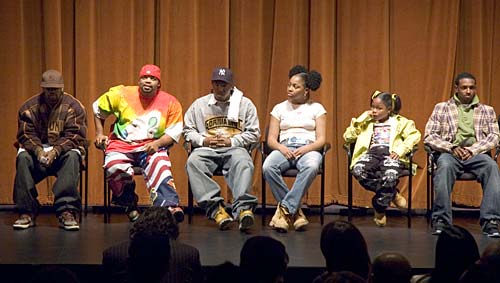
The theme of the movie is that these youths struggling to survive in the ghetto have found a creative outlet of expression and an alternative to the gangster lifestyle in krumping. Midway through the movie, clowning originator Tommy the Clown (a birthday clown for the ghetto, second from the left in the pic below) leads his group of Clowners in a dance battle against a new wave of krumpers, packing an entire arena, and the intensity of the competition and trash talk reveal a competitiveness at the heart of krumping. At dance parties, krumpers regularly shove each other off the dance floor, but the physical confrontation, as aggressive and combative as it appears, is peaceful in spirit.


The most charismatic dancer was Miss Prissy (she's the crazy-ripped girl in the movie poster), and she was one of the few stars not to attend Q&A because she'd gone on to become a backup dancer for the rapper The Game. Is krumping a fad? It's too early to say. It has yet to spread beyond Los Angeles, but perhaps the release of this documentary will spread the movement to other parts of the country. Though the documentary ties krumping to the ghettoes of LA, its violent and uninhibited movements look like a physical release of universal teenage feelings: alienation, anger, rebellion, and the conflicting desires to stand out and fit in.


In Red Doors, the NY Narrative Award winner, nearly all the characters are nearly at the end of their story arcs when the movie begins, and the story cliches shorten the distance they travel. All signs pointed to a family dinner with everyone's significant others at movie's end (Joy Luck Club style), and so it came to pass. Maybe some of the familiar tropes of these dysfunctional Asian American family stories are just too familiar to me as other people around me seemed to really enjoy it. The story of how a few college girlfriends banded together to stitch together financing and bring the movie to the festival, revealed during Q&A, was the portion of the screening that caught my attention. It's the type of story one hears over and over at film festivals, but it still hasn't gotten old for me.


Puzzlehead revives the Frankenstein myth. In this sci-fi thriller, a man who builds a robot of himself, only to lose control of it. The main actor was so wooden, I lost track of who was the robot, who was the man. Poor acting is a risk with any low-budget movie, but an audience will forgive if the movie is original. This one isn't able to outrun audience expectations. I felt as if I'd skipped ahead in the presentation and reached the finish while the movie was still presenting the first chapter.


I loved the docudrama 24 Hour Party People, by Michael Winterbottom, and 9 Songs was said to include concert footage by Franz Ferdinand, among others, and lots of sex. The movie should have been more accurately titled: 9 Songs, 24 positions. A young couple, Matt and Lisa, meets at a concert and begins an affair that alternates between live music and home-schooling in the kama sutra. The story is narrated in retrospect by Matt, now working in Antarctica on some sort of geological expedition. Long shots of the desolate, icy white snowscape hint at the shallow and empty nature of Matt and Lisa's relationship, but that idea isn't as tragic as it aspires to be considering how shallow both Matt and Lisa seem. The overall effect is much less provocative than it sounds, though at least it's an attempt to push audience buttons, something movie festivals should provide as an alternative to the average fare at local cineplexes.


Runaway is directed by Tribeca veteran (yes, there is such a think even though the festival has only been around since 9/11) Tim McCann and follows a pair of brothers on the run from a dark family past. Older brother Michael works at a convenience store and leaves his younger brother Dylan at the cheap motel that serves as their home base. Michael begins to fall for a fellow clerk named Carly (a back from wherever she's been Robin Tunney with the best performance in the movie), and as she opens up about her past, so does Michael, leading to a massive twist at movie's end. It's the type of twist which has become somewhat popular in movies in recent years, using a visual metaphor for an internal state of mind (I won't reveal what the trick is as it would ruin the movie). The first time you see it in a movie, it's surprising. Now, having been used several times, it feels a bit like a magician's invisible string. It's a dangerous game, because the gimmick also causes the audience to have to re-evaluate much of what they've seen. Leaving aside the plot twist, though, the greater problem is that Michael isn't sympathetic; it mutes the tragic payoff.


Fox Searchlight had already picked up Night Watch for distribution prior to Tribeca, so the Stuyvesant High School auditorium screening I attended had an unusually strict security detail. At the door, they took my phone and backpack and still security-wanded me before allowing me in. The director came on stage beforehand and billed Night Watch as the first fantasy movie to come out of Russia.


Night Watch is the first chapter of a trilogy, so it's particularly unfortunate that it's a mess. Take a vampire movie, zombie movie, a few witches and magic spells, and a heavy dose of CGI, put in a blender, top with a dollop of squid ink to darken the cinematography, and puree. The ending is a setup for part two of the trilogy and offers little emotional satisfaction. I welcome new entries in various genres from foreign countries, but the same economic pressures that produce unoriginal but globally palatable Hollywood fare can work in reverse. Night Watch feels a bit like Hollywood genre movies refracted back by a Russian fun house mirror, a Frankensteinian quilt of genre chunks. A movie like The Return, though it's in a genre with a long-standing tradition in Russia, feels far more original and unsettling.


Deep Throat


Deep Throat of Watergate fame is revealed as Mark Felt

A good excuse to go back and watch All the President's Men, one of my faves. The revelation is somewhat anti-climactic, even though it was on my list of things I hope happen in my lifetime (along with things like a Cubs World Series victory, contact with extra terrestrials)


New short fiction by George Saunders drops Sept 6


Nine common elements of billion dollar movie franchises


Short profile of Daniel Negreanu

Dolly Brunson: "He may be one of the all-time greats. Maybe the greatest ever.''


Stream the new Paul Anka album (via Stereogum)

He covers everyone from Oasis and REM to Nirvana and Van Halen. Very weird.


Stream the new Coldplay album


Danny Hillis's Babble makes the invisible cone of silence a reality

Sweet!


Audition, Donnie Darko, and Primer: Movies that make you go hmm


Two movie interpretations to put out there to see what people think (and a review of another mind bender of a movie that's a real brain tickle)...


The first movie interpretation is from my old roommate Scott about the Japanese horror flick Audition, directed by Takashi Mîke. I first saw Audition last Christmas break while in Temecula, even though I'd owned it for years. My dad shares my stomach for disturbing movies, and I wanted to watch it with him. We stayed up late one night to screen it after everyone else had fallen asleep. If you thought Michael Douglas had a tough time in Fatal Attraction...


I'll have to test out Scott's theory with a repeat viewing, but maybe some Audition and Mîke fans out there have something else to add. Those who haven't seen it and can stomach some graphic, disturbing, and horrific imagery (I'll never see piano wire again without curling into a fetal position and whimpering) will be treated to a very smart and thought-provoking horror movie about male insecurities about women and the loneliness of urban life (especially in Japan). Mîke's movies are always provocative, often disturbing, but seldom meaningless.


Excerpts from Scott's e-mail (minor plot spoilers):


It seems pretty clear to me that all the horrible things that happen in the last third of the movie are taking place in Aoyama's head (the last scene in which Asami accepts his marriage proposal is the final "real" scene), brought on by issues he has over his fear, mistrust, and guilt with women. There are "revelations" he sees that he could not possibly know, and the end, in which his son does not die, suggests to me there are limits to the torture he dare imagine for himself. Yet, I've yet to see this thought discussed in any meaningful way by people who've seen the movie, which strikes me as potentially missing most of the interesting aspects of the movie similar to a person who doesn't realize the first 90% of Mulholland Drive took place in Diane's (Betty's?) head.


Audition never struck me as having compromised with its ending, and the idea that Aoyama is "dreaming" a nightmare scenario for himself seems the most logistically and artistically satisfying of all possible conclusions.


First of all, Aoyama is f***ed up with women. His wife dies, oh, seven years before the true beginning of this story, and he hasn't really dated since? His teenage son is so much more wise about women that the son needs to give his father advice? His friend needs to fabricate a movie just so Aoyama can have the opportunity to talk to women? He fixates on one particular woman after seeing her picture and resume? This guy is screwed up! In the beginning we're introduced to a creepy secretary who suggests a Japanese Glenn Close, but by the end it seems obvious that Aoyama and her have had an affair in the past. It's actually Aoyama whose public indifference and inability to address the affair who seems ultimately troubled. He materializes his guilt into the form of his wife in at least two hallucinations, and he's all messed about about sexuality in general. Asami's dominatrix gear at the end seems to summarize Aoyama's overriding views of sex: he doesn't understand it, and he fears how it controls him. It's not clear whether Aoyama is even all that secure with the twin aspect of atavistic life: eating and f***ing. He doesn't seem able to even eat in the company of women (he just seems to drink a lot), and I thought it was particularly intriguing that he won't let his son's girlfriend make him dinner, but later on he envisions sleeping with her. It was just dinner, dude!


As for all the typical craziness that follows, well, I'm just going to call that "Miike-ness" for convenience. Remember when his friend tells him not to call Asami, and there's a scene where she's just waiting next to the phone (with a big burlap bag ominously in the background)? That's more Miike-ness. This is the thing: taken upon themselves, the Miike-ness just doesn't have any logical consistency. If we were to assume that the end was REAL, and the moment where he falls unconscious the only hallucination he has, we must wonder how he knew certain things. For instance, he clearly visualizes the same house we see earlier in the film (where Asami is waiting for him to call), but hey, how's that possible? Was he dreaming that earlier scene as well? There are several details that don't add up, including how he could possibly know Asami's fondness for wire before she gets to work on his ankle. The only logical explanation is if we discount as imaginary EVERY SCENE Aoyama is not in.


Asami's dialogue before they sleep together is admittedly a little odd, but doesn't it stretch suspension of disbelief to the limit when she disappears entirely for a couple days, and then re-appears to "gimp" Aoyama? Did she need to Fed-Ex some needles her way? Aside from wearing unusually frou-frou clothing, and looking like she only eats on days that start with "T", is there ever any real hint that Asami might have a crazy psycho hiding inside? While we're talking about characters, doesn't everyone seem really strange after Aoyama and Asami sleep together? A tenant sounds gleeful describing the body parts in the bar below, and a dance instructor (who barricaded himself inside by nailing planks to the OUTSIDE) spends his days heating pokers for, I guess, the unlikely scenario he gets another pupil.


So, I guess my very simplistic psychobabble explanation for why Aoyama dreams this really terrible nightmare is that he has large feelings of guilt for his wife, secretary, and Asami; he's fearful of the sex, openness, and commitment Asami requests of him; and perhaps after losing his wife he just expects something else terrible to befall him. He fixates on some careless words from his friend Yoshikawa (who probably said that because he saw Aoyama getting way too serious way too fast... and possibly with a little envy), and bolsters a subconscious mistrust he has of Asami. He's also startled by the depths of her devotion before they sleep together, and that plays into his Misery-on-crack hobbling delusion. The montage of nightmare elements in his "poisoning dream" are carelessly interwoven with all the women in his life, suggesting, at a minimum, this is really about more than his relationship with just Asami.


In doing some further research, I found this thread at IMDb that tries to distinguish dream from reality. It mentions an audio commentary by Mîke, but it's not on the DVD I own. Apparently Mîke's commentary states that all the torture scenes are reality. He would say that. I


Over Christmas break I also watched Donnie Darko again. Alan and Karen were seeing it for the first time. After watching it, Alan had an interesting interpretation, the details of which I've forgotten. One thought remains: he saw Roberta Sparrow/Grandma Death as a John the Baptist figure. She synthesizes both a pure scientific view, as represented by Noah Wylie, Most people regard her as a loon, but Donnie sees her as a prophet of sorts. Her writings train Donnie to harness his abilities. In the end, Donnie sacrifices himself in a Christ-like fashion by going back in time to die in the jet engine accident (a deleted scene shows Donnie impaled like Christ among the accident debris). In doing so, Donnie saves many others, like Gretchen, and also prevents the end of the Universe.


I should note that I have not seen the Director's Cut of Donnie Darko. So painful when a second and more deluxe DVD of a movie is issued after fans already purchased the original. The new DVD includes a documentary on the meaning of Donnie Darko as interpreted by some British fans. Sometime I'll have to check that out. Another resource is the Donnie Darko FAQ.


A few weeks back I rented Primer from Netflix. A low-budget indie movie shot for $7,000 [1], it took the Grand Jury Prize at the 2004 Sundance Film Festival. A beautifully clever movie, it inspired an almost immediate second viewing with the director's commentary on just so I could try to untangle the plot timeline, no small feat because the movie is about time travel [2]. A couple young garage inventors stumble into the creation of a time machine. How each of them reacts to this and how they each use the mechanism is the story. The writer Shane Carruth also directed and stars as Aaron, one of the main characters along with his fellow inventor Abe (David Sullivan).


The second time watching it, much more became clear to me, especially with some hints from the director's commentary. I'm happy to trade theories with folks, but the forums at the movie's official website should answer most people's questions.


The acting is stylized, with both Aaron and Abe rattling off science speak like a couple of traders discussing derivatives. Some may find the acting flat, but I much prefer the stylized deadpan delivery in independent movies than over-emoting from actors not up to the task. This movie is not about the acting, and the acting doesn't distract. The sound mix is muddy, but the director acknowledges it in his commentary and vows to do better next time. The director was on such a budget that he had to use film frames in which he is visibly saying "cut" (he simply cuts the audio out on that sequence). Films shot on a low budget can be forgiven for many flaws, but not a lack of originality. This movie is emotionally cool but intellectually rich, and what remains after one viewing is a pleasant lactic acid burn in the brain.


[1] Attend enough film festivals and you'll realize that no indie director ever reveals how much it cost to make his or her film unless the number is astoundingly low. This makes sense. If the figure is extremely low, that becomes a story in and of itself, portraying the director as a heroic artist, able to leap massive obstacles armed only with a credit card and passion-fueled ingenuity. If the movie looks lousy, the low budget is a built-in excuse. On the other hand, if the budget wasn't low, it serves no PR purpose to reveal the cost and in fact can work against you if the movie still doesn't look all that impressive despite an adequate budget.


[2] MIT recently hosted a Time Travelers' conference, though no one from the future showed up as the conference organizers had hoped. The idea was that if someone in the future had invented time travel, the conference would serve as a target in history.


Lions, midgets, and zombies, oh my


Lion mauls 42 midgets in Cambodia in staged battle

CMFL: Cambodian Midget Fighting League. Hmm. Cambodia sounds like a crazy place--they had a zombie outbreak there, too.


Idaho Legislature House Concurrent Resolution No. 29 commends the production of Napoleon Dynamite (via Mr. Sun)


WHEREAS, tater tots figure prominently in this film thus promoting Idaho's

most famous export; and

WHEREAS, the friendship between Napoleon and Pedro has furthered

multiethnic relationships; and

WHEREAS, Uncle Rico's football skills are a testament to Idaho athletics; and

WHEREAS, Napoleon's bicycle and Kip's skateboard promote better air quality

and carpooling as alternatives to fuel-dependent methods of transportation; and

WHEREAS, Grandma's trip to the St. Anthony Sand Dunes highlights a long-

honored Idaho vacation destination; and

WHEREAS, Rico and Kip's Tupperware sales and Deb's keychains and glamour

shots promote entrepreneurism and self-sufficiency in Idaho's small towns; and

WHEREAS, Napoleon's artistic rendition of Trisha is an example of the

importance of the visual arts in K-12 education

WHEREAS, Pedro's efforts to bake a cake for Summer illustrate the positive

connection between culinary skills to lifelong relationships; and

WHEREAS, Kip's relationship with LaFawnduh is a tribute to e-commerce and

Idaho's technology-driven industry; and

WHEREAS, Kip and LaFawnduh's wedding shows Idaho's commitment to healthy

marriages;

WHEREAS, Napoleon's tetherball dexterity emphasizes the importance of

physical education in Idaho public schools;

WHEREAS, any members of the House of Representatives or the Senate of the

Legislature of the State of Idaho who choose to vote "Nay" on this concurrent

resolution are "FREAKIN' IDIOTS!" and run the risk of having the "Worst Day of

Their Lives!"


Darwinian's survival of the fittest in action


People spend more on golf clubs, but their scores stay the same


Eat Hufu, the healthy human flesh alternative (via Marginal Revolution)

"It's not people!"


Alex Ross reviews the the Opera Bastille production of Tristan und Isolde, done in collaboration with video artist Bill Viola

I'm a fan of Viola's work and would love to see this. It would mean going to Paris, though I don't need an excuse to visit. New experiments like this are exciting. During your typical three to four hour opera, my attention is almost guaranteed to waver at times. A video that evokes the themes of the opera might not only serve as eye candy but add to the audience's understanding of the opera's themes (especially to those sitting so far away that they can't discern the expressions of the performers.


China tops Italy to become the world's fourth most popular tourist destination behind France, Spain, and the US

I hope to visit there myself this summer.


What would your Wu-Tang Clan name be?


Bateman...or Batman?


At the end of this Batman Begins trailer, Christian Bale quips, "Guy dresses up like a bat clearly has issues."


James and I immediately thought the same thing: that brief clip looks and sounds like Patrick Bateman, Bale's character in American Psycho (what's this, a Killer Uncut Edition DVD of American Psycho on the way in June?!). We're huge fans of both Bale and American Psycho, and the symmetries between the characters Bateman and Batman/Wayne (both wealthy urbanites have two identities, one of them being dark and psychotic) are so beautiful that the casting of Bale as the lead in both movies seems like more than coincidence.


That led to a e-mail exchange of imagined Bateman as Batman dialogue, one of them being simply Bateman, verbatim (btw, I'm not guaranteeing these are funny, but they're certainly more amusing if you hear them in your best Patrick Bateman voice):


"Robin gets his costume from the same designer as me, though I have a slightly better cape."


"Owen has mistaken me for this d***head Clark Kent. It seems logical because Clark also works for DC Comics and in fact does the same exact thing I do and he also has a penchant for caped costumes."


"You'll notice that my friends and I all look and behave in a remarkably similar fashion, but there are subtle differences between us. Green Lantern is the biggest a**hole. Flash is the yes man. Hawkman is the most wired. I'm the best looking. We all have elaborate costumes."


"There is an idea of a Bruce Wayne, some kind of abstraction, but there is no real me, only an entity, something illusory, and though I can hide my cold gaze and you can shake my hand and feel flesh gripping yours and maybe you can even sense our lifestyles are probably comparable, I simply am not there."


An early iteration of the Batman outfit


"Aquaman? Oh yeah, he's part of that whole Justice League thing. Aside from being a closet homosexual he probably does a lot of cocaine. You know, that whole Justice League thing."


"Alfred, it's Wayne, Bruce Wayne. You're my butler so I think you should know: I've killed a lot of people. A couple goons in an alleyway, a guy dressed up like a scarecrow. I left him in a parking lot behind a Krispy Kreme. I killed Dick Grayson, my old sidekick, by accident. I killed this clown called the Joker with a ninja star shaped like a bat, I had to, he was going to kill all these people. I killed this old fat guy with flippers who calls himself the Penguin by running him over with my Batmobile. His body is dissolving in Gotham river somewhere. I don't want to leave anything out here. I guess I've killed maybe 20 people, maybe 40. I have tapes of it, you can watch them in the Bat Cave. I did this while, um, dressed up as a giant bat. I'm not sure how much longer I can get away with this. I guess I'll uh, I mean, I guess I'm a pretty, um, I mean I guess I'm a pretty sick guy. So, if you have time tomorrow, meet me in the Bat Cave, keep your eyes open."


Superman: "Good coloring."

Batman: "That's ebony. The chest plate coating is a kevlar titanium composite."

Wonder Woman: "Kevlar titanium?"

Superman: "It is very cool, Wayne. But that's nothing. Look at this. Blue lycra full body suit, red accent speedo goes over the top, matching red cape and boots. What do you think?"

Batman: "Nice."

Wonder Woman: "Jesus. This is really super, Clark. How'd a nitwit like you get so tasteful?"

Batman (v.o.) "I can't believe that Wonder Woman prefers Superman's outfit to mine."


Batman: "When I see a pretty girl walking down the street, I think two things. One part wants me to be real nice and sweet and treat her right."

Superman: "And what did the other part think?"

Batman: "What she'd look like in a Wonder Woman outfit."


"My nightly bloodlust has overflowed into my days. I feel lethal, on the verge of frenzy. I think my mask of sanity is about to slip."


"Two things. One. You can't bleach a Batsuit. Out of the question.

Two, I can only get this suit custom made. This is a very expensive

suit and I really need it clean. Understand?!?!"


On a similar note, Samuel Jackson's Mace Windu would've been 10X more endearing if he was, well, the cussing, angry Samuel Jackson (this old Top 10 Things We Want to Hear Samuel L. Jackson, JediMaster Mace Windu, say in the Star Wars Prequel list still holds true for Episodes II and III). One can only dream that such line readings will be included on a future, R-rated special edition box set of the Star Wars Ep 1-3 trilogy DVD.


On a less similar but still related note, Liam Neeson really has cornered the market for sage teacher to future heroes, hasn't he? Episode I: The Phantom Menace, Kingdom of Heaven, Batman Begins. He's taken the baton from Mister Miyagi and shows no sign of letting go.


Episode III


Back from a midnight showing of Episode III: Revenge of the Sith. More like a 12:30am showing by the time the 20th Century Fox title animation appeared on screen. I'm so tired my eyes look like Anakin's after he turns to the dark side and my face probably looks like Chancellor Palpatine's in his Darth Sidious phase (the Dark Side is a pathway to many abilities, some considered unnatural, but apparently they don't include cosmetic enhancement; the best looking Sith Lord ends up being an 83 year old Christopher Lee as Count Dooku, unless you were hip to the pagan black, red, and horny look of Darth Maul).


Some more thoughts on the movie tomorrow, when my mind is in a better place. Exhaustion leads to confusion. Confusion leads to incoherence. Incoherence leads to unintelligible prose.


Jump


Robert Evans describes how he met his 7th wife during a nude photo shoot with Andrew Blake

Now this is what we want out of Huffington Post.


Stereogum has been posting MP3s from the new Paul Anka album of covers

The CD releases June 7, so for now, you are at the mercy of Stereogum's generosity. Jump on that quick.


Many of American Rhetoric's top 100 American speeches are available for download


Filmcritic.com lists its top 100 movie voices

I'd add Denzel Washington, Harvey Keitel, and Morgan Freeman. Maybe also Rex the dojo from Napoleon Dynamite.


Tor is a toolset that anonymizes your Internet activity


Liev Schrieber's moustache in the new Broadway production of Glengarry Glen Ross is awesome

His Ricky Roma's the best thing about the production, one that doesn't quite live up to the movie version.


Voices of Light by Richard Einhorn is haunting

Especially when accompanying the amazing movie that inspired it, Carl Dreyer's The Passion of Joan of Arc.


Video clips of games on the PS3: Madden (annoying ad pop-ups) and Killzone 2

Wish these were in high def/H.264 so as to provide a better sense of the true picture quality, but even these poor facsimiles hint at the awesome graphics power of the next-gen consoles. Actual game play almost always fails to live up these stunning game trailers, but maybe soon that will change. Console wars, begun again they have.


The Da Vinci Code teaser trailer steals the Batman opening concept

That's a star-studded cast. I wonder who drew the short straw and ended up as the albino monk.


Children's fantasy on the big screen


Two fantasy franchises teased online this weekend, both in Quicktime:


I remember the event of reading The Lion, the Witch, and the Wardrobe but not what happens in the book itself. I think I was in third or fourth grade, and we were over at a family friend's house in Naperville (before we moved there ourselves, many years later). The adults were playing Mah Joong or something like that, and I, being a shy and somewhat antisocial youngster, wandered the shelves of the library with my eyes. The Chronicles of Narnia paperback boxset stopped me for some reason.


By the time the adults had finished an entire four rounds of Mah Joong, I had finished the first volume. As a child, I always had a soft spot for books about children who travel alone to fantastic lands to deal with unimaginable problems. As children, we never feel that anyone, especially adults, understands the daily challenges we work through. These books use fantasy as a metaphor for these feelings of alienation, transforming rites of passage into larger-than-life confrontations with mythical beasts. It's no coincidence that the mysteries in the Harry Potter books/movies are never solved by the teachers at Hogwarts, some of whom seem incompetent. Adults may appreciate the books/movies, but they are written from a child's perspective, with a youth's sensibility.


Wicked


Either Wicked or Spamalot is the hottest musical in town. Wicked has been running over a year now, and somewhere along the line it blew up. I receive e-mails from Ticketmaster offering tickets for Wicked shows six months from now. Most shows from now until then are sold out. A friend walked up to the box office and managed to score good seats to last Thursday's show, and while I'm not a musical aficionado, I look forward to heading out on the town for a show.


The Gershwin Theatre, one of the larger I've been to in NYC, was packed. The atmosphere was that of a rock concert. Everytime Elphaba (Shoshana Bean) finished a solo, dozens of young girls stood up and screamed their support. Depending on your frame of reference, it had the atmosphere of a Beatles or Justin Timberlake concert. Usually an overzealous audience is a drawback, but perhaps for a musical it helps to energize the cast. Most shows that have been running for a long time go stale which is why it's often worth the price premium to see a show while it's fresh and hot.


I didn't know much about Wicked going in except that Kristin Chenoweth (most familiar to me as Annabeth Schott from The West Wing) had originated one of the leads before leaving in July. As soon as the musical started, though, it was clear that Chenoweth had played Glinda. As played by Jennifer Laura Thompson, Glinda sounded and acted like, well, Kristin Chenoweth as a peppy, ditzy blonde. Either Chenoweth had made the part her own, or it was perfect casting. Probably somewhere in between, especially when I recalled the movie version of The Wizard of Oz and recalled that Glinda was indeed a bubbly and spacey fairy. If Phoebe Buffay was your favorite character on Friends, Wicked's Glinda makes this the musical for you. Her comic performance and plenty of faithful references to characters, events, and dialogue from the movie provide most of the humor and a-ha pleasure in the show. The production value of the set is top-notch; the giant animatronic wizard has an impressive mechanical grandeur.


Wicked is the back story of The Wizard of Oz, but it also spans the entirety of the movie. It's a canny concept, just the right mix of familiar and foreign that musical productions favor. None of the music stuck in my brain, and the surprise ending is awful, but musical fans will embrace it for many years to come. I suspect I'll leave New York City before Wicked does.