I dabbled with Google Scholar

I dabbled with Google Scholar this morning and snagged a few interesting PDFs, though I couldn't find any more Steven Levitt papers than I have by just using Google itself. In this area, the selection isn't overwhelming yet, but it's useful for those times when you want to get academic.
Speaking of Steven Levitt, he has a new book being published in the spring: Freakonomics: A Rogue Economist Explores the Hidden Side of Everything. I suspect his publisher added "rogue economist" to the title.
Running long distances set humans apart from primates
And there was the gluteus maximus, the muscle of the buttocks. Earlier human ancestors, like chimpanzees today, had pelvises that could support only a modest gluteus maximus, nothing like the strong buttocks of Homo.
"Have you ever looked at an ape?" Dr. Bramble said. "They have no buns."
Maybe I was wrong. Maybe the marathon makes the man.
ABC aired Saving Private Ryan on Veteran's Day in 2001 and 2002 with no incident. In 2004, though, over 60 ABC affiliates chickened out and aired programs like Hoosiers instead. Why? Fear of the F.C.C. Of course, it will surprise no one that I find this ridiculous, but I'm also shocked that people still watch movies on CBS, NBC, or ABC. I haven't done that since...I can't even remember anymore.

Review: The World, and Together

China gets its own indie/mainstream cinema dichotomy
In October, I caught a screening of Jia Zhangke's The World at the New York Film Festival. I'd never seen any of his movies before, though Unknown Pleasures was atop my Netflix queue just before I suspended it for my move to NYC. American audiences eat up foreign movies that are foreign, but familiar, like fusion Asian restaurants. Movies with happy endings, like Amelie, or rapid-paced action scenes, like House of Flying Daggers, well-received at an earlier NYFF screening.
The World has none of that going for it. The ending is not happy. The pacing is deliberate. The narrative is a collection of loose plot strands, rather than the tight three-act arc Western audiences have been raised on. The soundtrack does not cue the audience in to how they should react to the events on screen, unlike the transparent, sweeping themes of the latest Hans Zimmer score. Not surprisingly, a steady stream of spectators, many of them elderly, walked out during the screening, their patience exhausted.
Weaned on a diet heavy in American flavors, I needed nearly the full length of the movie to find my footing and absorb the director's vision. Not only is the movie foreign, but so is the story. The movie follows the lives of young Chinese who've moved from the countryside of China to the big city of Beijing, where forces of modernization are moving faster. The main character, a young woman named Tao, works as a performer at The World Park, an amusement park filled with miniature recreations of famed monuments from around the world. The Eiffel Tower. The great pyramids of Egypt. Big Ben and the London Bridge. New York City, including the two towers of the World Trade Center ("Ours are still standing," remarks one visitor, drawing a sympathetic laugh from the New York audience; the healing has progressed). The park is setting ripe with visual puns, and Jia resorts to them perhaps a few times too many.
Tao carries an on-again, off-again relationship with Taisheng, a security guard at the park and also an emigrant to the city. China is modernizing, but Tao and Taisheng feel trapped, adrift, and disillusioned in Beijing. The most they will ever experience of the world is these reproductions of famous locales, exacting but hollow cultural artifacts. Not only can they not connect with the world, but they can't connect with each other, a common theme in movies set in Communist China. We see one other couple fight bitterly over perceived betrayals, the boyfriend going so far as to set himself on fire at one point to catch her attention. However, since they have only each other, in the very next scene they proudly announce their engagement. Ironically, the most emotionally lyrical communications between youths like Tao and Taisheng are in the form of simple text messages sent to each other via cell phone. Jia emphasizes this by depicting the text messages with colorful, expressive, animated sequences. Perhaps the closest two characters, Tao and a Russian woman who is forced to work at the theme park, don't even speak each other's languages and communicate with hand gestures and body language. Jia doesn't pass on many opportunities for irony, both visual and narrative.
A series of emotionally charged episodes arrive later in the movie, but just when you think they'll lead to some climax or closure, Jia releases the tension again. The movie's stark realism induces in its audience the feeling of aimlessness and disillusionment that the characters themselves feel. It's a style a Hollywood studio would never approve of. The American movie machine believes its audiences want to laugh, cry, cheer, or scream in terror, but never to leave in an existential gloom. That makes The World an ideal entry for a film festival: a movie that will never find American distribution.
A deeper exploration of these characters' emotional origins would relieve some of the movie's dramatic stasis, but on one front the movie is wildly successful. The movie makes no attempt to speak English or to fit in with its American audiences, yet it broadens our conception of the universality of film as a language. Prior to seeing the movie, I had no familiarity whatsoever with emigrant youths to China's major cities, like Shanghai and Beijing, yet by movie's end I felt the bars imprisoning their souls, pushing in.
If The World is representative of China's indie cinema (and in China, that is a tougher economic curse than the title implies in America: it means the government doesn't allow your movie to screen in theaters at all), then Chen Kaige's Together might signify the Chinese movie mainstream. Ironically, in China the mainstream has to emerge from the underground since most of China's most famous directors have had their movies banned by the government (after my description of The World, you might suspect it is another of Jia's underground productions, but in fact it is his first government sanctioned piece).
In Together, another pair of peasants from the countryside make their way to Beijing. A father, Liu Cheng, brings his son Xiaochun to the capitol to compete in a violin competition. The young boy is a gifted player who has won many local honors, and his father harbors high hopes of seeing his son achieve a better life.
The movie is surprisingly, unabashedly sentimental for a Chinese drama. From very early on, the machinery of a familiar plot announces its intentions to run the audience over: simple, honest, and naive country folk eaten up by the big city and corrupted by the pursuit of fame. At times it feels like populist propaganda, especially with the stone-faced acting of real-life violinist but non-actor Tang Yun as the young violin prodigy (his violin playing, on the other hand, is splendid, especially considering how ridiculous how most on-screen violin playing looks), but the movie plows forward with the earnest and pure-hearted determination of a children's fable. Along the way, some welcome humor arrives, unexpectedly, from the director Chen himself playing a ruthless but perceptive and successful violin instructor and by the director's real-life wife Chen Hong as a Lili, a woman who supports herself the beautiful plaything of wealthy society men. She befriends young Xiaochun and adds some much-needed levity with her flamboyant personality.
The movie crescendos with melodramatic plot twists and one grand revelation, but the movie earns those emotional peaks. Anyone watching the entire way will feel them approaching, and those uncomfortable with such a passionate, tearful embrace will have had ample time to turn from the welcoming arms and ample bosom of this open-hearted tale and flee for the exits.

The Leopard

Criterion's DVD containing the new digital transfer of the original 185 minute Italian release of Luchino Visconti's The Leopard is stunning, both in video and audio (yes, despite being simply Dolby Digital 1.0). I've seen the movie twice now, and every viewing leaves me ineffably sad, nostalgic for the end of an age I never lived in. I'm not sure it's possible for me to tire of the Nino Rota score and the performance of Burt Lancaster.
The final ball, lasting nearly an hour, is the perfect showcase for the quality of the video transfer, the colors of the lavish tapestries ravishing the eyes. And Claudia Cardinale? Just plain ravishing. Only someone with her beauty could convincingly win the heart of someone as handsome as Alain Delon. The scene in which she invites Burt Lancaster to dance with her, and their subsequent waltz together, is one of my favorite movie scenes of all time. It is so charged with meaning and emotion that it spills off the screen and overpowers the viewer. The movie is also a master class by cinematographer Giuseppe Rotunno, from the start to the final poignant shot.
Have you ever been to a museum or palace and been entranced by a painting or sculpture or an old piece of furniture, in the rapture of a nostalgia for a way of life that you never lived? That's how I feel when watching this movie.
[If you rent the movie from Netflix, note that the first disc contains the original Italian soundtrack. That means the voices won't match the lips, but it's much less obtrusive than usual, thanks to Lancaster's incredible physical acting. Disc 3 contains the English dubbed soundtrack, allowing you to hear Lancaster's actual voice, but that version is the shortened, 161 minute American release. Your first time seeing the movie should be the 185 minute Italian release.]

A thousand empty paper cups

I've been reading the 9/11 Commission Report, and the 9/11 timeline at Center for Cooperative Research has been a useful copmarison. More and more, I doubt the former and trust the latter. Paul Thompson is also planning to publish his terror timeline in book form.
A treasure trove of SNL transcripts
It was a great year for humor books
Halo 2 sells $125 million in its first 24 hours
I...must...resist...
The Grand List of Console Role Playing Game Cliches (sent from James)
Trailer for the remake of the Japanese suspense flick Dark Water
The remake is directed by Walter Salles. I saw this with Bean at the Seattle Int'l Film Fest a few years back and enjoyed it. Unlike Ju-On, the creepiness of the original didn't derive just from camera tricks and audio. At its root the mother in the story is haunted by her own feelings of maternal abandonment, and that overpowering sorrow pervades the movie. I'm not high on these remakes of Japanese horror movies, though. I love Jennifer Connelly, once a dormmate of mine, but having highly recognizable Hollywood stars instead of relatively unknown Japanese actors in these roles reduces the sense of everyday horror by a crippling amount.
Interesting quiz on population and health and economy - I only scored 60%. This quiz, on agriculture and food, was even tougher. I only scored 50%.
Amazon follows in BMW's footsteps with a series of short filmercials.
Informative graphics illustrating the ebb and flow of the electoral vote from 1940 through 2000.
The trailer for the videogame based on Star Wars III: ROTS gives away more about the action scenes in the movie than the trailer for the movie itself.
Now that the nearest snowcapped mountain is further away for me, maybe I need to turn to alternatives to snowboarding, like Freebording. Seems like it would be a lot more fun in San Francisco, where there are hills, than New York, where you're likely to end up as a multi-colored advertisement on the side of a cab. Looks like fun, regardless. Clever design.
David Foster Wallace reviews the new Borges biography for the NYTimes, using 7 footnotes in the process.
Ramen restaurants in NYC
Mmmmmm, just in time for the winter cold snap.

Review: The Incredibles

What's amazing about Pixar, and what uniquely identifies their brand, is not the stunning 3-dimensional computer generated animation, though certainly all their movies share that. Other studios can imitate that, and have.
No, what's unique about Pixar is that somehow, they consistently root their movies in stories that manage to be both funny and heart-warming, with appeal to people of all ages. They've bottled the innocent joy that used to be a property of Disney and pass it on to every next director. In the process, they've become the only Hollywood studio whose brand stands for something in consumer's minds, having stolen that honor, ironically, from their sister studios Disney and Miramax. Other studios have all but forsaken hand-drawn, 2-D animation in an attempt to duplicate Pixar's success, but they're chasing a false idol. The true secret sauce is much trickier to reverse engineer.
The Incredibles is a departure for Pixar from their heretofore successful animated creature/animal stories. The characters here are all human, albeit superhuman in many cases, and some cartoon action sequences earn Pixar it's first ever PG-rating. One trait of the Pixar comedy routine remains: no matter how different these characters are from the rest of us, they have the same human problems and emotions. It's one reason that audiences feel such strong emotional resonance with Pixar characters.
In this case, a family of superheroes (the Simpsons mold: father, responsible mother, mischievous son, precocious but socially maladjusted daughter, and as-yet personality-less infant) struggle to overcome suburban ennui in a world that has banned the use of their powers. Of course, it isn't long before a threat to society requires them to unleash their powers. Okay, you know all that from the trailer. Any more plot detail here is unnecessary.
The voice work is excellent, as usual, especially from Holly Hunter. And the humor, unlike that of movies like Shrek, is not grounded in time-stamped pop culture references that will be stale within a decade but in classic family relationship issues. The improvement in animation quality from one Pixar movie to the next are not as dramatic as from old-school animation to Toy Story, but a few sequences showed some new tricks. The rendering of water and ocean waves in motion is gorgeous, and because these are superheroes, one of them able to move at super speed like the Flash, some chase scenes are shot and rendered at hyper speed. We're talking "Leia and Luke on speeders flying through the forests of Endor in Return of the Jedi" speed. These action sequences are dizzying, breathtaking, and exhilarating, the kind that leave an audience clapping at the end out of sheer delight.
The moral of the story is somewhat fuzzy. Let all people use their natural abilities to the fullest? If Terrell Owens scores a touchdown, let him do his dance? I was pondering the issue early in the movie, during a momentary lull, and then I was having so much fun I forgot all about it.
[Footnote: Prior to the movie, Pixar trailered Cars, their next movie, due out in 2005. Just a tease. I thought of it as Pixar does NASCAR. And of course, Pixar showed a short, Boundin', about a dancing sheep. It's clever, like Pixar's other shorts, with an infectious rhyming verse.]

Star Wars Episode III teaser trailer

Of course, the Star Wars Episode III teaser trailer is leaking all over the web today. It seems a bit stilted and rough, but my first reaction in the wake of the election is that Anakin's conversion to the dark side, and Emperor Palpatine's evil voice summoning Darth Vader, "Rise..." all feels quite appropriate.
If you want to track down a copy, use your favorite search engine. I found a Quicktime mirror and a BitTorrent, though I'm sure it's spread much wider by now. Or catch a midnight showing of The Incredibles.

Review: SidewaysSwingers for middle-aged divorcees

Miles (Paul Giamatti) organizes a week-long bachelor trip for his engaged college buddy Jack (Thomas Haden Church), a jaunt through Northern California wine country. We realize as the movie progresses that Miles has set the trip up as much for himself as for Jack; Miles is the oenophile, the one who loves pinots and syrahs. Jack, a former soap opera star, is an overgrown surfer who chugs wine while chewing gum.
For those who watched Swingers, Jack is Trent, and Miles is Mike. The parallels continue. Miles is divorced but not over his ex-wife Victoria. He's uneasy around women, even those attracted to him, and he over analyzes every situation. Jack is about to be married but hasn't got the inveterate womanizing out of his system. He's an easygoing charmer with the looks of a middle-aged surfer and the personality of one who never grew up. Jack sets them up on a double date with a women who serves them alcohol at a winery (in Swingers it was a cocktail waitress at some off-Strip casino). There's a painful phone call and later a voice message from Miles, though Mike's in Swingers is far more uncomfortable. There's the distribution of condoms. While Jack puts the moves on his date Stephanie (Sandra Oh), Miles has a soulful conversation with his date Maya (Virginia Madsen), a waitress he's met before and has always been attracted to. Later, the two men play a painful round of golf. The territory of male healing treads familiar ground.
The other similarity between the two movies is that they're both very funny. After seeing the trailer, I didn't think I was ready for middle-aged men on a road trip, but the trailer doesn't do the movie justice. Alexander Payne and Jim Taylor (Citizen Ruth, Election, About Schmidt) write dialogue that is always informing us about the characters at the same time that it keeps us laughing. Only a few moments into the movie, and Miles and Jack emerge as distinct personalities with depth. Giamatti, Haden Church, and Madsen are all excellent.
It's always enjoyable to poke fun at oenophiles. Miles, at one point, babbles on about a wine while Jack looks on with wide-eyed incomprehension: "...just the faintest soupçon of asparagus, and, like a nutty Edam cheese." He says all of this with a straight face but can muster none of this eloquence when describing his own emotional hurt.
Payne's comedies have dark souls, though. Unlikeable and somewhat grotesque middle-Americans inhabit his movies (Reese Witherspoon and Matthew Broderick in Election, Jack Nicholson and his daughter's fiancee's family in About Schmidt). The movies seem to elbow us in the ribs, with a pursed lips and a point of the chin: aren't these losers pathetic? Don't you pity them? We hope most of them will find a patch of unpolluted happiness or grace, but the end credits always leave us uncertain.

Another reason to see The Incredibles...

...as if you needed one. The first teaser trailer for Star Wars Episode III: Revenge of the Sith will debut with Pixar's latest movie on Nov 5, though members of StarWars.com get the trailer Nov. 4 in Quicktime, so it will inevitably make the rounds on the Internet as a BitTorrent and be mirrored up the wazoo. The teaser will also be shown on television the evening of Nov. 4.

Frontline - The Choice A

Frontline - The Choice
A new process for coloring black and white films, employed by Scorsese in The Aviator.
Qurio.com is an interesting photosharing option for Windows users. It serves photos directly off of your computer, through your high speed Internet connection, so you don't have to upload photos to an external site.

Remains of a weekend

I haven't set up my television here in NYC, and before that I was traveling for months so I had just sporadic access to a television. I haven't missed it nearly as much as I thought. It's given me time to read and enjoy life outside my apartment. I'm sick of reality television, have no need for CSI: Minneapolis ("Hmm, I think Steve Buscemi died when his partner axed him in the head and put him through the wood chipper. Yaaaa, I do."), and any television show I really want to watch can usually found on BitTorrent. For example, the clip of Jon Stewart on Crossfire as he bitch-slapped Tucker Carlson. Deeply, deeply satisfying. I can't stand Tucker Carlson. What a buffoon. If you don't know how to use BitTorrent, you can see the clip just fine here at iFilm. Could Jon Stewart be any more golden right now? I walked by the Union Square Barnes and Noble when he was there for his book signing, and by the looks of the drooling women in line, you'd think Jude Law or Brad Pitt was there to sign a swimsuit calendar.
Of course, I must have my television set up by this Thursday, when The Office Christmas Specials (part 1, part 2) air in the U.S. on BBC America. I tried to find it on DVD in London this summer, but all I could turn up was pity from Londoners who tsk tsk'd as they revelled in recounting the rapture of humor the special had bestowed upon them. The DVDs? Release in the UK Oct. 25. If you haven't seen the show yet, I either pity or envy you. And who the hell are you and where have you been living?! The show has no laugh track, because you'll provide one. But don't take my word for it. The New Yorker calls it perfect.
Malcolm Gladwell writes about the high cost of prescription drugs with his usual (i.e., unusual) insight.
Wal-Mart.com, of all sites, has audio clips of the Friday Night Lights soundtrack. I'm just about over my Friday Night Lights kick. After watching the movie I bought the soundtrack and inhaled the book (recommended and recommended, respectively). The music has been a nice change of pace from the usual stuff in my "Running" playlist in my iPod, all of which I've heard about eighty times by now.
The baseball stadium in Houston is a joke. People are hitting pop flies out of the stadium in left field for home runs, and that hill with the pole in it in center field is ludicrous. What an atrocious baseball playing field (I've never seen the exterior, but it seems fine). The fact that all baseball stadiums have different dimensions in the outfield used to never bother me, but if they standardize the dimensions of all playing areas of all MLB stadiums, allowing architects to customize all other aspects and dimensions of the stadium, I'd have no objections. Imagine one NBA basketball court having baskets nine feet high instead of ten, or a three point line that was shorter than in other stadiums.
Games 3 and 4 of the ALCS were brutal. Each game lasted about two days. Alan, Sharon, and I rented a movie, started watching when game 3 started, and when the two hour movie finished that game was in the fourth inning. I don't know how anyone who's not a Yankees or Red Sox fan could stay awake. I remain steadfast in my hope that MLB will speed up the games. If you adjust your batting glove and then stand there to take a pitch, why do you need to step out and adjust it again? Is the velcro defective?
I met James, Angela, some of their college friends, Alan, and Sharon for lunch at Carnegie Deli today. The Carnegie sandwiches are MASSIVE. RIDICULOUS. I had a reuben, their specialty, and it was actually just a mountain of pastrami covered by several layers of cheese. It looked like an elementary school model of Mt. St. Helens erupting cheese. I finished about a quarter of it and will nibble on the remains for the rest of the week. Carnegie Deli is a mecca for pastrami and corned beef lovers.
I didn't miss my car until I saw this promotional clip for the new BMW M5. Sweet mother of...sometimes, late at night, when the subway seems like it will never arrive, wouldn't you just like to hop into something like this and just play Pole Position with the cabs.
NYC's arts lineup is overwhelming. Everyday I find at least five things I'm dying to go see. Monday night (oh, that would be tonight) Ricky Gervais is speaking at the Museum of Television and Radio before a screening of The Office Christmas Special. I'd kill to see Julie Taymor's production of The Magic Flute (Die Zauberflöte) at the Met. Alex Ross raves about it. What stops me is the memory of my first NYC credit card bill. Upon opening it and reading the balance, I screamed, dropped the bill, my eyes rolled up into my head, and I fainted theatrically, like a swooning movie diva.
The weekend ended with puppet entertainment. No, not the marionettes of Team America World Police, but the puppets of Avenue Q, the much acclaimed musical that won the Tony for best musical in 2003. I am not a huge musical fan, but I enjoyed this one for not taking itself so seriously. It offers quite a contrast to the melodrama of most musicals and seems a descendant of the Rent lineage of musicals, one that's sadly sparse. The show features a cast of puppets and people who live in a rundown neighborhood in Manhattan as they sing about life and its problems. But these are HBO-class puppets, not Sesame Street or Jim Henson muppets (even though some of the characters really resemble Ernie and the cookie monster), so they swear, drink, and have sex. As Phil said at intermission, it might not a musical you'd be comfortable seeing with your parents. The puppets are held by actors who stand alongside them as puppeteers, singing, with their hands clearly inserted up into the puppets or waving their arms around. It's jarring for just the first few seconds, but then, the rest of the time, as the cast sings songs like "Everyone's a Little Bit Racist" or "The Internet is for Porn" or "Schadenfreude", you realize it all feels on some level like a clever deconstruction of the musical as an art form. Would Kermit and Miss Piggy have grown up to be a dysfunctional married couple? Would Bert have come out of the closet to confess his love for Ernie? Would Big Bird be surfing porn on the Internet? I'm of the generation that wouldn't find those stories surprising at all, and I'm glad some musicals have caught up.

GOOGL B(E) 10003

Google SMS. Keen.
B to the E power?! B(E)? I can just see shouting this over heavy techno music to a bartender at a club.
"Can I have a B(E)?"
"What kind of beer?"
"NO, A B(E)!"
"A BEER? I KNOW! WHAT KIND?"
"A B TO THE E!"
Firefox extensions for BugMeNot.com.
They don't have GMail Drive shell extension for Mac users, but I've been using my GMail account like that all along. I don't really receive any e-mail at my gmail account. I just forward files and messages there for storage and easy search/retrieval later.
Kerry is trailing again in the Electoral Vote Predictor, 264 to 270. These debates do seem to matter, though it's just a guess on my part. Bush started out like a shrill screamer again, but he hung in and landed several effective blows in debate #2.
I AM LEARN is a weblog written by a Perl script.
Carl Lewis vs. William Shatner in the celebrity-turned-musician category. Advantage Captain Kirk. Seriously, he has Ben Folds in his corner as guest producer, he did a cover of Pulp's "Common People", so he has taste, and guest appearances include Aimee Mann, Joe Jackson, and Henry Rollins.
Mark Cuban passes on "the handjobber."
Humorous exchanges between pilots and air traffic control towers.
Tricks of the Trade continues on in weblog format.
The saying "You want to have your cake and eat it too" makes no sense. If it's my cake, why can't I eat it? It makes more sense as "You can't eat your cake and have it too."
While I was in France and the UK this summer, I saw the new Smart Car Roadster and Roadster-Coupe. They looked smart. Now the Smart Car is coming to the U.S., with an American-friendly SUV among the optional models. Chouette!
The next Pixar short is Boundin'.
Okay, this is fairly stale, but it's still the best suggestion I've seen yet about how to cure the ills of USA Basketball.

Review: The Machinist

Finally, The Machinist comes to theaters. Jason and I saw this at Sundance this January, and I thought it would gain distribution sooner. Paramount Classics is putting it out Oct. 22.
Christian Bale lost 60 pounds to play this role, and his physical transformation is nearly as painful for the audience to witness as it must have been for him to pull off. Bale plays Trevor Reznik, a man who hasn't slept for a year. He is plagued by nightmares; are they real or hallucinations brought on by his own paranoia? He works in a factory with a distinctively apocalyptic feel, and someone is leaving cryptic post-its on his refrigerator.
It's a psychological suspense thriller, and director Brad Anderson and his crew create a foreboding atmostphere, filled with a lush darkness and eerie fluorescent lighting. It's also a mystery, and I enjoyed trying to unravel the clues, though living in someone's nightmare for that period of time left me ready for a round of beers with friends at the local pub.

Review: Maria Full of Grace

Anyone who feels the slightest bit of self-pit about their first year struggles upon arrival in New York City should see this Maria Full of Grace, one of the best movies I've seen this year. It's potent, not easy to stomach, but not nearly as difficult to swallow as the capsules of heroin or cocaine that drug mules carry in their stomachs from Colombia to the United States.
Maria Alvarez is a bright, courageous, and fiery seventeen year old. She is not the type of person who would seem to have to turn to life as a drug mule to survive. But writer and director Joshua Marston efficiently and methodically shows us the forces that both push and draw her in that direction: the meager pay of her monotonous job de-thorning long-stem roses, her abusive boss and working conditions, the claustrophobic pressures of living at home with and helping to support her impoverished mother and sister and nephew, and the simple desire for something more out of life. She is also pregnant by a deadbeat boyfriend she doesn't love. Soon she is on an airplane along with several other drug mules, carrying not just her unborn child but dozens of drug pellets. Not everyone comes to America on a boat that passes by the Statue of Liberty on its way to Ellis Island. Some arrive at JFK Airport and encounter suspicious and unforgiving customs officers.
Marston doesn't over-dramatize material that comes loaded with tension. He catalogs it all with a documentarian restraint, and Catalina Sandino Moreno makes an unforgettable screen debut as Maria Alvarez. In an otherwise bleak view of the American Dream, her spirit reminds us that many who come to America carry the American dream inside them, rather than finding it here.
[Interesting footnote: On the movie's official website I learned that Orlando Tobon, who plays Don Fernando in the movie, plays a real-life Don to Colombian immigrants in New York City. The "Mayor of Little Colombia" operates a travel agency in Jackson Heights, Queens, where he aids Colombian immigrants. Over twenty years, he has repatriated the bodies of approximately 400 Colombian drug mules who died while journeying to the U.S.]

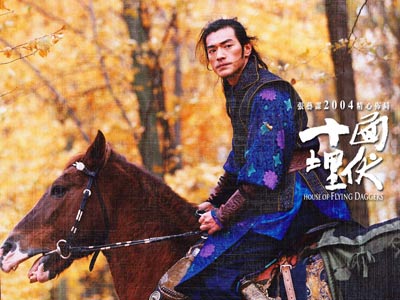
Review: House of Flying Daggers

I saw a midnight screening of House of Flying Daggers at the New York Film Festival Saturday night. While walking into the theater, I saw a pseudo-red-carpet alley being formed by throngs of people. I went over to see what the commotion was about, thinking that there was no way it could be...and it was. Zhang Ziyi. She is stunning. Some people never lose the skin they had as a baby. I had an urge to reach out just to run my fingers across her cheeks, but then I remembered that I'd probably get tackled and beaten by a few aspiring Vin Diesels, and I still did want to see the movie.
Director Zhang Yimou also walked in. Both of them received a Cannes-lite reception. Inside, Zhang spoke a few phrases which were translated into English. He mentioned that he was almost too intimidated to attempt a bamboo forest fight scene after Ang Lee's success with the same in Crouching Tiger, Hidden Dragon but that he was pleased to have found a unique way to shoot it which he hoped we'd enjoy. Zhang Ziyi came out to the crowd's delight and said in shy, halting English, "Thank you for coming. Please enjoy the movie."
I've never seen a movie at Alice Tully Hall before, and especially since my seats were in the back row, I wasn't too hopeful about the acoustics and picture. I was wrong. As the picture came on screen, a huge drum sounded, and it was LOUD. No surround sound, but the acoustic picture in the front half of the theater was distinct and LOUD. I was so pleased, because as the movie progressed, I realized that the sound design and soundtrack of the movie are critical to its effect. The sound of drums shaking the air, the whisper of silk fabric sssssliding across itself, the whistling of (flying) daggers slicing through the air, of leaves rustling as horses or soldiers rush past...all of them came through crystal clear.
As with Hero and Raise the Red Lantern, Zhang favors lush, saturated color palettes. The scenery, shot in parts of the Ukraine and China, is gorgeous, and the actors outfits are often coordinated to the environment. When Zhang Ziyi dances at a brothel, her blue dress complements the hall decor. When she's running through an autumn forest, she's dressed in muted navy and gold, and near movie's end, when she's in a forest of bamboo and leaves, her spring green robe blends in such that an interior designer would be proud. Those ancient Chinese had great fashion sense. The finale brings together all the color palettes from the movie and highlights them against the neutral backdrop of a white snow-covered landscape.
The House of Flying Daggers is a clandestine rebel group that steals from the rich, gives to the poor, and combats the waning Tang Dynasty government. Leo (Andy Lau) and Jin (Takeshi Kanehiro) are two soldiers in the General's Army, given the assignment of capturing the new leader of the House of Flying Daggers in ten days. Jin, a ladies man, is sent undercover to the Peony Pavilion, a brothel, to investigate and win the heart of a new blind dancer, Mei (Zhang Ziyi), rumored to be a member of the House of Flying Daggers.
Anyone who's seen Crouching Tiger, Hidden Dragon or Hero or any of the classic wuxia movies will realize that to summarize any more of the plot would be difficult. Wuxia movies always involve complex, labrynthine plots full of double crosses and shifting loyalties. Whereas the characters, love stories and, combat in Hero felt so ethereal and mythic and pure as to be constricting and suffocating, HOFD contains more humor and humanity. Jin and Mei, both played by real life heartthrobs, flirt and laugh, a refreshing change from the formal, muted romances between Chow Yun Fat and Michelle Yeoh in Crouching Tiger, Hidden Dragon or Tony Leung and Maggie Cheung in Hero. The scale of the story also stays at an individual level, focusing on Jin, Mei, and Leo, instead of rising to the level of a national epic.
The combat is somewhere between that of a Crouching Tiger, Hidden Dragon, where characters could fly, and a Bruce Lee movie, no wires required. The warriors in HOFD can certainly leap in a manner that defies physics, but not so much that they seem superhuman. In Manhattan, they'd still have to take the subway to get from downtown up uptown. More importantly, the combat has force and impact. Characters bleed and sweat and stumble in the leaves and snow. Not that there's any shortage of the balletic. As in CTHD, there are battles set at treetop level in a forest, and a fight that soars up and down stalks of bamboo. Yimou uses a combination of special effects shots and wire work to achieve some lyric shots. Overhead shots frame Mei's acrobatic backflips, and the bullet-cam shots so popular with John Woo allow the camera to circle and follow daggers and arrows as they rip through forests and over fields of wildflowers, traveling impossible distances to slice and stab their targets (Jin is Aragorn with the sword, Legolas with the bow and arrow). It's technically ravishing.
The acting and dialogue are true to the wuxia tradition which is both a strength and a limitation. Wuxia movies won't ever provide the type of dialogue or elicit the type of acting that wins Oscars. It takes a game actor to keep a straight face pronouncing some of this dialogue, and it's even more difficult for the audience to keep a straight face listening to much of it (the subtitling was actually quite good, even if it failed to convey bits of nuance here and there). Some people find the chivalry and heroism of wuxia movies touching, and others hokey. HOFD is not as geniunely moving as the pictures Yimou made with Gong Li, but the emotional hooks dig deeper than those of the typical swordplay movie. At the very least, Lau, Kanehiro, and Zhang are a handsome group, even when their faces are frozen in the wuxia tragic mask--expressionless, stoic, as a tear runs down one's cheek to hang for dear life at the corner of one's chin.
[The movie was dedicated to the memory of Anita Mui, who died from cervical cancer during filming. Zhang rewrote the script to remove her character. Kathleen Battle sings the theme song.]


Review: Ray

While I was in Seattle last week, I caught a screening of Ray, the Ray Charles biopic directed by Taylor Hackford which opens at month's end.
I don't know Ray Charles's life story. When I was young, though, my dad would occasionally play his music on an old reel-to-reel, and I'd also see Charles on television, usually on Bob Hope or July 4th specials, singing America the Beautiful. I'm skeptical of the historical accuracy of most movie biographies (e.g. A Beautiful Mind) given Hollywood's distaste for truth that doesn't go down easy, but I enjoyed learning the rough sweep of Charles's life story. Others with more knowledge of his life story are better suited to address the movie's historical accuracy.
But the music...goodness, gracious. Jamie Foxx, who owns a degree in classical music, plays piano and plays it like a pro, and the vocals are provided by old Ray Charles recordings. Played over a good movie theater sound system, the soundtrack is glorious, and it will sell a lot of CDs (on the movie website, you can preview clips from some of the songs by clicking on the headphones icon in the lower right corner).
The movie is a montage of moments from his childhood and his adult life. The seeds of conflict in childhood are obvious. Charles goes blind at age seven, a huge obstacle in achieving the independence his mother wants for him (a scene where a young Charles finally learns to use his hearing reminded me of the origin of Daredevil). Later in life, the usual vices of popular musicians take hold: drugs, women, and money. Charles marries, but as his star rises, temptation overtakes him.
Still, the movie pulls its punches, and for the most part is a loving tribute to the man. It's difficult not to be seduced by Charles's soulful voice and beatific smile, reproduced with uncanny accuracy by Foxx. What makes Foxx such a suitable actor for this role is his natural warmth and charm. He has an everyman-type of humanity that comes across on screen both here and in his role in Collateral (where it was featured in perfect contrast to co-star Tom Cruise's larger-than-life intensity and celebrity; the roles could not have been reversed). Foxx practiced for this role by living in darkness, with his eyes covered for days on end. This is Foxx's star-making role, and he nails it. He's crossed over into serious leading man territory.
The movie is only partially successful in two areas. One is in the commingling of the story lines of drugs, womanizing, family, and music-making. Story lines seem to disappear for scenes on end before reappearing suddenly, in jarring fashion. Scenes of joy and sadness don't mesh as smoothly as those same feelings do in his music. Heroin use scenes (flame, surgical tubing, spoon, needle, eyes rolling back into one's head) have become a movie trope and have lost their originality and power to shock. The movie seems to drift for a long period in the middle before tying up the movie abruptly.
The second problem is with the visualization of one of particular personal demons. Charles is haunted by a tragedy from his childhood, and since Charles is blind, the moviemakers visualize his struggle to overcome it for the audience. It includes hallucinations involving water and imagined encounters with his mother and brother in places he saw before he went blind. Movies struggle to depict imagined demons, usually resorting to visual metaphors (Bruce Lee fighting a giant warrior in Dragon, Paul Bettany as imaginary friend to John Nash in A Beautiful Mind). It's difficult to think of alternative methods to document mental afflictions on screen, but the current methods still don't satisfy me.
When the movie sticks to Foxx winning people over with his music, it's entirely convincing. There are moments of wonderful humor throughout, showcasing Charles's ingenuity. And that music. Foxx has said that while he simulated blindness, he realized that the reason Charles would sway to and fro all the time was that it was easy in the darkness to nod off.
But when his music plays, I want to close my eyes and sway with a smile on my face, just like Ray. Maybe he, too, was overcome by the beauty of his own music.

Review: Friday Night Lights

Friday Night Lights is an adaptation of journalist H.G. Bissinger's bestselling book Friday Night Lights: A Town, a Team, and a Dream. The Permian Panthers of Odessa are the winningest high school football team in Texas history, and Bissinger chronicled their 1988 season. I haven't read the book, but from what I've read about it, the movie pares down the breadth of the book and focuses on Odessa's high school football obsession, only hinting at other socioeconomic issues. With just that story to tell, and with a dash of Hollywood fairy tale dust (some documented here), the movie seizes the audience's emotional strings and tugs. Hard.
The movie unwinds expeditiously. The movie opens and It's football preseason, and the players roll up to Ratliff Stadium in the late summer Texas heat. The sun is so blinding it bakes the color out of the landscape. We meet the key players: Boobie Miles (Derek Luke), the star running back. Mike Winchell (Lucas Black), the quarterback whose athletic peak will always be to be a winning high school quarterback and who has the burden of an ailing mother at home. Don Billingsley, the fullback who can never live up to the expectations of his alcoholic father Charles Billingley (Tim McGraw) who himself won a state championship at Permian 20 years ago and wears his state championship ring like a war medal. Ivory Christian is the silent but driven defensive lineman and a dead ringer for Joe Dumars, down to his quiet demeanor. And the coach under fire, Gary Gaines, who bears the burden of the community's obsession with winning at all costs and struggles not to pass those costs on to his young players.
Billy Bob Thornton plays Coach Gaines with a pitch perfect control. I tried to think of another actor who could have played this West Texas high school football coach any better, and no one came to mind.
I won't give away any major plot points. The season and story unfold with familiar twists and turns for anyone who has seen football movies or grown up in a suburb consumed by high school football. Players and coaches alike struggle to handle the pressure which engulfs them at every turn in the small town that few will escape. Most scenes are shot close and tight, even the sports scenes, emphasizing the claustrophobia the actual townspeople feel. Young players who make mistakes on the ball field are berated by parents and coaches and classmates, and of course the local sports radio station is deluged at all hours by angry callers second questioning the coach and team. A player who endures serious injury is in denial, and family and coaches knowingly join him in his denial in sending him back on the field at the expense of his health. The football scenes are, as in most movies, elevated to that particular level of exaggeration that fails the test of documentarian realism but passes the one of cinematic and emotional impact. Quarterback Winchell is crushed after every pass by defenders who fly into him sideways like torpedoes--if he'd been hit like that in real life they'd still be prying his teeth out of the turf. Some tacklers fly out of the sky at angles that suggest they were launched out of a circus cannon.
As I mentioned before, the movie only hints at some broader socioeconomic issues. Many of the players live in single parent homes. We detect hints of racial divisions in the town and within the team, some of which may be economically echoed in the geography of town, but the screenplay doesn't amplify them. These hints linger as omens casting shadows over the movie's uplifting moments, even after you leave the theater.
What elevates the movie is the nuance the actors bring to each character. Everyone who could be a stock football movie character type displays enough complexity to be human. Coach Gaines is alternately chilling, as in a speech trying to motivate/antagonize Winchell at his home, sympathetic, as when accosted by the near psychotic team announcers in a grocery store parking lot, and moving, during a halftime speech at the movie's end that gave me goosebumps.
And the movie passes the test I give all sports movies, and that is whether or not it makes me want to run out of the theater and go play that particular sport. I was ready to don some pads, run stadium stairs, and play some tackle football. The woman in front of me in the theater was alternately whooping and hollering at the screen, clapping at plays as if the football game were real, and sobbing like a baby.
When I was in high school, on Friday nights in the autumn, everyone headed to the high school football stadium. Naperville wasn't as football-obsessed as Odessa, so many of us went just to socialize, but it did feel like there was no other place in town to be. From all over town, we could see the towering lights at the football stadium calling us there like airport runway lights. On other nights of the week, we'd cruise around town in someone's car, music blasting, wondering when we could escape beyond the confines of the cornfields and strip malls to see the world beyond, but on Friday nights, we couldn't see much. The lights were so damn bright.

Reckless

Last Friday, I saw the second showing of the preview for a new Craig Lucas play, Reckless, at the Biltmore Theatre. Going in I knew nothing other than it starred Mary-Louise Parker, of whom I'm a big big fan, and that Craig Lucas had written Prelude to a Kiss which I'd never read or seen.
The play begins on Christmas Eve. Rachel (Mary-Louise Parker) is sitting in bed with her husband Tom as the snow falls outside on an idyllic suburban community. She gushes about how much she loves the holiday while her husband trembles in silence. He's not moved by her nostalgia; no, he's racked with guilt for having taken out a contract on the life of the mother of his two children. He spills the beans, ushers her out the window in her bathrobe just as the hitman enters their living room, and she's set off on a strange, almost absurdist journey.
She's picked up by a stranger named Lloyd at a gas station and invited to live with him and his deaf wife Pooty (Rosie Perez). Eventually Rachel gets a job at Lloyd's company, and a bizarre journey through financial scandal, game shows, and talk shows ensues.
The play feels not just surreal but imprecise. It's not a pure comedy, nor is it purely a drama or tragedy. The theme seems to center around a line Rachel asks Lloyd at one point, "Do you think you can truly ever really know somebody?" Clearly Rachel didn't know Tom, her own husband, well enough to understand why he'd take out a contract on her life. Nor, for that matter, does the audience. Lloyd and Pooty are not who they seem, nor is Trish, the assistant at Lloyd's company. Post 9/11, the bewilderment from being the object of hatred or harm from complete strangers resonates to some degree, but the play also contains some awkward attempts at comedy, especially a game show appearance in which near complete strangers Lloyd, Pooty, and Rachel prove to know more about each other than Rachel did about her own family. Is it luck, more proof that nobody really knows anything about each other?
The play ends with Rachel reuniting with her son in an unexpected way, and we're left wondering if she'll actually finally know someone. It's perhaps the most poignant moment of the play though it comes too late.
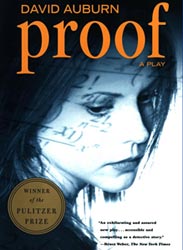
The part of Rachel casts Mary-Louise Parker as a wide-eyed naif, and perhaps my problem with the play is that she is so good as the smart and sassy woman, her large and penetrating eyes always seeming to see right through everyone. She's so self-assured on stage. Her origination of Catherine in David Auburn's Proof was definitive, and I wish she'd been tapped for that role on film (it went to Gwyneth Paltrow who also did that role on Broadway).
Perhaps Parker's gaze is too penetrating. That may explain why both images in this post show her looking off to the side instead of directly at the viewer.