2046

Wong Kar-Wai's 2046 opens today in Asia. The traffic has slowed enough that you may have luck viewing the trailer at the European 2046 website. If not, at least you can gaze at photos of Zhang Ziyi, Gong Li, and Faye Wong, some of the sirens in the movie.
More on Wong Kar-Wai's organic filmmaking style and his current rift with Christopher Doyle in this past Sunday's NYTimes Magazine article. I heard Christopher Doyle speak at the Seattle Film Festival earlier this year. He must have been on okay terms with Wong Kar-Wai then, as he showed footage he shot from 2046 and spoke fondly of Wong's maddening and "eastern" filmmaking technique.

Review: Sky Captain and the World of Tomorrow

All that technology for Kerry Conran to play with, and yet he did so little with the toys I'd be most excited to play with, and that's Jude Law, Gwyneth Paltrow, and Angelina Jolie. No, most of the $70 million budget of Sky Captain and the World of Tomorrow was spent on drawing the art deco backdrops, not in crafting the plot, which reminded me of Saturday morning cartoons I watched as a kid, or in writing smart dialogue.
Law, Paltrow, and Jolie come off as flat, both physically since they are clearly superimposed over blue-screen drawings and emotionally as they do what they can with harebrained sci-fi/fantasy dialogue. The movie reminds me of crazy stories I dreamed up and enacted with toy action figures when I was just a kid, and some of Conran's boyish enthusiasm for his childhood influences comes across in the fusion of the swashbuckling soundtrack, fantastical plot twists, and often grand landscapes. Ultimately, though, I outgrew my action figures and such shallow stories.
For all the time spent in illustrating this digital world, the movie feels strangely underpopulated. All the people besides those played by real people (the three leads, Giovanni Ribisi, Michael Gambon, and a handful of scientists) are about as animated as video game characters, which is to say not very (Laurence Olivier makes a cameo, and in one nice bit of irony, we realize he's dead on multiple levels, not just in real life or because he's been digitally resurrected). It doesn't feel like there's anyone else in the movie, further lessening the importance of the main characters' mission to save the world. It's a planet that feels empty, and by the end of the movie so did I.

Wong Kar-Wai collection on DVD

Kino is releasing a Wong Kar-Wai 5 movie boxset. Though all these movies have been available on DVD already in one form or another, this box set features remastered versions of Fallen Angels and Happy Together. The other movies included are Chungking Express (on loan from Buena Vista), Days of Being Wild, and As Tears Go By. Good stuff.
On a lighter note, Will Ferrell earned a second volume in the SNL DVD series: Saturday Night Live - The Best of Will Ferrell - Volume 2. James bought it, of course, and we watched the whole thing after the season finale of Entourage on Sunday. If you combined the first and second volumes of The Best of Will Ferrell, you'd have one solid DVD. The second volume includes the bad doctor ("I'm sorry, your son is a witch"), Wake Up, Good Morning, and the abusive boss sketch with Pierce Brosnan, but it also includes a bunch of duds. Divided, the two volumes are rentals best used as chasers after a night of drinking.

In other news...

politics.slashdot.org - a limited edition flavor of Slashdot available through the 2004 election.
Roger Ebert's very own website, a work in progress, using most of the same material as his current Suntimes site.
Why are foreign language movie subtitles so bad? Is it similar to the reason television subtitles are so bad: the method of transcription? I always wondered how those court reporters typed so quickly. You'd think movie subtitlers would just work off of the shooting script, but perhaps not. All I know is that I rented the American release of Shaolin Soccer to show Eric, and we nearly wet ourselves at some of the English subtitles. They added a further level of absurdity to an already absurd comedy.
Good TMN interview with Alex Ross about the state of classical music. True, the future of classical music seems dire, but then again, every baby I know is transfixed by Baby Mozart. Alex Ross, the music critic for The New Yorker, also has his own weblog titled The Rest Is Noise.
You can

Grayson, the movie

Grayson, a movie shot over one and a half years for just under $18K by a pair of film fanatics. Since it appears we won't get the big studio Superman/Batman movie, this excellent faux trailer lets us dream of what a DC Universe-encompassing comic book movie might be like. Worth the long download. [via Metafilter]
I forwarded this to James, who sent me the following e-mail, in which he poses a question and then, perhaps unintentionally, answers it:
"So this isn

Ridiculous

James introduced me to Revenge of the Ninja tonight. It is quite possibly the most unintentionally hilarious movie ever. I'm not sure what's more ridiculous: the movie, or the rave reviews for the movie on Amazon.com, written by ninja aficionados, including several who claim to be ninjas. In one scene, the hero is assaulted by a group of thugs hanging out at a local playground. What's ridiculous is that the thugs are dressed up as the Village People. Believe me; that only scrapes the surface of the hilarity contained in this 80's flick. James and I cackled like hyenas, and only a sliver of credit for that should belong to the bag of Kasugai gummies we polished off.
In the pantheon of movies that are so awful they're good, Revenge of the Ninja has to rank in the top ten.
Speaking of ridiculous, though, click on the "Making Of" link on the official French site for the Thai martial arts movie Ong Bak. The trailer contains a concluding shot that's nearly obscene, but the Making Of clips are even more ludicrous. Lead actor Phanom Yeerum is reminiscent of a Thai Jackie Chan what with his acrobatic, look-ma-no-wires stunt moves. The movie's available on DVD from a variety of sources including eBay. Make sure to get a copy with English subtitles, though only if that matters to you; the dialogue isn't exactly Shakespearean.

and so on and so forth

Trailers for movies from some hip directors:
Sports nicknames that sound dirty, some vaguely, and some not: The Big Unit (Randy Johnson), The Thorpedo (Ian Thorpe), Horny (Jeff Hornacek), Mordecai "Three Fingers" Brown, Hammerin' Hank Aaron, The Splendid Splinter (Ted Williams), Walter "Big Train" Johnson, The Big Red Machine, Harvey's Wallbangers, Monsters of the Midway, The Italian Stallion (Rocky Balboa), The Chicoutimi Cucumber (Georges Vezina), and any nickname involving the word Rocket. Sexual euphemisms that won't catch on.
Qualia, Sony's new super high-end line of electronics, all identified simply by three digit codes. The minimalist (okay, empty and pretentious) website reminds me of the first Nissan Infiniti commercials which showed ocean water crashing on beaches, or fields of trees, but no cars.
Stuff to listen to on your new Qualia system: music from Iceland, much of it not available on CD in the US. However, you can order direct from Bad Taste.
A new study shows that one's inability to express a concept in language may limit one's ability to understand that concept. Is it a good or bad thing that most of us only learn a few dirty words in foreign languages?

click click click

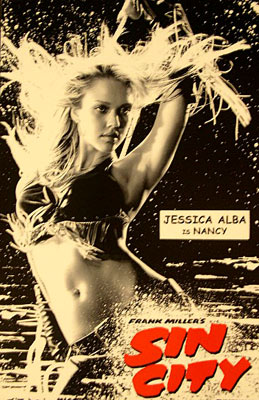
Jessica Alba can't escape being cast as a comic book fantasy. She'll play Nancy in Sin City. Hellllloooo, Nancy. She'll also play Invisible Girl in the Fantastic Four movie. Why would anyone want Alba to be invisible? Can we make her new boyfriend Derek "Overrated" Jeter invisible?
How to fold a t-shirt in two moves (.mpg), as seen in Esquire. Gives me the goosebumps.
Movie Ministry (as seen in Time magazine) - need to tie your sermon in to a movie in theaters now?
Dusty Baker calls Sammy Sosa sensitive for refusing to be moved out of the 3 spot in the batting order despite being in a horrendous slump. The truth hurts; Sosa is a sensitive prima donna.
Quicktime trailer for Fight Club, the videogame. Looks like you can choose to play Bitch Tits. With x-ray cam cut shots a la Romeo Must Die.
Martin Scorsese Collection coming on DVD. Richard Linklater's Slacker gets the Criterion Collection treatment, as does Battle of Algiers. The Best of Triumph the Insult Comic Dog also arrived on DVD, just this week. Sweet.
Use the popular vote, not the electoral college to elect our president - Amen.
Great little article by Louis Menand on Michael Moore and the history of the documentary. Where and when did we get this notion that documentaries were supposed to be completely unbiased?
Confessions of a Questec operator

Review: Open WaterOut of sight, out of mind

PETA (People for Ethical Treatment of Actors) would surely look askance on the treatment of Blanchard Ryan and Daniel Travis in Open Water. The directors tossed the two of them into shark-infested waters in the Bahamas along with dead tuna to attract the predators. Call it Stanislavsky for Dummies.
Moviemakers continue to obsess over making video look more like film, but for now, at least, the distinctive look of video serves as a useful visual cue. Open Water was shot with digital video camcorders, and this lends the movie the look and feel of realism (many a honeymooner will see the resemblance to their own crappy honeymoon video). The movie is also inspired by a true story of two scuba divers abandoned in the ocean, and all this conspires to produce the strong audience empathy that is central to the movie's chilling horror. The feeling, forever to be associated with the Blair Witch Project, is that of unearthing someone's private nightmare and realizing the personal terrors concealed by everyday life (the soundtrack is thankfully spare, except for occasional bursts of aboriginal music that distracted from the documentary feel).
The two lead actors play a generic yuppie couple stealing a quick scuba vacation in the midst of their fast-paced professional lives. Even as they pull out of the driveway, they're on their cell phones, tying up loose ends. Before we even have time to learn much about their respective personalities, they're underwater petting moray eels, and then an accounting error that would make Enron proud causes them to surface to a large expanse of empty ocean.
The audience never feels close to the characters in the way they might have if the story spent more time on character development, or even if the two parts had been played by more recognizable actors, but by movie's end, the shallow characterization didn't matter as much to me as it would in the usual movie. Open Water is about how quickly and how similarly we'd all devolve in the same situation, how being left behind by the world to serve as fish bait to packs of sharks strips us of our humanity and turns us literally into animals. As the hours tick by, the parade of emotions unfold in a familiar sequence: confusion, quick reanalysis of the situation (are we sure we surfaced in the right place?), attempts at humor (well, at least we have a good story to share at the office water cooler), disbelief, a gnawing terror as the sharks begin to circle, anger at the arbitrary cruelty of fate, blame (I wanted to go skiing instead!), and then a numbness as the two realize that they have been forgotten, that in this wide expanse of a world, a person might go days, even weeks, before he is missed.
The directors occasionally cut back to the mainland and show other vacationers reveling in tropic bars and clubs, daily life having continued without the couple in question. An even more claustrophobic depiction might have stayed solely with the couple from the time they were abandoned. It would make a fascinating alternative cut of the movie.
When I was on sabbatical in South America last year, I went on a several day W circuit through Torres del Paine. I did not realize that for three days I would not see another human being, the longest period of isolation from human contact in my entire life. On the third evening, I awoke in the middle of the night needing to use the bathroom, but I could not find my flashlight. Without a single ray of moonlight, I was lost in the thickest darkness ever.
As I crawled and groped around my tent, primal horrors leaked out of my subconscious. What if I got lost and died out in the wintry wasteland? What if a pack of wild dogs hunted me down? What if I simply collapsed of illness and perished alone, like the young man in Into the Wild? How long would it take for the world to come searching for me? Was anyone in the world wondering where I was at that moment? Did anyone remember me, or was my connection to the rest of the world merely a matter of convenience and location?

More Seattle Essentials

  • Cinerama - probably the finest theater I've ever seen a movie in. The bathrooms are almost fully automated. If you could wave a hand in front of the door to the men's bathroom and have it open, I don't think you'd need to touch a single thing in the bathroom. Well, except...oh never mind. We can simply agree that automated public bathrooms are a really good thing. Decent candy selection, and of course the sound system and video quality are awesome. The two downsides to Cinerama are that it's difficult to find affordable parking and the seats are in serious need of renovation. The seatback spring tension needs a dose of Viagra, or Levitra, or Cialis (hey, those TV commercials work! I remember all three brand names). If you are tall, you will have the seatback in front of you resting on your knees during the entire movie.
  • Cedars - I wish I could remember who first recommended this Indian/Middle Eastern restaurant to me, because it's a place that gets passed down from one Seattlite to another, like an heirloom. Cedars is cheap, and the food is dreamy. A real tandor (clay oven) produces fabulous chicken tikka, naan, and paratha. Cedar's chicken tikka masala or malai kofta are canonical in my mind. If you haven't overdosed on sugar in the constantly refilled chai (service is snappy), owner Mohammed Bhatti nearly always sends a free dessert. In the seven years I've been in Seattle, Cedars has never been less than packed on weekends. That's staying power. My last meal there was with Rich and Christina and Eric and Christina, a fitting last supper since they are some of the devoted acolytes who I was happy to introduce to the restaurant.
  • Summer weather - Seattle's summer climate is the nicest of any major city in the U.S. There, I said it. Not too hot, not too cool, and dry. Many days, the temperature outside is so neutral I don't feel anything at all, neither warm nor cool. There are no mosquitoes, and because Seattle is so far north, it's light out from 5 in the morning until 9:30 in the evening for a good few months.

Review: Before Sunset

I saw Before Sunset at SIFF at the Cinerama and never found a moment to put my thoughts down. But I see it's out in theaters now, and so I wholeheartedly recommend seeing it in theaters.
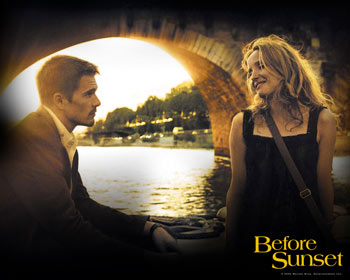
Before Sunrise is one of my favorite romances, and Before Sunset is its unexpected real-time sequel (Before Sunrise came out 9 years ago, and Before Sunset is set 9 years after the events of that movie). The timing works; no makeup is needed to see that Jessie (Ethan Hawke) and Celine (Julie Delpy) have aged physically. They're still attractive, but Hawke sports patches of grey, and both of them are leaner, not so much ravaged by time but perhaps hardened. Or are have they been starved for something they once thought possible?
The plot consists of their reunion in Paris, nine years after that magical day they spent together in Vienna. They have much less time this time; Jessie's plane home to America leaves in an hour and a half. Fortunately, they spend it strolling through Paris, perhaps the most endearing pedestrian destination anywhere. Hawke and Delpy blur the lines between reality and performance by ignoring them. Hawke plays an author in the movie (as he was in real-life), and Delpy speaks of having spent time in NYC (she did, as a film school student at NYU). These characters have become as much theirs as Linklater's, and all three love Jessie and Celine in a way that no fan of the first move need fear the taint of a financially motivated sequel. Yet this is a sequel that risks even more than its predecessor, and that's a rarity.
As with most Richard Linklater movies, much of the movie consists of dialogue. Not just any dialogue. This kind of conversation sounds more genuine than the usual theatrical rhetoric and yet it dances from topic to topic with an emotional honesty and intellectual curiosity that holds our attention until we step back and see the brilliant tapestry that Linklater, Hawke, and Delpy have woven. Linklater fans love to hear his characters walk and talk. Neither Jessie nor Celine is as young and impulsive as they once were, and yet they find themselves grasping for something they hope isn't simply nostalgia for a day that sparked on physical attraction. We sense it isn't; their minds flirt on streams of dialogue. And if it their conversation is at times pretentious (as when they discuss the environment and other such current events), it's no more so than when we hear it from our more crusading friends. Without revealing any major plot points, we come to realize why they are so desperate to preserve this moment they have with each other.
The real-time feel of the movie works wonderfully, for the most part. We feel the urgency of Jessie's impending flight time because we sense it will end not only their encounter but the movie. That's why the ending is so perfect. When it arrives, unexpectedly, we feel that our two heroes have managed to stave off the tyranny of the clock and carve out a space in time for themselves. The final images as the screen fades to black are enough to hold us until what would be a welcome next chapter in a new type of franchise: the romantic walkie talkie.

Review: Spiderman 2

[Minor spoilers ahead in the form of some high-level plot synopses; no more than you could infer from the trailer, though]
Spiderman 2 is the type of exhilarating summer popcorn blockbuster that seemed like a momentous happening when I was a young boy. Maybe there is an age when I'll outgrow that, but I suspect that some of us will always enjoy a movie like this, and others never could. Thank goodness, too, because the first Spiderman was a letdown, and Peter Parker is the superhero for the geeks of the world. A science nerd, shy, clumsy around women, oppressed by bullies, who one day gains not only superpowers but also some mysterious magnetic charm over babes like Gwen Stacy and Mary Jane Watson, one whose clever mind finds outlet in witty repartee while sparring with assorted villains with costumes and names as ridiculous as his own. [I stood in line for a long time next to some of these thirty-something geeks tonight, and while we share some common interests, I'm glad to say I dress better and shower more regularly]
Most superhero comic book writing is patently absurd and childish. Literature is no different. The best superhero stories give us heroes who have human emotions and problems. If you can empathize with the man behind the mask, your sense of fantastical uplift is that much greater when the hero is doing the superhuman. Peter Parker is the easiest of the major superheroes to empathize with. He's a teenager trying to make ends meet, in love with a girl, struggling to fit in socially, rather than a superhuman from another planet (which is why Christopher Reeve's vulnerability was pitch perfect for the Superman movies) or a billionaire (Bruce Wayne has two alter egos, his wealthy playboy side and his sadistic vigilante side; the lonely orphan is repressed out of existence. He'd make a great Freudian subject.). He wants to do good, but out of a sense of loyalty to family and friends. In the comic books, Mary Jane is the supportive wife who supports her husband in his career aspirations while seeking work of her own. They're urban DINKs.
The first half of the movie gives the characters and narrative some real heft, something the first movie lacked. Peter's double life as Spiderman is taking its toll on his schoolwork, love life, and freelance career as photographer and pizza delivery guy. In an interesting twist on the mythology, Peter's frame of mind is closely tied to his powers; where there's a will, there's a web.
What keeps the movie fun is that the screenwriters, director, and actor sprinkle the movie with audacious humor. In-jokes (listen for the theme song from the old cartoon and watch for the appearance of several characters from the Spiderman mythology), guest appearances (Elvis is alive!), one-liners, freeze frames (one particularly memorable one), and even a musical interlude set to Raindrops Keep Falling On My Head. It's a level of confidence in the material that wasn't in the first movie (except for one moment when Willem Dafoe took off his shirt to climb onto a metal platform and uttered, "Ooh, that's cold!" when metal straps were placed over his chest), and it liberates the movie creator's joy and love for the material.
The movie has a refreshingly utopian view of Manhattan. Spiderman has to take an elevator in one scene in this sequel, and the way the other person in the elevator reacts to him is true to New York City; celebrities find the anonymity granted by others in Manhattan soothing. In another scene, as in the first Spiderman movie, Spidey receives assistance from his fellow New York City citizens against his foe.
Peter goes through one day that's so bad it achieves a comic-book feel, campy and iconic. Each depressing episode flashes one after the other like frames in a comic strip. It feels more like a comic book than some of Ang Lee's more explicit imitation of that art form, such as the split frames. Even certain camera angles, like an extreme upward shot of Tobey Maguire, his fists clenched, recall the visual dynamism of comic book panels.
Among many competing themes, it's primarily a love story. Tobey Maguire's Spiderman isn't as much of a smart-ass as the Parker of comic books. He's more sullen, mopey, and doe-eyed; a quiet romantic. It's an interpretation that flows from Maguire's minimalist acting style, and it strengthens the on-screen love affair. A wounded heart that yearns plays sweeter than a smart aleck who covets. Kirsten Dunst looks younger than the Mary Jane Watson in print, and that's a good thing. Dunst's MJ is a model, yes, but one with teenage crushes and insecurities of her own. She quiets her face, droops her eyelids, and hunches her shoulders when she's feeling doubt or sadness. This MJ is a creation all her own, and theirs is the Romeo and Juliet romance of pop fiction.
The superpowers and supervillains then serve as amplifiers to push the human problems in the movie up to life-or-death heights, like MSG in takeout Chinese food. Unrequited love is much grander when the girl you love is a model, plans to marry an astronaut, and finally needs you most when she's kidnapped by a mad scientist with four metallic arms.
In the one scene that feels hokey, if such a thing is possible in a superhero movie, Tobey Maguire converses with his dead Uncle Ben in a car floating in a sea of white nothingness. Were they in the Matrix? I thought perhaps Morpheus would show up to ask if Peter wanted the blue or red pill. It's a metaphor played too visually literal. But other than that, the screenplay has a clean, classic structure, one reason the trailer was a model of clarity.
The special effects are improved from the first movie, though the movement and look of Spiderman in the long shots when he's soaring through the city still lack weight and realism. In closeup and medium shots, when Tobey Maguire is in costume, or when he's being tossed against solid objects, the sound and textures and human-executed physical movements contribute to a sense of realism. Doc Ock's mechanical arms look and move like real metallic appendages when viewed up close. In contrast, the CGI Spiderman who swings from building to building moves too quickly. If the camera would just stay still for a second and lock the background in place, Spiderman would look more realistic, but perhaps that would also expose flaws in Spiderman's texture. The other problem in the long shots is the lighting. When he is swinging dozens of stories above the ground level through a pastel-colored CGI city, Spiderman's form seems immune to shadows, and that flattens his figure. No DP can light a scene that high in the air, but it's an area for improvement in visual effects.
Perhaps this will be the last movie I see at Cinerama. If so, it was a good movie to end with. I've seen all sorts of movies at Cinerama, from experimental movies to arthouse movies to grand epics like Lawrence of Arabia to SIFF entries, but what I'll remember it for are the big summer blockbusters, the Star Wars and LOTRs. I won't miss the now flaccid seats or the hours spent waiting in line alone, but I'll miss the arrival of friends just before being let in, the smell of butter popcorn just inside the entrance, the fully-automated bathrooms (if the doors could be opened by a wave of the hand, the only thing your hands would have to touch in the men's bathroom would be your own zipper), the massive screen, and the digital surround sound system, and the whooping and cheering and palpable energy of a fired-up opening night crowd. When the lights would go down, it felt like re-entering a womb, except one with an impeccable A/V system.

Farenheit 9/11 sets box office records for a documentary

Playing on only 868 screens and rated R, Farenheit 9/11 still won the weekend box office crown by pulling in $21.8 million and in the process became the top grossing documentary of all time.
It could have opened on more screens and tried to bank more business before the Spiderman 2 onslaught this weekend, but I suspect the movie will benefit from strong word-of-mouth.
I'd be surprised if Spiderman 2 doesn't shatter all the weekend box office records over the July 4 weekend. They cut an awesome set of trailers and commercials, and unlike Farenheit 9/11 Spidey will show up on a bazillion screens Wednesday.
In front of one of them I shall be.

Review: Farenheit 9/11

Those desperate to see George Bush defeated in the November elections must have hoped that Farenheit 9/11 would put a dent in his seemingly impervious polling numbers. In this polarized political environment, where Democrats and Republicans turn their backs on each other to whoop up their respective choirs, it would take a documentary nearly free of bias and charged rhetoric to kick-start any true dialogue.
Michael Moore is not that type of documentarian, nor does he profess to be. Moore can't resist any opportunity to ridicule his prey, to get in the cheap shot or the easy jab, or to project himself into the picture to push buttons when he should be behind the camera. And God bless him, all democracies need their populist rabblerousers, though in this year of all years I wish he could have resisted the urge. It would have strengthened the persuasiveness of his message, though how could Moore resist a target like Bush? Charlton Heston in Bowling for Columbine was senile and evoked a reflexive pity; Bush is dangerously smug in his convictions for someone who most believe to have the intellect of your typical fraternity president.
The first two-thirds of the movie are edited for maximum humor: Bush on vacation, Bush golfing, Bush clowning around. Moore shows Republican leaders being primped for television interviews and speeches, including Paul Wolfowitz licking a comb before running it through his hair. Is that to imply Republicans are vain? It's a weak jab, especially as Democratic politicians must go through the same process.
Other bits are hilarious. I've seen the last clip of Bush several times ("There's an old saying in Tennessee - I know it's in Texas, probably in Tennessee - that says, fool me once, shame on - shame on you. Fool me - you can't get fooled again." ), yet it never fails to delight. Moore edits clips together in sequences that put Bush and his staff in as foolish a light as possible, and the accompanying music is a hammer onto itself. Moore has never used music to better effect.
Many in the packed opening-night crowd I saw the movie with were whooping and hollering at various Bush gaffes and verbal slips. I admit to feeling a cathartic glee at jeering Bush with a partisan audience, as if Moore were providing a channel to release nearly four years of pent-up frustration and indignation. It's the same feeling as when I'm derisively cheering the error of a Cardinal with 40,000 fellow Cubs fans at Wrigley.
Which is to say it's just more of the same, and that may not be enough. Bush has been the object of scorn and the butt of jokes for years now, and yet he still polls either neck and neck or ahead of Kerry. It's a challenge. We love our gadflies to sting hard, and with defiance, and nobody does that like Moore. It feels so liberating to skewer the White House. But in these times, Moore may only further polarize the country.
Moore also can't stay behind the lines and leave good enough alone. He narrates most of the first half of the movie, and he appears in many of the clips. He also pulls several more of his patented first person stunts, like renting an ice cream truck to drive around the hill reading the Patriot Act over a loudspeaker because many of the Congressmen had failed to read it. He accosts other Senators and House Representatives on the street to ask if they'll enlist their own children to serve in the military in Iraq. Not only are these stunts childish, they border on unseemly self-promotion. At times, Moore is like the boor who expresses your own opinion in such a vulgar manner that you're somewhat embarrassed to have him on your side.
It's a shame, because when Moore lets his material speak for itself, he's very effective. The footage of George Bush reading to schoolchildren for a good seven minutes after the two planes had crashed into the World Trade Center are shockingly bizarre. A montage of House Representatives, mostly minorities, refusing to concur with the Supreme Court's decision to hand the 2000 election to Bush, standing to protest only to be silenced by none other than Al Gore, the head of the Senate at the time as the exiting Vice President. It's a passage that both maddens and saddens. Footage from Iraq shows innocent Iraqis killed and maimed by the war, very little of which was broadcast by the U.S. press, another group Moore turns a spotlight on for giving Bush and his cronies a free pass on too many issues. Not much of the material will be new to those who have listened to the liberal chorus these past three years, but stitched together one after the other, it's an eye-opening refresher as to how not just liberals but much of the world views our current government.
And about two-thirds of the way through the movie, a hero emerges. Lila Lipscomb gives the movie a moral gravity and heart that anyone, Republican or Democrat, can feel. Her grief over losing her son in the war in Iraq and her subsequent reversal in sentiment towards the war convey, in just a few short scenes, what those on the fence about Bush need to know. Her outrage emanates off the screen with an energy that silenced the audience in the theater.
There's meat in this movie, if you are willing to search for it beneath the excess of sauces and garnishes and sides. It's a movie that I hope has long legs and that I wish had more poise.
[Footnote: Farenheit 9/11 sold out all over Seattle, and I've never seen that for a documentary. It will clearly surpass Bowling for Columbine as top-grossing documentary of all-time, and it's per-theater averages this weekend will be through the roof. It's the type of energy I usually only feel with opening night crowds for action blockbusters like Star Wars or Lord of the Rings. It's one movie whose coffers I have no problem contributing to.]

Review: Secret Window

When I saw the trailer for this movie, I immediately formed a theory in my head about who the John Turturro character was. Unfortunately, the movie bore me out.
Secret Window was adapted from a Stephen King short story, and it shows. The movie feels like a single conceit stretched out to feature movie length. The director and screenwriter stuff the story full of plot tissue to give it a chest, but its flimsy. Johnny Depp, as interesting as he is, has a difficult plot gimmick to act out, and even he can't help the movie to earn the ending.

Fahrenheit 9/11--sold out

A group of us were going to try and see Fahrenheit 9/11 tonight, but the two West side theaters showing the movie here in Seattle sold out all prime time showings yesterday. That's quite surprising for a documentary, a movie that isn't something like Lord of the Rings or Spiderman. Controversy is good business.
I wonder if it's selling out in more Republican regions of the country?

Review: Dodgeball

After seeing the awful trailer for Dodgeball, I had low expectations. They were met--in fact, the movie did the limbo and shimmied below my expectations. How could so many professional movie critics praise this? The movie tries so hard to be funny (at least to a twelve year old) that it creates its own idiotic characters and situations to lampoon. That's harmless enough, but the movie also contains a few mean-spirited, mildly offensive homophobic and racial jests; they're like flies on the dog dropping.
The lone redeeming moment in the movie comes when a sports star I'm a huge huge fan of shows up unexpectedly for a short cameo. He almost lends enough class to the entire enterprise to validate it, but by movie's end I was hoping the he had washed his hands on the way out.
BTW: adults playing dodgeball? Not cool. Not funny.

John Gaeta and Christopher Doyle

I attended a talk by John Gaeta at Microsoft today. Gaeta, as most everyone now knows, was the visual effects supervisor on the Matrix trilogy, and he's most well-known for bullet-time and virtual cinematography. After showing a montage of all the amazing visual effects clips from all three Matrix movies, Gaeta emerged in a patterned silk shirt, with hair and sunglasses straight out of Zoolander.
Gaeta attended NYU film school back when it had just opened its graduate program, and he lived in Greenwich Village. After working at several different companies after graduation, Gaeta got a job as a production assistant working for the legendary Douglas Trumbull in western Massachussetts, at a visual effects facility Trumbull built in an old textile mill. This was an experimental lab from which Trumbull developed technologies like Showscan (60 fps projection) and pioneered simulation rides (he built Back to the Future...The Ride). This sounded like a movie geek utopia. Employees rode mountain bikes to work and spent all day building robotics and camera systems.
It was at Gaeta's next job, at Mass Illusions, where he began experimenting with shooting and modeling physical objects, technology that would later become the basis of the backgrounds in bullet-time and virtual cinematography shots in The Matrix movies.
The moderator showed The Campanile movie, the now legendary short by some students at Berkeley that was the predecessor of bullet time. Download it--even now that bullet time is a movie staple, the short is still mind-blowing. Gaeta discussed many of the technical challenges that they had to overcome to render the visual effects the Wachowski brothers sought. Someone asked what the key chasms they had to cross, and he replied, "Everything Neo did." I won't delve into the detail, but it was interesting.
Some other interesting points from his talk: he was under a lot of pressure to turn Neo and Agent Smith into virtual humans in the second and third movies, a la Final Fantasy which was playing in theaters at the time. He resisted and instead turned to a technique he calls Universal Capture, using 5 high-def cameras to capture data of human actors making various facial expressions. He showed us a clip of Agent Smith rendered digitally using this technique, his face morphing from Hugo Weaving into Agent Smith, and the realism was staggering. He believes, and I agree, that this technique produces much more realistic facial movements.
When asked if virtual humans would ever render human actors superfluous, he said, "No." He used the example of the nuance that an actor like Anthony Hopkins brings to his various characters and the raw material that such an actor could bring to the screen as one reason why. He did note, however, that he once thought differently.
Someone asked what movies he admired, particularly for their visual effects. After a long silence, he confronted the elephant in the room and responded, with some reluctance, "I liked the last Lord of the Rings movie, mostly for the Gollum performance." He noted that it was a rare case of supreme animation, different from the facial capture they used for the Matrix movies. He then noted that he's bored by most visual-effects laden movies, preferring more subversive uses of technology as in the Charlie Kaufmann movies. He also cited Fight Club as a movie that was nearly subversive all the way through.
Someone asked why certain parts of the Burly Brawl looked more obviously artificial than others. Gaeta attributed it to clips where lighting wasn't baked into the DP's shots. For such shots, lighting had to be done later, and results with that had been mixed. For example, when Neo flies into the air like a helicopter, 3-point lighting hadn't been anticipated to be necessary some 30 feet in the air.
The only shot Gaeta liked in the first Spiderman was the last one, and he liked it a lot.
When asked how to avoid artificial-looking visual effects of people doing superhuman things, he recommended stylized camera speeds. Avoid 24fps special effects like the plague. If you go from slow-mo to high-speed, the shot is so stylized the audience can't process its artificiality. He cited one example from Hulk, when the Hulk is swinging a tank around. It's shown in 24fps, and while the Hulk looks realistic, the tank looks as if it has the consistency of a box of tissue paper. A wise tip.
Finally, Gaeta tossed out some thoughts on the future of entertainment and storytelling. He did believe in the primacy of a story crafted by a single storyteller, but thought it could be blended with more interactive stories. For example, you might have a story with several key, unchanging anchor plot points, but the story could be loaded up with expository bits that could be accessed by the viewer in any order. Each of those would still eventually take the viewer to the same basic points in the story, but the experience each time would be different. One example might be the ability to go back and watch a movie several times from the perspective of different characters.

_________________________________________

At the Seattle Film Festival, I went to a Master Class with another movie technician I admire: Christopher Doyle, longtime DP for Wong Kar Wai, among others. For some reason, I assume Doyle would be like someone out of Wong Kar Wai's movies, a reserved man with an eye for beauty, like one of the Tony Leung characters.
Not even close. Doyle cussed like a sailor, dropping f-bombs and sexual innuendos and gleeful cackles every other sentence. It makes sense; he once was a sailor. The interviewer, Rachel Bosky (sp?) from American Cinematographer, managed to mask her exasperation with a wry smile the whole time. Doyle was conscious of his behavior, noting, "Most cinematographers are not like this."
He showed a few montages of clips from his movies. One in particular was amusing, showing some unseen footage of Tony Leung and Maggie Cheung dancing very formally during the shoot of In The Mood for Love.
His is an organic movie-making process, a style he refers to as Eastern. He spoke of "finding the film": the image is there, it's the filmmaker's duty to find it as opposed to imposing or creating it. He opposed it to a more Western style, say that of Quentin Tarantino. Instead of removing the fourth wall for a shoot, he believed in appropriating a space. During In The Mood for Love, they shot in an actual apartment building and had to use mirrors to light in tight quarters. He believed that style was often how one responded to space.
"The East finds movies. The West buys them," he said. "Miramax, that is."
This philosophy of his was certainly influenced by his environment in Asia, and by his long-time collaborator Wong Kar Wai. For movies like In The Mood for Love or 2046, WKW shot without a script, just shooting tons of footage in search of that elusive moment (it's one reason movies like 2046 have taken so long to complete, and even at Cannes, it was rumored the final print was still in the editing room until the last minute). Doyle said that when he shoots with WKW, over 90% of the footage is just tossed out (he compared it to masturbating, or, as he said with a guffaw, "Goodbye my children!")
This is rare because in the West, film stock is one of the least expensive costs while in the East it's one of the chief costs. That means that in most shoots in the East, they could average at most 1.2 takes per shot. As a result, most scenes are rehearsed vigorously.
Doyle said Americans like to shoot with Kodak film stock because it more closely resembles a Norman Rockwell color scheme, the way American see the world. Fuji, in contrast, looked more like a Japanese woodcut.
Doyle was not formally trained. He had many friends who were making movies, and that's how he got his start. Over the years, he learned through trial by error. One of his first shoots was with 40 ASA Kodachrome (extremely slow film). The entire thing came out solid black.
Some other random tidbits:

  • Doyle on 2046: "It's the sequel to In The Mood For Love. In ITMFL, they talk about it. In 2046, they just f***."

  • Chungking Express took about 3 months to shoot, near where Doyle lived in Hong Kong

  • Happy Together was shot almost entirely with one lightbulb.

He's currently working on Last Life in the Universe with Pen-Ek. I really want to see it.