Review: House of Flying Daggers

I saw a midnight screening of House of Flying Daggers at the New York Film Festival Saturday night. While walking into the theater, I saw a pseudo-red-carpet alley being formed by throngs of people. I went over to see what the commotion was about, thinking that there was no way it could be...and it was. Zhang Ziyi. She is stunning. Some people never lose the skin they had as a baby. I had an urge to reach out just to run my fingers across her cheeks, but then I remembered that I'd probably get tackled and beaten by a few aspiring Vin Diesels, and I still did want to see the movie.
Director Zhang Yimou also walked in. Both of them received a Cannes-lite reception. Inside, Zhang spoke a few phrases which were translated into English. He mentioned that he was almost too intimidated to attempt a bamboo forest fight scene after Ang Lee's success with the same in Crouching Tiger, Hidden Dragon but that he was pleased to have found a unique way to shoot it which he hoped we'd enjoy. Zhang Ziyi came out to the crowd's delight and said in shy, halting English, "Thank you for coming. Please enjoy the movie."
I've never seen a movie at Alice Tully Hall before, and especially since my seats were in the back row, I wasn't too hopeful about the acoustics and picture. I was wrong. As the picture came on screen, a huge drum sounded, and it was LOUD. No surround sound, but the acoustic picture in the front half of the theater was distinct and LOUD. I was so pleased, because as the movie progressed, I realized that the sound design and soundtrack of the movie are critical to its effect. The sound of drums shaking the air, the whisper of silk fabric sssssliding across itself, the whistling of (flying) daggers slicing through the air, of leaves rustling as horses or soldiers rush past...all of them came through crystal clear.
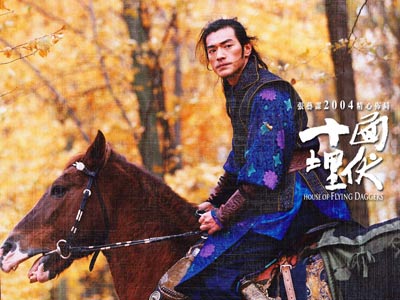
As with Hero and Raise the Red Lantern, Zhang favors lush, saturated color palettes. The scenery, shot in parts of the Ukraine and China, is gorgeous, and the actors outfits are often coordinated to the environment. When Zhang Ziyi dances at a brothel, her blue dress complements the hall decor. When she's running through an autumn forest, she's dressed in muted navy and gold, and near movie's end, when she's in a forest of bamboo and leaves, her spring green robe blends in such that an interior designer would be proud. Those ancient Chinese had great fashion sense. The finale brings together all the color palettes from the movie and highlights them against the neutral backdrop of a white snow-covered landscape.
The House of Flying Daggers is a clandestine rebel group that steals from the rich, gives to the poor, and combats the waning Tang Dynasty government. Leo (Andy Lau) and Jin (Takeshi Kanehiro) are two soldiers in the General's Army, given the assignment of capturing the new leader of the House of Flying Daggers in ten days. Jin, a ladies man, is sent undercover to the Peony Pavilion, a brothel, to investigate and win the heart of a new blind dancer, Mei (Zhang Ziyi), rumored to be a member of the House of Flying Daggers.
Anyone who's seen Crouching Tiger, Hidden Dragon or Hero or any of the classic wuxia movies will realize that to summarize any more of the plot would be difficult. Wuxia movies always involve complex, labrynthine plots full of double crosses and shifting loyalties. Whereas the characters, love stories and, combat in Hero felt so ethereal and mythic and pure as to be constricting and suffocating, HOFD contains more humor and humanity. Jin and Mei, both played by real life heartthrobs, flirt and laugh, a refreshing change from the formal, muted romances between Chow Yun Fat and Michelle Yeoh in Crouching Tiger, Hidden Dragon or Tony Leung and Maggie Cheung in Hero. The scale of the story also stays at an individual level, focusing on Jin, Mei, and Leo, instead of rising to the level of a national epic.
The combat is somewhere between that of a Crouching Tiger, Hidden Dragon, where characters could fly, and a Bruce Lee movie, no wires required. The warriors in HOFD can certainly leap in a manner that defies physics, but not so much that they seem superhuman. In Manhattan, they'd still have to take the subway to get from downtown up uptown. More importantly, the combat has force and impact. Characters bleed and sweat and stumble in the leaves and snow. Not that there's any shortage of the balletic. As in CTHD, there are battles set at treetop level in a forest, and a fight that soars up and down stalks of bamboo. Yimou uses a combination of special effects shots and wire work to achieve some lyric shots. Overhead shots frame Mei's acrobatic backflips, and the bullet-cam shots so popular with John Woo allow the camera to circle and follow daggers and arrows as they rip through forests and over fields of wildflowers, traveling impossible distances to slice and stab their targets (Jin is Aragorn with the sword, Legolas with the bow and arrow). It's technically ravishing.
The acting and dialogue are true to the wuxia tradition which is both a strength and a limitation. Wuxia movies won't ever provide the type of dialogue or elicit the type of acting that wins Oscars. It takes a game actor to keep a straight face pronouncing some of this dialogue, and it's even more difficult for the audience to keep a straight face listening to much of it (the subtitling was actually quite good, even if it failed to convey bits of nuance here and there). Some people find the chivalry and heroism of wuxia movies touching, and others hokey. HOFD is not as geniunely moving as the pictures Yimou made with Gong Li, but the emotional hooks dig deeper than those of the typical swordplay movie. At the very least, Lau, Kanehiro, and Zhang are a handsome group, even when their faces are frozen in the wuxia tragic mask--expressionless, stoic, as a tear runs down one's cheek to hang for dear life at the corner of one's chin.
[The movie was dedicated to the memory of Anita Mui, who died from cervical cancer during filming. Zhang rewrote the script to remove her character. Kathleen Battle sings the theme song.]

Review: Ray

While I was in Seattle last week, I caught a screening of Ray, the Ray Charles biopic directed by Taylor Hackford which opens at month's end.
I don't know Ray Charles's life story. When I was young, though, my dad would occasionally play his music on an old reel-to-reel, and I'd also see Charles on television, usually on Bob Hope or July 4th specials, singing America the Beautiful. I'm skeptical of the historical accuracy of most movie biographies (e.g. A Beautiful Mind) given Hollywood's distaste for truth that doesn't go down easy, but I enjoyed learning the rough sweep of Charles's life story. Others with more knowledge of his life story are better suited to address the movie's historical accuracy.
But the music...goodness, gracious. Jamie Foxx, who owns a degree in classical music, plays piano and plays it like a pro, and the vocals are provided by old Ray Charles recordings. Played over a good movie theater sound system, the soundtrack is glorious, and it will sell a lot of CDs (on the movie website, you can preview clips from some of the songs by clicking on the headphones icon in the lower right corner).
The movie is a montage of moments from his childhood and his adult life. The seeds of conflict in childhood are obvious. Charles goes blind at age seven, a huge obstacle in achieving the independence his mother wants for him (a scene where a young Charles finally learns to use his hearing reminded me of the origin of Daredevil). Later in life, the usual vices of popular musicians take hold: drugs, women, and money. Charles marries, but as his star rises, temptation overtakes him.
Still, the movie pulls its punches, and for the most part is a loving tribute to the man. It's difficult not to be seduced by Charles's soulful voice and beatific smile, reproduced with uncanny accuracy by Foxx. What makes Foxx such a suitable actor for this role is his natural warmth and charm. He has an everyman-type of humanity that comes across on screen both here and in his role in Collateral (where it was featured in perfect contrast to co-star Tom Cruise's larger-than-life intensity and celebrity; the roles could not have been reversed). Foxx practiced for this role by living in darkness, with his eyes covered for days on end. This is Foxx's star-making role, and he nails it. He's crossed over into serious leading man territory.
The movie is only partially successful in two areas. One is in the commingling of the story lines of drugs, womanizing, family, and music-making. Story lines seem to disappear for scenes on end before reappearing suddenly, in jarring fashion. Scenes of joy and sadness don't mesh as smoothly as those same feelings do in his music. Heroin use scenes (flame, surgical tubing, spoon, needle, eyes rolling back into one's head) have become a movie trope and have lost their originality and power to shock. The movie seems to drift for a long period in the middle before tying up the movie abruptly.
The second problem is with the visualization of one of particular personal demons. Charles is haunted by a tragedy from his childhood, and since Charles is blind, the moviemakers visualize his struggle to overcome it for the audience. It includes hallucinations involving water and imagined encounters with his mother and brother in places he saw before he went blind. Movies struggle to depict imagined demons, usually resorting to visual metaphors (Bruce Lee fighting a giant warrior in Dragon, Paul Bettany as imaginary friend to John Nash in A Beautiful Mind). It's difficult to think of alternative methods to document mental afflictions on screen, but the current methods still don't satisfy me.
When the movie sticks to Foxx winning people over with his music, it's entirely convincing. There are moments of wonderful humor throughout, showcasing Charles's ingenuity. And that music. Foxx has said that while he simulated blindness, he realized that the reason Charles would sway to and fro all the time was that it was easy in the darkness to nod off.
But when his music plays, I want to close my eyes and sway with a smile on my face, just like Ray. Maybe he, too, was overcome by the beauty of his own music.

Review: Friday Night Lights

Friday Night Lights is an adaptation of journalist H.G. Bissinger's bestselling book Friday Night Lights: A Town, a Team, and a Dream. The Permian Panthers of Odessa are the winningest high school football team in Texas history, and Bissinger chronicled their 1988 season. I haven't read the book, but from what I've read about it, the movie pares down the breadth of the book and focuses on Odessa's high school football obsession, only hinting at other socioeconomic issues. With just that story to tell, and with a dash of Hollywood fairy tale dust (some documented here), the movie seizes the audience's emotional strings and tugs. Hard.
The movie unwinds expeditiously. The movie opens and It's football preseason, and the players roll up to Ratliff Stadium in the late summer Texas heat. The sun is so blinding it bakes the color out of the landscape. We meet the key players: Boobie Miles (Derek Luke), the star running back. Mike Winchell (Lucas Black), the quarterback whose athletic peak will always be to be a winning high school quarterback and who has the burden of an ailing mother at home. Don Billingsley, the fullback who can never live up to the expectations of his alcoholic father Charles Billingley (Tim McGraw) who himself won a state championship at Permian 20 years ago and wears his state championship ring like a war medal. Ivory Christian is the silent but driven defensive lineman and a dead ringer for Joe Dumars, down to his quiet demeanor. And the coach under fire, Gary Gaines, who bears the burden of the community's obsession with winning at all costs and struggles not to pass those costs on to his young players.
Billy Bob Thornton plays Coach Gaines with a pitch perfect control. I tried to think of another actor who could have played this West Texas high school football coach any better, and no one came to mind.
I won't give away any major plot points. The season and story unfold with familiar twists and turns for anyone who has seen football movies or grown up in a suburb consumed by high school football. Players and coaches alike struggle to handle the pressure which engulfs them at every turn in the small town that few will escape. Most scenes are shot close and tight, even the sports scenes, emphasizing the claustrophobia the actual townspeople feel. Young players who make mistakes on the ball field are berated by parents and coaches and classmates, and of course the local sports radio station is deluged at all hours by angry callers second questioning the coach and team. A player who endures serious injury is in denial, and family and coaches knowingly join him in his denial in sending him back on the field at the expense of his health. The football scenes are, as in most movies, elevated to that particular level of exaggeration that fails the test of documentarian realism but passes the one of cinematic and emotional impact. Quarterback Winchell is crushed after every pass by defenders who fly into him sideways like torpedoes--if he'd been hit like that in real life they'd still be prying his teeth out of the turf. Some tacklers fly out of the sky at angles that suggest they were launched out of a circus cannon.
As I mentioned before, the movie only hints at some broader socioeconomic issues. Many of the players live in single parent homes. We detect hints of racial divisions in the town and within the team, some of which may be economically echoed in the geography of town, but the screenplay doesn't amplify them. These hints linger as omens casting shadows over the movie's uplifting moments, even after you leave the theater.
What elevates the movie is the nuance the actors bring to each character. Everyone who could be a stock football movie character type displays enough complexity to be human. Coach Gaines is alternately chilling, as in a speech trying to motivate/antagonize Winchell at his home, sympathetic, as when accosted by the near psychotic team announcers in a grocery store parking lot, and moving, during a halftime speech at the movie's end that gave me goosebumps.
And the movie passes the test I give all sports movies, and that is whether or not it makes me want to run out of the theater and go play that particular sport. I was ready to don some pads, run stadium stairs, and play some tackle football. The woman in front of me in the theater was alternately whooping and hollering at the screen, clapping at plays as if the football game were real, and sobbing like a baby.
When I was in high school, on Friday nights in the autumn, everyone headed to the high school football stadium. Naperville wasn't as football-obsessed as Odessa, so many of us went just to socialize, but it did feel like there was no other place in town to be. From all over town, we could see the towering lights at the football stadium calling us there like airport runway lights. On other nights of the week, we'd cruise around town in someone's car, music blasting, wondering when we could escape beyond the confines of the cornfields and strip malls to see the world beyond, but on Friday nights, we couldn't see much. The lights were so damn bright.

Bandon Dunes

Last weekend, Bill, Ken, and I journeyed to Bandon, Oregon, to Bandon Dunes for what's become an annual golf trip for me. The tagline of Bandon Dunes is Golf as it was meant to be, and I'll attest to that. If I were Hemingway and wrote a letter to a friend after this weekend, I might write:
Just played Bandon Dunes golf course this weekend. It's a goddamn beautiful course. It's been called golf as it was meant to be, but nothing's pure in life, I've decided. But it's the closest thing to it.
On the ninth hole, we spotted some wild pheasants resting in the gorse. Bill and I circled around the back, inch by inch, all the while watching the wind direction. We got close enough to take our 8 irons to a few of them. Bloody mess. Knocked the head of one of them thirty yards. Ken had no stomach for it.
I hadn't played much golf this year, but I made up for it over the weekend. As Bill and I arrived at the airport at North Bend on Friday (a single gate in a structure the size of Bill Gates's outhouse), I called the course to see if any tee times had opened up on Pacific Dunes.
We were in luck. I grabbed the next available tee time on Pacific for that afternoon, and I also put us down for another round on Pacific the next morning, before a previously scheduled round at Bandon Dunes at 12:30. Our room wasn't even ready yet. Bill and I just headed straight to the course from the airplane and teed off.
The Tom Doake-designed Pacific is more difficult than David McLay Kidd's Bandon. The fairways and greens are tighter, and it's more like target golf. Low handicappers tend to favor Pacific. The course has a longer stretch of holes along the ocean. My golf swing was rusty and felt alien to me. I stood over every ball confused and expecting the worse, and I shot my worst round in years.
Saturday morning, Ken, Bill, and I were the first group sent out at Pacific Dunes. We arrived at the course in near darkness just after 6:30 in the morning, and as soon as enough light diffused through the cloud cover, we teed off, at around 7:20am.

My swing was still nowhere to be found, though it wasn't nearly as disastrous as the previous afternoon. Ken was driving everything straight down the heart of the fairway. In the early morning fog, the course felt mysterious, gothic. We could have been in Scotland, and standing over one of my many disaster recovery shots amidst patches of gorse, I half expected Will Smith as Bagger Vance to suddenly appear in a dark brown suit and top hat and say, "I hear you lost your swing. I guess we got to go find it."

One of the great things about Bandon is that they encourage ready golf and push for a pace of 4 hrs 20 minutes a round. And they receive it. We finished our round in four hours and headed straight over to Bandon Dunes for a second eighteen. The sun was out by then, transforming the course again.
They've taken the fangs out of Bandon since last year. They cut back the gorse (a nasty, thorny bush that swallows golf balls whole) on either side of the fairways, widening already wide landing areas on most holes. It's a great course for creative links-style play, though, especially when the wind is gusting. You can use your imagination and approach every whole in a variety of ways. The greens roll as true as any greens I've played anywhere, and the course always plays fair.


We finished our second round at about 5:30pm. I could barely walk. At Bandon, your first round of a day is full price, your second round is half price, and your third round is free. Since we'd already played two rounds that day, any additional holes we played would be free. There's not a whole lot else to do there, and who could turn down free golf on a course as beautiful as Bandon on a glorious day? Bill's caddy Dale did a double take. "You're headed out again? You guys are crazy." This from a guy who said he was half blind in one eye because his brother had dropped a slab of concrete on his head while horsing around when they were young.
We were the first ones out that morning, and we were the last ones to tee off that evening. We could hardly walk, but having that entire course to ourselves was magic. The course had changed yet again, framed by the searing orange of the setting sun.

We staggered to the ninth hole and finished in the murky gray of twilight. 45 holes of golf in one day, the most I'd ever played in a single day.
We sat outside of Mulligan's Pub by an outdoor fireplace, slumped in our chairs like soldiers returned from war, feet aching. A few glasses of the Rogue beer brewed especially for Bandon Dunes restored our energy.
Sunday we had planned on another 25 holes of golf: 18 at Bandon and the 7 just-opened-that-weekend holes at Bandon Trails, the new Ben Crenshaw/Bill Coore designed course that's set to open next year. Unfortunately, Bandon Trails wasn't open on Sunday so we'll have to challenge it next year.
I birdied the second hold on Sunday, a par 3 that played about 170, but it was Bill who was the story. By hole three, when he hit his approach shot, Ken and I looked at each other and made the "whooo-eee" expression. Bill was in that happy place athletes call the zone. We're not professionals, so it wasn't that he was assaulting every flag stick, but he was just rock steady, consistent from tee to green.
On the back nine, I found my swing for a stretch and stayed with Bill for about five holes, all pars and bogeys, but the last few holes he lost me. After the round, Ken and I tallied the score and asked Bill what he thought he had shot. He said 84. We showed him the scorecard, which we had autographed for him. He had shot a career-best 81.
I carded a 91. I think I'm a good luck charm. I was there with Robert when he shot a 73, just barely missing a putt for par, at Washington National. I think I carded a 91 that day also.
Pacific and Bandon rank #2 and #7 in Golf Magazine's 2004 Top 100 Courses You Can Play. Pebble Beach is #1, but at a cost of $395 to $420 a round, it's not a better value. I'll have to try Bethpage (Black) which is ranked #3 and is in Farmingdale, NY. I played Torrey Pines (South) in June, and it doesn't compare to Bandon or Pacific. For golf purists, Bandon Dunes may be the premier single destination in the U.S., especially once all eighteen holes of Bandon Trails open next year.

Marathon toys

One thing I do enjoy about taking up new sports, even ones as painful as marathon training, is examining new gadgets. I thought that a simple sport like running would be immune to gadget excess, and for the most part it is, but not completely. For the runner without a budget:The only real gadget I've used is the Timex Bodylink System (I'd be remiss if I didn't mention that Bean bought me a stick of Bodyglide, and that's been a lifesaver also; it sounds vaguely kinky but protects against distinctively unsexy running maladies). The Timex Bodylink System consists of a watch, a GPS unit you wear on your upper arm, and a heart rate strap. When it works (which is when the GPS unit has a decent line of sight to the sky), it's great. It provides your mile pace and total distance covered, and it can be set to record mile splits automatically. My first month and a half of marathon training, I didn't run a long run in the same city twice, so having a device just track my distance allowed me to just focus on running and enjoying the views.
I ran in Seattle around Greenlake a couple times, then to the base of Golden Gate Bridge from Bean's place in Nob Hill, then through Stanford campus (including a pass by The Dish), then along Manhattan Beach near my sister Karen's new apartment, and finally all over Central Park in Manhattan. I love the view of the city skyline at night from the north end of the Reservoir.
The variety and often stunning views really helped, because otherwise I find running to be slow and painful. If I were Kenyan gliding across the land at a five minute mile pace, I'm sure I'd feel differently. Others speak of runner's high and of how they can't wait to get a run in. I just don't feel that way about the sport. In fact, with the marathon just a month away, I'm realizing that marathon refers to the training, which seems interminable. My knees ache, and this tendon that runs under the big bone on my ankle throbs all the time. Laura said she had tendinitis there also, and hearing that helped, because I wasn't sure there were any tendons in that part of my foot. When I run, it seems like everyone and their mother and their grandmother blows past me. So frustrating for someone prone to overcompetitiveness.
Can you tell I'm dragging a bit?
I am looking forward to the marathon itself. I'm ready for that day to be here.

Ichiro vs. Gwynn

Pointed comment from Gary Huckabay of Baseball Prospectus in a recent roundtable on Ichiro:
Ichiro is Tony Gwynn with an MLB work ethic.
Gwynn is one of the most overrated players in the history of the game, and in my view, one of the most tragic and confusing. He got a ton of press for basically being someone who pounded the videos and was chronicled as a "dedicated and disciplined student of the game," which is crap.
Discipline isn't manifested through compulsive and repetitive execution of those tasks which you enjoy, like cage time and video study. It's manifested through the diligent repetition of those tasks you don't like--in the case of Mr. Gwynn, cardio workouts, weightlifting and proper nutrition--so that you're in a position to perform the entirety of your required task set at the highest possible level. The final years of Gwynn's career were a pathetic waste, plagued by excessive fragility and impaired defense, primarily because of miserable conditioning. Barry Bonds could look like Tony Gwynn instead of like a 28-year-old Rickey Henderson. He doesn't.

MLB playoffs

I'm having a hard time watching the baseball playoffs, given the Cubs collapse at year end. Sharon, Alan, James, Angela, and I were at the game at Shea Stadium (one fugly-looking stadium, I might add) when the Cubs blew a three run lead with two outs and two strikes in the ninth. Ryan Dempster walked two batters to lead off the ninth, and Latroy Hawkins came in and gave up a three run home run to Victor Diaz. Yeah, I have no idea who Victor Diaz is either. Two innings later, in the eleventh, Kent Mercker gave up a game winning walkoff home run to some guy named Brazell. Brutal. The Cubs went on to lose a few extra inning games to the Mets and Reds (two awful teams) and basically flamed out to end the season.
In the game, Sammy Sosa struck out four times, and his fifth at-bat, he grounded into a double play. In the final game of the season, Sosa arrived late and left early. Later, Sosa blasted Dusty Baker for blaming him for all the team's woes. Clearly, it's time for Sosa to go, especially since his bat speed has evaporated. He's always been vulnerable to good fastballs, and now he's lost his plate discipline and willingness to go to the opposite field. He proved sensitive to the fans booing, his manager's innocent comments, and the harsh words of the press. In other words, he needs to be fitted for diapers.
The rest of the Cubs were a whining crew as well. They complained about announcers Steve Stone and Chip Caray (especially Kent Mercker). They complained about the umpires (especially Alou). It was really unbecoming and made it difficult to root for them as hard as I usually do. The Cubs had a team OBP of .328, ranking them 11th out of 16 NL teams, and thus they went through long offensive droughts between home run binges.
Fortunately, though they're certainly no spring chickens, the Cubs are not as old as the competitive teams they've fielded in the last twenty-five years. An imminent collapse can be avoided by building around the really young and talented (Prior, Zambrano, Leicester), reasonably young and talented (Wood, Lee, Ramirez, Barrett, Hawkins), and old but still effective (Maddux, Walker). Patterson is so frustrating, but he's still young and cheap, so he'll probably stay. Everyone else is either too old, too ineffective, too expensive, or some combination of all three. They can go.
I like the Red Sox and Astros to go the World Series.

Recycling

Vice President Cheney, meaning to direct viewers to factcheck.org, instead directs them to factcheck.com, a site that quickly posted a redirect to an anti-Bush site from George Soros.
Sports Guy goes premium. ESPN.com now requires a paid subscription of $40 a year to ESPN Insider to read Sports Guy. A quiet knife in the back. Brutal. ESPN.com doesn't offer any options for decoupling their Insider subscriptions, so you end up paying for content from some uninsightful ex-jocks like Rick Sutcliffe, Joe Theismann, and Trev Alberts.
UPDATE: Whew, turns out it was only a glitch and Sports Guy remains a freebie.
Seriously now. Are stories like this real? Right now, on the page where the article is listed, an unfortunate juxtaposition shows a photo of a dog and a separate photo of what appears to be a bratwurst in the right gutter.
SpaceShipOne completed the first two journeys 100km above the earth's surface. One more journey into space within two weeks of this one and they'll capture the $10 million XPrize.
UPDATE: SpaceShipOne wins the XPrize with a second successful flight.

Reckless

Last Friday, I saw the second showing of the preview for a new Craig Lucas play, Reckless, at the Biltmore Theatre. Going in I knew nothing other than it starred Mary-Louise Parker, of whom I'm a big big fan, and that Craig Lucas had written Prelude to a Kiss which I'd never read or seen.
The play begins on Christmas Eve. Rachel (Mary-Louise Parker) is sitting in bed with her husband Tom as the snow falls outside on an idyllic suburban community. She gushes about how much she loves the holiday while her husband trembles in silence. He's not moved by her nostalgia; no, he's racked with guilt for having taken out a contract on the life of the mother of his two children. He spills the beans, ushers her out the window in her bathrobe just as the hitman enters their living room, and she's set off on a strange, almost absurdist journey.
She's picked up by a stranger named Lloyd at a gas station and invited to live with him and his deaf wife Pooty (Rosie Perez). Eventually Rachel gets a job at Lloyd's company, and a bizarre journey through financial scandal, game shows, and talk shows ensues.
The play feels not just surreal but imprecise. It's not a pure comedy, nor is it purely a drama or tragedy. The theme seems to center around a line Rachel asks Lloyd at one point, "Do you think you can truly ever really know somebody?" Clearly Rachel didn't know Tom, her own husband, well enough to understand why he'd take out a contract on her life. Nor, for that matter, does the audience. Lloyd and Pooty are not who they seem, nor is Trish, the assistant at Lloyd's company. Post 9/11, the bewilderment from being the object of hatred or harm from complete strangers resonates to some degree, but the play also contains some awkward attempts at comedy, especially a game show appearance in which near complete strangers Lloyd, Pooty, and Rachel prove to know more about each other than Rachel did about her own family. Is it luck, more proof that nobody really knows anything about each other?
The play ends with Rachel reuniting with her son in an unexpected way, and we're left wondering if she'll actually finally know someone. It's perhaps the most poignant moment of the play though it comes too late.
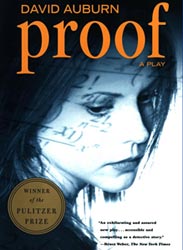
The part of Rachel casts Mary-Louise Parker as a wide-eyed naif, and perhaps my problem with the play is that she is so good as the smart and sassy woman, her large and penetrating eyes always seeming to see right through everyone. She's so self-assured on stage. Her origination of Catherine in David Auburn's Proof was definitive, and I wish she'd been tapped for that role on film (it went to Gwyneth Paltrow who also did that role on Broadway).
Perhaps Parker's gaze is too penetrating. That may explain why both images in this post show her looking off to the side instead of directly at the viewer.


Timing is everything

I've been spending my time between the West Coast and New York serendipitously. I left NYC during the RNC and enjoyed some gorgeous sunshine driving from Seattle down the West coast to Los Angeles. Then I landed back in NYC in time for the first blushes of autumn. Now I've landed back in Seattle just as tropical depression Jeanne wreaks its final fury on NYC before sailing off into the Atlantic
I found it a strange coincidence that this Gothamist post was titled "You Are Not Living In Seattle". As if addressed to me. Yes, I don't live in Seattle anymore, but for a few days, I can pretend as if I still do. And yes, Seattle has less avg. annual rainfall than NYC.

2046

Wong Kar-Wai's 2046 opens today in Asia. The traffic has slowed enough that you may have luck viewing the trailer at the European 2046 website. If not, at least you can gaze at photos of Zhang Ziyi, Gong Li, and Faye Wong, some of the sirens in the movie.
More on Wong Kar-Wai's organic filmmaking style and his current rift with Christopher Doyle in this past Sunday's NYTimes Magazine article. I heard Christopher Doyle speak at the Seattle Film Festival earlier this year. He must have been on okay terms with Wong Kar-Wai then, as he showed footage he shot from 2046 and spoke fondly of Wong's maddening and "eastern" filmmaking technique.

Review: Sky Captain and the World of Tomorrow

All that technology for Kerry Conran to play with, and yet he did so little with the toys I'd be most excited to play with, and that's Jude Law, Gwyneth Paltrow, and Angelina Jolie. No, most of the $70 million budget of Sky Captain and the World of Tomorrow was spent on drawing the art deco backdrops, not in crafting the plot, which reminded me of Saturday morning cartoons I watched as a kid, or in writing smart dialogue.
Law, Paltrow, and Jolie come off as flat, both physically since they are clearly superimposed over blue-screen drawings and emotionally as they do what they can with harebrained sci-fi/fantasy dialogue. The movie reminds me of crazy stories I dreamed up and enacted with toy action figures when I was just a kid, and some of Conran's boyish enthusiasm for his childhood influences comes across in the fusion of the swashbuckling soundtrack, fantastical plot twists, and often grand landscapes. Ultimately, though, I outgrew my action figures and such shallow stories.
For all the time spent in illustrating this digital world, the movie feels strangely underpopulated. All the people besides those played by real people (the three leads, Giovanni Ribisi, Michael Gambon, and a handful of scientists) are about as animated as video game characters, which is to say not very (Laurence Olivier makes a cameo, and in one nice bit of irony, we realize he's dead on multiple levels, not just in real life or because he's been digitally resurrected). It doesn't feel like there's anyone else in the movie, further lessening the importance of the main characters' mission to save the world. It's a planet that feels empty, and by the end of the movie so did I.

Gourmet, August 2004

I don’t usually purchase cooking magazines (correction: Gourmet bills itself as “the magazine of good living”, a broader lifestyle claim, though it is grouped with the cooking magazines at the bookstore, rather than with, say, The Robb Report or Cigar Aficionado) though I do subscribe to Cook’s Illustrated (the cooking magazine for gadget geeks, what with its scientific-method laboratory tests of cooking methodologies, kitchen tools, and foods). Cooking magazines are dangerous for a pack rat like myself. I can’t bring myself to throw out magazines that contain useful information I might someday need or use, however remote the possibility. By that definition, cooking magazines are almost never disposable, filled as they are with recipes and articles on various foodstuffs and magical cooking techniques and secrets. However, I purchased the August 2004 issue of Gourmet because it included an essay by David Foster Wallace.
I go out of my way to collect magazines with essays by Wallace or Malcolm Gladwell or short fiction by Tobias Wolff (in the case of Gladwell and Wolff, nearly always the occasional issue of The New Yorker). I enjoy Foster Wallace’s fiction (okay, let’s abbreviate to DFW, as his fans refer to him), but I adore his essays. His essay collection A Supposedly Fun Thing I’ll Never Do Again is, in my opinion, his finest work. It is in his essays that DFW's odd writing tic of inserting copious footnotes throughout his writing (to a shallow inspection, it’s the habit that most identifies him as a sui generis of the writing world) is most effective and endearing rather than ponderous, as it can be in his fiction. I admit to a similar tendency (one could argue that it’s a symptom of being a writing pack rat, unable to jettison the least relevant train of thought), albeit in HTML my digressive train of thought manifests itself in an abundance of parentheticals due to laziness (creating footnotes in HTML is a hassle, and for longer works not broken up into separate web pages, anchor links are necessary to prevent the reader from having to scroll back and forth vertically, an action which, if performed multiple times in succession, might lead to repetitive stress injuries such as carpal tunnel syndrome).
DFW’s essay for Gourmet is a paragon of the DFW essay style. What makes him such an unique and engaging journalists is not just his cool, perceptive, and almost clinical eye, or his flat and just slightly satirical, acerbic tone, but his complete disinterest in writing a conventional half-investigative, half-advertorial piece that most travelogues or celebrity interviews turn out to be. Gourmet commissioned a piece on the Maine Lobster Festival. A third of the way into his essay, DFW abruptly shifts gears from a straightforward overview of the logistics of the Maine Lobster Festival and the taxonomical and culinary history of the lobster itself to raise the real topic of his essay:
”Is it all right to boil a sentient creature alive just for our gustatory pleasure?”
It’s a question DFW spends the rest of his essay attempting to answer with his usual cubist mind. But enough on DFW and his essay. His work is nearly impossible to describe simply through a few excerpts. The footnote-laden style demands a journey to the source material.
This issue of Gourmet also contains another article that fascinated me, one that investigates whether or not wine glasses, particularly Riedel wine glasses, actually make a difference in how wine tastes. It’s particularly relevant in light of the recent news that Riedel purchased Spiegelau, creating the world's largest wineglass producer.
The article recounts how Riedel claims that their glasses improve the flavor and aroma of wine. How do they do this? At a Riedel-sponsored seminar, a Riedel representative explains that their glasses are engineered to deliver the wine to precise areas of the tongue, taking advantage of the "tongue map" which charts which regions of the tongue experience which tastes (e.g. sweet, acid, bitter, salt). Riedel has glasses for just about every variation of wine you've heard of, and many you haven't.
There's only one problem. The tongue map is a myth. It's one I was taught in grade school health class, and even I hadn't heard that it had been debunked until reading this article.
Furthermore, the article points to all sorts of scientific studies that have not only shown that in blind taste tests, the type and brand of glass makes little to no difference. It also cites one famous experiment in which wine experts were fooled into thinking a white wine with food coloring and another in which wine experts pooh poohed a mass market wine while praising a luxury wine to the heavens, only to discover that the testers had reversed the two wines.
Wine has always been a front in class struggles, bolding otherwise imperceptible lines between the highbrow and lowbrow. Non-wine snobs always suspect that they’re being bamboozled, victims of an elaborate hoax, and perhaps they’re right. Price disparity of wines is high, and objective measures are lacking. I often find myself in the wine aisle of the supermarket or a wine store, baffled by the selection of wines, the hundreds of brands, all priced seemingly randomly.
On the other hand, as the article concludes, expectations can have a huge impact on one's enjoyment of an experience or product. If you believe that paying more for a bottle of wine will buy you a better wine, or if you believe that a $40 Riedel glass will improve the taste of that Pinot Noir, that belief may indeed improve that bottle for you. Certainly Riedel wineglasses are more aesthetically pleasing than a Dixie paper cup or your average wineglass from Target. Disentangling form and function altogether in assessing a product is counter to how we experience them in everyday life. Despite the fact that most golfers would be better served by spending their money on lessons, sometimes it helps to spend it on a fancy new driver that they believe will improve their drives. If you feel more confident with a certain club in your hands, that can translate to better swings. Mind over matter.
Many people wish to affirm their purchases after the fact, like reading a Pauline Kael review after seeing a movie in the hopes of finding her in agreement with your opinion. After reading this article, I won't feel quite so bad snickering at the wine snob at the next party I attend. There's always one.
Related: Ordering lobsters online
Kinky sex secrets of the lobster (in which Trevor Corson, author of The Secret Life of Lobsters, debunks DFW's Gourmet article)

ENTJ

After reading a recent Malcolm Gladwell article about personality tests, and after Howie randomly mentioned his Myers Briggs personality type, I stopped in an Apple Store (the world's most glamorous Internet cafe) in SOHO to take an online Myers Briggs test. The test claimed I was an ENTJ, thoughly only mildly T.
The Complete Cartoons of The New Yorker - All 68,647 of them across 2 CD-ROMs, with 2004 of them excerpted into book form. Ooh la la.
CRAZIEST laid across two triple word scores, with Z on the double letter score, leads to 311 points, the highest possible National Scrabble Association-approved scoring move.
This guy has slept with over 1000 prostitutes and defends his lifestyle. No, it's not Charlie Sheen.
Sims 2 is built on emergent behavior. So, so cool.
Bone. Bone. Both cool. The FingerWhisper looks interesting, but you'll look like you're picking your ear all the time. Try the Jawbone demo for a taste of its military-grade technology.

Funeral by Arcade Fire

I really dig the album Funeral by Arcade Fire. I need something to listen to as I unpack, especially since Time Warner botched the work order for my Internet and cable TV installation, leaving me in the dark for another two weeks. Good to know the cable company out here is just as incompetent as Comcast. Verizon, the local phone provider, is no customer service Hershey Kiss either.
Download an MP3 of "Wake Up", a track from Funeral. Purchase the album from a used seller at Amazon.com (click on the Used and New link as Amazon has it on special order right now; used sellers have better pricing and immediate availability).

You bleeping bleeper! Bleep bleep!

Sunday, I visited Yankee Stadium for the first time to catch the rubber game of the Yankees-Red Sox series. My seat was in the right field bleachers, a few rows down from the DiamondVision scoreboard.
Before the game started, I took in the view of the stadium. It didn't impress me. The history of great players and great games played there is undeniable, but the actual structure itself is non-descript and rather dumpy. It lacks the distinguishing visual features of other stadiums of seniority like Wrigley Field (ivy-covered outfield walls, manual scoreboard, views of Lake Michigan and buildings outside the outfield walls) or Fenway Park (the Green Monster). The thing I do like about Yankees Stadium is the P.A. announcer. The deadpan delivery (a refreshing contrast from the biased, Michael-Buffer-like grandstanding of most home team introductions) and the acoustic texture of his voice as heard through the old-school speaker system gave me goosebumps. I'm not sure how to describe it without a sound clip, but every name he uttered sounded like a legend, even Miguel Cairo.
The best bleacher seats in sports are those that attract the die-hard, loud-mouthed fans. The ones at Wrigley Field certainly do, and by the end of the Yankees game, I had no doubt that the ones at Yankee Stadium did as well. Bleacher seats are the modern day equivalent of the standing-room only cheap seats at the Globe Theatre back when a Shakespeare play was mass entertainment, except nowadays the rabble are further from the stage than the well-to-dos. These are the fans that will throw back a home run ball if it's hit by an opposing player, assuming they're sober enough to toss it in the right direction.
And of course, they also taunt everyone, from opposing players to opposing fans. I wasn't surprised to hear profanity-laced trash talk from the fans around me, but the sustained viciousness impressed me.
Any Red Sox fan brave enough to venture into the bleachers was serenaded by a rhythmic chant of "ass...hole...ass...hole" and pointed out by a forest of jabbing index fingers, moving in time to the chanting. A few younger boys, Red Sox fans, had their Red Sox t-shirts turned inside out. I suspect their mothers forced them to do so out of fear for their lives.
In the top of the first inning, after the Yankees took the field, the bleachers conducted roll call. They started by chanting Ber-nie, Ber-nie, Ber-nie, until Bernie Williams acknowledged them with a wave of his glove. Then they moved to Mat-su-i, Mat-su-i, and then Sheff, Ole-rud, Cai-ro, Je-ter, and A-Rod. No roll call for Mussina and Posada, busy pitching and catching. I hadn't seen roll call performed at a baseball game like that before, and it was impressive. It offered a sense of camaraderie between the right field bleachers and the players, even if most of them were purchased as free agents like so many bobble-heads off of eBay.
In the bottom of the first, the bleacher fans turned from love to hate, and the target of nearly all their ire was center fielder Johnny Damon, who hasn't cut his hair since the Carter administration. I'm not sure what to call his coiff--a caveman mullet? His do and the varied hirsuteness of his teammates were a great affront to Yankees fans, perhaps in deference to the strict grooming rules passed down from Steinbrenner.
Some of the chants directed at Damon (these choruses were chanted to the "Let's go defense" cadence, i.e., [chorus in four beats], clap clap clap-clap-clap, repeat):
You're a wookie
Jesus Damon
Get a haircut
You're a homo
Take a shower
You're a [two syllable expletive]
[expletive] [expletive] [expletive] [expletive]
One Red Sox fan sitting in front of me had on a Red Sox cap, white and red and navy blue Red Sox t-shirt, and dark, thick-rimmed glasses. A Yankees fan walking up the aisle saw him and started shouting "Where's Waldo? Where's Waldo?" Then, pointing at the Red Sox fan in glasses, "Here's Waldo!"
In the sixth inning, between innings, the Village People's YMCA played. Yankees fans sought out all the Red Sox fans and pointed at them while altering the chorus: "Whyyyy are you gay?"
By the seventh-inning stretch, when the famed Irish tenor (so famous I've forgotten his name; if he's so famous shouldn't he have another gig somewhere else?) popped out to sing God Bless America, the game was out of reach. Pedro Martinez got knocked around pretty good by the Yankees. Pedro has lost a few mph off of his fastball (reducing the velocity differential and effectiveness of his nasty changeup) and some bite off of his curveball. He's still good, but he's no longer dominant. The score was 8-1 by now, Pedro had stalked off to the showers to a derisive chorus of PEEE-DROOO, and Yankees fans were preening in triumph.
One particularly obnoxious Yankees fan, a young punk with a bandana on his head, was nearly frothing at the mouth. He found one mild-mannered Red Sox fan and stood over him, screaming, "You're an asshole! Boston sucks! Get your ass back to Boston!" Unlike some other Yankees fans, Punk Yankee Fan lacked the gift of wit or creativity, so that was all he could muster, over and over. The Red Sox fan, who looked like a skinnier version of Alan Cummings, was a bit shell-shocked, so stunned he made the mistake of forgetting to remove his cap during God Bless America. Some Yankees fans shouted at him, "Hey asshole, remove your effing cap!" Though I doubt he was a Communist, Alan-Cummmings-Lite refused to acknowledge requests uttered with such disrespect, even if it offended the crowd's sense of patriotism.
After the seventh inning stretch was over, Punk Yankee Fan went over to Alan-Cummings-Lite and knocked his Red Sox cap off and kicked it down the aisle. The two of them started shoving each other and had to be separated.
The Yankees won, increasing their AL East lead to 4 1/2 games, and everyone piled back on the uptown 4. Needless to say, I wouldn't recommend bringing young children to the Yankees bleachers for games against the Red Sox, even if those are the cheap seats. The threat of collateral damage is just too great.
Next week they repeat a 3 game series, but this time in Boston. I wish I could be there to see how Yankees fans are received in the bleachers at Fenway, though I suspect the reciprocity principle holds true here.