Reviews: Destino, Les Triplettes de Belleville (aka The Triplets of Belleville), and Ping Pong

Some thoughts on 3 movies I saw long ago but never finished. I salvaged my thoughts because Ping Pong is a gem worth seeking out...
Destino, an entrancing short that played before Les Triplettes de Belleville, is a collaboration of two mad geniuses, Walt Disney and Salvador Dali. This is Dali's version of Fantasia, complete with all the most iconic of his images: melting clocks, human forms assembled from stone and empty space, vast desert plains. It's about as much hallucinatory visual tickling as one can experience without the use of recreational drugs (or so I hear).
Les Triplettes de Belleville is refined caricature. A young boy, raised by his grandmother to be a professional cyclist, is kidnapped by American gangsters during a stage of the Tour de France and forced to perform in gladiatoral cycling competitions in a city that is an obvious spoof of Manhattan. His grandmother rushes overseas to rescue him. As a cycling fan, I loved the send-ups of the young boy's cycling training and physique. He is all leg--two massive quads supported by chiseled calves. The animators knew to draw the calf muscles with the cleft which only well-trained cyclists achieve. It's a level of attention to detail both accurate and delightful. The depiction of the suffering during climbing stages of the Tour de France is pitch perfect.
The movie is limited by the lack of dialogue and by its loyalty to exaggeration. The characters are all limited in personality, and the movie doesn't aspire to be more than an entertaining caricature. I felt as if I was watching a caricaturist at a carnival drawing a picture of an odd-looking couple. Laughter as each of the prominent features took shape, and eventually boredom as the artist filled in the final details. No one hangs such pieces in their homes. Or do they?
Ping Pong (2002) also departs from hyper-realism in the service of characterization. The ping pong played is not realistic, but the styles of each of the players reflects their personalities. This Japanese movie follows the intertwined fates of two high school boys, Peco and Smile, as they navigate the world of competitive ping pong. As is the norm with sports movies, the world of sport is a metaphor for the world at large, and it's no coincidence that the two leads have opposing personalities that are reflected in their playing styles. Peco is brash, outgoing, demonstrative, and thus he plays an attacking style. Smile (I can't vouch for the accuracy of the translation of his name; it reminds me of the Mickey Mouse and Dumbo debacle from The Killer) is sullen, silent, and stoic. He plays a chopping, defensive style, taking all the energy away from his opponent's shots, waiting for mistakes instead of looking for openings to hit winners.
The movie is an adaptation of a popular manga by Matsumoto Taiyo, and the action sequences reflect its dynamic framing. Players leap into the air, whipping their paddles across the screen in a slow-motion blur, their faces frozen in fearsome grimaces, droplets of sweat scattering in all directions.
The movie is curiously touching. Yôsuke Kubozuka (Peco) and Arata (Smile) not only resemble the manga characters they play but also stay faithfully within the margins of their characters. This is not an acting vehicle, and neither actor tries to make it so. Director Fumihiko Sori translates the manga's understanding of the zen of ping-pong with great empathy. That's not an easy feat, especially for a sport played at such superhuman speeds. Baseball, with its measured pace, has been captured well on screen (the pauses in the game allow for actors to fire expressions at the camera and do what comes naturally to them, and the natural source of action allows for one-on-one confrontations between pitcher and batter), but few others. Even golf, one of the most zen-like of sports, hasn't played well in movies.
Ping pong has the advantage of allowing for direct confrontations and varied physical playing styles, and Sori takes advantage of both. Now the sport finally has a worthy silver screen representation.
Review: Harry Potter and the Prisoner of Azkaban

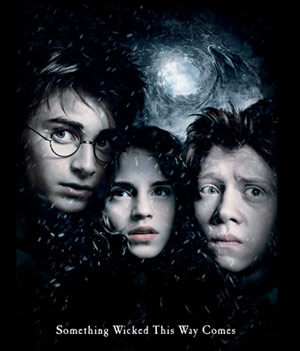
Of the three Harry Potter movies thus far, Harry Potter and the Prisoner of Azkaban possesses the strongest John Williams' soundtrack, the most expansive and spectacular visuals (that new castle is breathtaking), the darkest and most captivating cinematography (the grain of the film is beautiful), and the hottest Hermione yet. Wait, how old is she? Oops. Strike that last comment.
The adults are still mostly incompetent (perhaps that's part of the appeal of these stories to children?) and the child acting is occasionally terrible. If you were contemplating pulling a Jack Grubman by trading a favorable rating on AT&T to have Sanford Dumbledore put in a good word for your child at Hogwart's, I'd think twice. It's a wonder more kids aren't seriously injured or killed, the supervision at that school is so loose.
Those quibbles aside, Rowling processed through Filter > Alfonso Cuaron > 75% is a beautiful effect. Save that adjustment layer (I'm not nearly as certain about the Newell filter). Cuaron's building an another impressive oeuvre of movies about two guys and a girl.
I haven't read the book, but living in a Harry Potter world, it was simple enough to get an exhaustive debrief on every Potterthology reference I missed. Apparently, this is the least faithful of the three movies to date in transferring plot from page to screen. But then, that's what kids do when they reach their teens. They stop taking everything so literally, and the real fun begins.

Spartan indeed

The synopsis on the back sleeve of a bootleg DVD of Spartan, one which an unnamed friend of mine brought back for me from China:
Lsection tghe is a secret work, in the troops mileage undergo military servicing of year robust artistic skill is with the fortitude and resilience's personalityBecome the secret the work empress outstanding prove tghe score, and make him enjoy the colleague with the speak well ofing of superior section th accepted a new mission recently, with the workPreisdent daughter(1)that new hand the (virtuous gram) look for the disappearance together to pull the Newton.(gram is in theshell)Because of the matter passImportant, the president also send outed the own adviser(love virtuous ) helped to solve, like this, an is from tghe F.B.I.(FBI) with centralThe intelligence bureau( CIA) unites to constitute of solved the group to establish.At the same time, this rise the president daughter the disappearance the case, and quickly encountered to growed after launching to investigateGrow the , and become the complicacy to rise. a politician who maniuplate the government, he is apprently disappearance towards pull know aller than owner many ***s of ***
Every episode ever of Friends (a 60 DVD box set!)? Shrek 2? Day After Tomorrow? All available, though it's a roll of the dice whether you'll get a DVD or negative copy, camcorder footage from a movie theater, or some random cantopop karaoke video.

Review: Natural City

My first movie date of the 2004 Seattle Film Fest was Natural City, and for a punked out girl from the future, she was a real bore. A mess of a sci-fi movie set in 2080 A.D.
Agent R is an MP responsible for hunting down rogue cyborgs, but his heart is occupied with a female cyborg night club dancer who's about to expire. Meanwhile, one particular rogue cyborg is causing all sorts of problems from the police. Will Agent R get his head together in time to prevent a nefarious plot from unfolding?
South Korea's movie industry is booming in output, but recent entries I've seen like this movie and Tube resemble Frankenstinian collages of American movie cliches. The visuals in Natural City are sufficiently impressive, but Blade Runner came out in 1982, and this movie doesn't even match it. The movie needs some serious editing, and the screenplay is crippled by its failure to explain why R cares so much for a cyborg that has the personality of, well, a cyborg. Much of the rest of the plot is murky, leaving me and the rest of the audience tapping our toes until the next appearance of the spinning, jumping cyborg killers. It's not a compliment when the most compelling characters in a human drama are the robots.
I'd love to see South Korean cinema focus on telling stories from its own culture or milieu, stories inspired by its country and environment, such as Joint Security Area by my favorite South Korean director, Chan-Wook Park. His Old Boy won the Grand Jury Prize at this year's Cannes Film Festival.
The more money Korea spends on its movies, the more unoriginal they turn out. Hey, that sounds like Hollywood.


Review: Bubba Ho-tepThank ya, thank ya very much

Bubba Ho-Tep is about a man in a nursing home who believes he's Elvis, battling a reincarnated Egyptian mummy who is sucking the life out of the King's fellow geriatrics. The Elvis impersonator (Or is he really The King? The movie lays out an amusing backstory) is played by Bruce Campbell, and his sidekick is another nursing home resident who believes he's JFK (Ossie Davis), dyed black and missing part of his brain that the government replaced with sand. It sounded like a movie that aspired from the start towards cult status, and that worried me. Cult movies shouldn't start life aspiring towards cult status.
But Don Coscarelli's adaptation of a Joe Lansdale short story is disarmingly amusing, with just enough funny lines of dialogue (delivered by Bruce Campbell with sincere Elvis feeling) and low-budget charm to overcome the occasional comic overreach. Its culinary analogue is the local taco stand: unpretentious but uninspiring, probably not all that good for you, spare in decor, but damn tasty while in the mouth.

Review: Shrek 2

I was in the minority in finding Shrek to be middling entertainment. The idea of spoofing fairy tales, giving them a modern makeover, replete with satire and irony, wasn't as original to me as it was to most.
Shrek 2 veers off the path of the fairy tale spoofs, which fall flat for me, and dabbles more in pop culture satire, which I enjoy. The movie plays like a longer, more child-safe episode of The Simpsons with more expensive and realistic animation. Though the humor doesn't cut quite as sharp as a Simpsons's episode,
Shrek 2 machine-guns jokes at the audience throughout, and enough of them hit their mark to leave me chuckling more often than not. The jokes that miss, like the dozens of commercial store and product name spoofs, don't get enough screen time to dampen the proceedings.
Antonio Banderas as Puss in Boots, hell, Antonio Banderas as himself, was a caricature waiting to happen. In fact, SNL's Chris Kattan already did it, and Antonio spoofed himself in the Desperado sequels. Banderas can make a living off this niche alone.
The high-tech animation does little for me. That's not what's entertaining about Shrek. It looks expensive and detailed, to be sure, but we've long since passed the point where that's original or awe-inspiring, and in a satire it's not really even appropriate.
The Simpsons, any Pixar movie, Shrek, and even to some extent The Sopranos are entertainment franchises with legs because they are not really about what they are about. They are malleable vessels for transporting pop culture references and jokes in a sugar-coated, easy-to-swallow gel cap form. Times change, you just update the jokes and use the same containers. And, in the case of Shrek and the Pixar movies, the animated format means adults can bring their kids.
And that broad demographic appeal is box office gold. It's no accident Shrek and Fiona are colored green.
FOOTNOTE: You can watch the first 5 minutes of Shrek 2 online, a rarely used marketing tactic.

Seattle Film Fest recos

For once, I actually know quite a few of the movies screening at SIFF this year. Unfortunately, I'm out of town for most of the festival and had to give away nearly all of my tickets. It's killing me! SIFF lacks in movie star wattage (as compared to Cannes or Sundance), and it's not an acquisition hotbed that premieres a ton of movies (as compared to Sundance or Toronto). But SIFF makes up for it in sheer quantity. It's a movie lover's movie fest, and I'm smarting at missing most of what is likely my last SIFF.
If I were around for it this year, I'd either recommend or want to see the following:

  • The Twilight Samurai - I have the DVD but haven't watched it yet. Early reviews are quite positive. A samurai movie for the more thoughtful crowd that can't stomach the bloody violence of Kitano's Zatoichi (see below).

  • The Saddest Music in the World - already out in theaters in some cities, so those who only try to see movies they can't see in theaters soon (or ever) might want to pass on the latest strange creation from Guy Maddin.

  • Doppelganger - by SIFF favorite Kiyoshi Kurosawa and starring Japan's Robert De Niro Koji Yakusho. One of my favorite SIFF movies ever was Kurosawa's Cure.

  • The Corporation - A documentary about that selfish, ruthless entity known as the corporation.

  • Open Water - Based on a true story, and every scuba diver's worst nightmare. A tour boat leaves two divers behind in the middle of the ocean, and soon the sharks and barracudas begin circling. To film the movie, the director threw two rookie actors into the ocean and used bait to attract real sharks to circle them. Talk about method acting.

  • The Girl on the Bridge - I wanted to catch this back when it was in theaters and have meant to watch it on DVD. Patrice Leconte is the featured director this year, so here's another chance to see this black and white love story on the big screen. A knife-thrower (Daniel Auteuil) who needs a partner finds her in the form of despairing beauty (Vanessa Paradis) whom he rescues just before she throws herself off a bridge. Why can't I ever meet hot babes on the brink of suicide?

  • Primer - Won a Grand Jury prize at Sundance, but the word of mouth on this has been that it's incomprehensible. Still, the premise, about some guys who invent a time-travel machine, and the fact that this is Shane Carruth's directorial debut, shot on 16mm, is enough for me to give it a chance.

  • Donnie Darko (The Director's Cut) - Many of you have probably already seen this cult classic, but my guess is this Director's Cut may not make it to DVD, so catch it while you can. Great soundtrack.

  • A Tale of Two Sisters - Korean horror flick. Creepy Flash website. Is there any doubt Asia is the new capital of horror movies?

  • Natural City - I haven't been all that impressed with Korean sci-fi movies of the last several years, but for some reason I've been forgiving enough to always see the next one.

  • Cinematography Master Class with Christopher Doyle - long-time collaborator of Wong Kar-Wai, Doyle's cinematography is legend. His work on Hero and In the Mood for Love is just a sample of his brilliance. I'm going to this event, and I am jazzed beyond belief.

  • The Blind Swordsman: Zatoichi - saw this on DVD. Didn't adore it since Kitano plays Zatoichi as almost completely devoid of humanity and humor, those aspects of his persona that made him such an interesting character in the past. Still, Kitano sees the character as I do, as patently absurd (a blind master swordsman, ronin, masseuse, master gambler all in one?!?) and finds a new and less reverent take on the character that is refreshing. Cartoonish violence: lots of digital blood spewing like geysers from wounds opened by Zatoichi's flashing sword.

  • Infernal Affairs 1, 2, and 3 - Perhaps my favorite Hong Kong movie trilogy of all-time. Really, what other HK trilogy maintained its quality through all three chapters the way this one did? Excellent, though the back to back to back showings at Cinerama would rival the LOTR trilogy as a butt number. Still, that might be the best way to see them as the sheer number of characters and plot twists forced me to watch them each twice to remember all the characters and plot developments, especially as Andy Lau and Tony Leung's characters are played by other actors in the middle chapter. There's talk that Martin Scorsese wants to remake the trilogy with Leonardo Dicaprio, a serious endorsement in my book.

  • Hero - I couldn't wait for this movie to come out back in2002: Zhang Yimou directing truly a Hall of Fame lineup (Tony Leung, Maggie Cheung, Jet Li, Zhang Ziyi). Perhaps my expectations were too high, and it underwhelmed me. But it's worth seeing on a big screen as some of the cinematography is gorgeous. I'm more excited about Yimou's next wuxia pic, House of Flying Daggers. starring Takeshi Kaneshire, Andy Lau, and hottie Zhang Ziyi.

  • Before Sunrise/Before Sunset - The original is a classic, and the sequel arrives nine years later and is set, well, nine years after the original.

  • Goodbye Dragon Inn - I enjoyed King Hu's original Dragon Inn and the remake, so it stands to reason I should see this homage. Ming Liang Tsai is one of the more interesting and cutting-edge directors working today. I don't always love his movies, but he's brave and daring.

  • Riding Giants - Missed it at Sundance, will miss it at SIFF. Too bad, because who knows when Sony Classics will get around to putting it in theaters. This surfing documentary is by Stacey Peralta (Dogtown and Z-Boys) and stars insanely stoked surfers like Laird Hamilton.

  • Garden State - Whoo-hoo, Natalie Portman is single again! If I were a first-time director, I'd definitely pull the "I'll star in the movie myself and cast some hottie to be my romantic interest." I missed this at Sundance, I'll miss it at SIFF. Someday I'll see it. Someday Natalie and I will be together.

  • Undead - It's something of an annual tradition for me to attend the midnight horror movie showing at the Egyptian at SIFF. It might just be the most fun night of the fest, what with the rowdy fans screaming their lungs out until the wee hours of the morning in the acoustic nightmare that is the Egyptian. I don't even know what Undead is about (some Aussie zombie movie?) and I'd still see it just to be social. Bring that squeamish date you've been meaning to cuddle with.

  • Criminal - Let's see what Soderbergh disciple and director of this movie Gregory Jacobs can whip up. I'm a sucker for con-game flicks.

  • Ghost in the Shell 2: Innocence - If I could see just one movie at SIFF this year, it would be this single screening at Cinerama.

  • Sky Blue - Originally titled Wonderful Days, this movie set in the future combines miniatures, hand-drawn animation, and computer-generated animation. I know little about the story, but the visuals look gorgeous.

One thing you might note is that because Seattle doesn't premier a lot of movies, many of these are available on DVD already. Still, seeing a movie on a massive screen in the company of others just can't be beat, if you can stomach waiting in long lines with the occasional passhole (i.e., obnoxious SIFF all-series passholder who hasn't showered in seven days of sweaty sprinting from one theater to the next in an attempt to see as many movies as possible).

Review: Troy

[This review will contain spoilers for those of you uncultured swine who haven't read The Iliad]
He has some of the greatest teammates ever surrounding him. But the offense is not geared towards him, it stifles him, prevents him from displaying his true talents. How galling, for he is the greatest among the greatest. His coach wants him to play within the confines of the offense, to involve his teammates, but he will not listen to reason and charges headlong into battle alone, foolishly, yet no one can take their eyes off him as he soars into the air. His only downfall? A woman. Every generation has its Achilles, and ours is Kobe Bryant.
How to reimagine The Iliad for a modern audience? No need. Classic art emerges relevant to each generation, as it has again. Besides Kobe Bryant as Achilles (Brad Pitt) we have Shaquille O'Neal as Aias or Ajax, "give me the damn ball" Gary Payton as "give me the damn spear" Patroclus, "I just want to win a ring" Karl Malone as Odysseus, "why won't Kobe listen to me" Phil Jackson as "why won't Achilles obey my orders" Agamemnon (Brian Cox), Tim Duncan as noble Hector (Eric Bana). The Zen master should take his team to see Troy.
I revisited The Iliad to confirm my suspicions. Yes, indeed, long before Shaquille O'Neal was fouled by one brutish opposing player after another, Ajax suffered the same rude treatment during the Trojan War:
But Ajax could no longer hold his ground for the shower of darts that rained upon him; the will of Jove and the javelins of the Trojans were too much for him; the helmet that gleamed about his temples rang with the continuous clatter of the missiles that kept pouring on to it and on to the cheek-pieces that protected his face. Moreover his left shoulder was tired with having held his shield so long, yet for all this, let fly at him as they would, they could not make him give ground. He could hardly draw his breath, the sweat rained from every pore of his body, he had not a moment's respite, and on all sides he was beset by danger upon danger.
It's practically a transcript of Brad Miller on Shaquille O'Neal should the Kings and Lakers meet in the next round.
David Benioff does make a few other wise decisions. One is to shed the role of the gods in this version. A modern audience, especially the young girls in the theater to see Orlando Bloom and a buffed-out Brad Pitt would be unlikely to embrace Laurence Olivier as Zeus strolling about an Olympus shrouded in dry ice fog as in Clash of the Titans.
Another is to de-emphasize the role of the face that launched a thousand ships. No woman could live up to that title, and unknown Diane Kruger is given the thankless role here. That she plays Helen as a vapid, pretty face is besides the point, but she will still be vilified by critics for not living up to an impossible standard. Instead, Benioff places most of the blame for the war on a power-hungry Agamemnon, who many will compare to George Bush for launching a war under convenient pretenses. Agamemnon is played with scene-chewing glee by the always maniacal and triumphant Brian Cox.
Benioff and Petersen redirect most of the movie's attention to one of Western culture's original prima donnas, Achilles, a perfect hero for our age of preening sports stars. Brad Pitt is a good choice for Achilles. His chiseled face and muscular figure always having made him somewhat superhuman, and he does aloof and cocky very well. His Achilles reminds me that the trash-talking Larry Bird or Michael Jordan, bat-flipping Barry Bonds, Sharpie wielding Terrell Owens and cell-phone dialing Joe Horn, they all trace their lineage back to Achilles. We finally also learn the answer to how someone like Brad Pitt came into being: some Greek god bedded Julie Christie. It's the most credible explanation yet.
Forget about writing an original screenplay like Gladiator. Here we have an epic battle with a script already finished by Homer, perhaps of the greatest screenwriters of all time. It's the perfect setup, isn't it?
Unfortunately not. For one thing, the Greeks were nothing if not realists. Their gods were arrogant and flawed as much as the mortals in their myths, and all parties always received comeuppance for their hubris. The people in Greek myths always misstep in some way, and for the error of their ways were turned into trees, deer, insects, and then just when you thought they couldn't be punished enough they'd usually be hunted down or killed by their friends and family members, after which they might be served up as the main course at their child's birthday party. These are, after all, the people who invented Greek tragedy, perhaps the most perfect story archetype ever invented. Unfortunately, another democracy several thousands of years later converted to a new story type, that of the happy Hollywood ending in which the hero wins out, and The Iliad isn't that type of story.
Most of the truly sympathetic characters, and there are few in this drama, are supporting players. Who should the audience root for? Hector? Killed. King Priam? Ditto. Hector's wife, played by Saffron Burrows? She weeps for most of the movie, perhaps at the limited nature of her role in the script. The end of the movie arrives without a cathartic release for the audience, an artistic deficiency that will suppress repeat viewings and limit the movie's box office potential.
Also unfortunate is that the battle scenes, from buildup and pre-game inspirational speeches to the ground-shaking march of thousands of soldiers, to the initial bone-crunching, metal-crashing collision of armies, have all been done before. Wolfgang Petersen seems to acknowledge this and rather than fight it simply recycles old standards, like the old, crazy guy from Braveheart (James Cosmo) who plays a Trojan army leader of some sort here. Hey, it's a career, like being the LOOGY (lefty one out guy) out of the bullpen. You laugh, but that crazy old warrior isn't much older than John Franco. We have Boromir, err, Odysseus played by Sean Bean, and Legolas, here transformed into an effeminate Paris, played by Orlando Bloom, still wielding bow and arrow. We encounter the same camera shot that sweeps over the plains along the fault line where two armies collide, taken from Return of the King. It was a much more impressive effect before Peter Jackson and team showed it to us several times, before the days of Age of Empires when any teenage boy can generate the same effect on his home computer.
The battle scenes in Troy aren't always clearly framed. Early on, the Greeks storm the beaches of Troy. Rather, Achilles and his men the Myrmidons (I couldn't help but think of Ben Stiller in Zoolander whenever they said Myrmidon: "Mer-man! Mer-man!") storm the beach early, take one temple, and next thing we know Agamemnon is celebrating the great capture of the beach in his tent. Where were the defenses? Earlier we had seen a few Trojans placing long, pointy logs in the sand. Were some Greeks on foot, their line of sight hampered by the unwieldy tin helmets on their heads, supposed to dash unknowingly into one of these and spear themselves? It won't cause anyone to drop the invasion of Normandy down in the pantheon of beach assaults.
Even the hand-to-hand combat between armies is difficult to see, what with the tight framing, chaotic mess of bodies, and quick cuts. This is actually a problem with many American battle scenes. Certainly, such battles were probably a mess, but directors rely on this purposeful murkiness to mask poorly choreographed fight scenes and to suggest bloody carnage. Compare that with any martial art scene from a Hong Kong director and fight choreographer where every blow is framed beautifully for the audience.
Even when the camera focuses on one fight, it isn't always the right choice. During one battle, Hector meets Patroclus, disguised in Achilles's armor, in the midst of thousands of clashing warriors. As soon as they meet, everyone stops and forms a circle around them, as if surrounding two dueling break-dancers at a night club.
"Dance off! Dance off!"
"C'mon dude, go in the circle."
"No way man! That's Hector and Achilles! Their moves are too good! That stuff is tight. Check it out, Achilles is swinging his spear behind his back."
Somehow when the fight ends, Hector is able to call off the entire battle for the day. How does everyone else on the battlefield find out about the temporary peace? Text pages on the vibrating cell phones tucked under their leather battle skirts?
One positive is that Troy doesn't rely too heavily on digital effects, or at least those it does use are more seamless than in a movie like the latest Star Wars movies. However, Troy doesn't have one memorable signature or money shot of its own.
That is, of course, unless you count the several shots of a nude Brad Pitt reclining on furs. Achilles's fight with Hector is the one memorable fight in the movie, mostly because it's one on one. Pitt's Achilles is a modern day video game character, leaping into the air with the vertical of, well, Kobe Bryant. At one point I swear he executes a cross-over dribble and breaks Hector's ankles. Watching Pitt, I imagined myself holding an X-Box controller, hitting the B-button to execute one of Achilles' flying leaps, and then pressing the A and B buttons together to execute his flying death move in which he soars and pierces the all-important left upper shoulder of his foe.
Pitt looks good. That is also a problem, for he always looks too good, in every role he is in. It's the curse of the incredibly good looking, one I know firsthand. The problem is that it emphasizes some of the weaknesses in the script. For example, Pitt is shown falling for a Trojan priestess Briseis after one encounter, and then after one night of tossing around in the fur, he's so in love that he eventually dies for her. It's hardly believable, not least because it's impossible to imagine Pitt ever falling that deeply in love with anyone. Why fall in love when you look like that and can have any woman? Maybe Jennifer Aniston should've played Briseis. Then at least we'd have circumstantial evidence.
We're also to believe that Pitt returns to battle to avenge his cousin Patroclus's death at the hands of Hector. Our only insight into Achilles and Patroclus's relationship is one brief training battle with wooden swords where the two horse around. It's not enough to set up Achilles's murderous rage at his cousin's death, one which results in him dragging Hector's body around behind his chariot. The engines in Greek tragedies never leave any doubt as to their course; the endings always feel inevitable, unavoidable. Troy evokes no such certainty.
My final quibble with the movie is how poorly it sets up The Odyssey. The Odysseus of Troy is crafty, as to be expected, but also much too humble and mild-mannered. After all, this is the man who, having blinded and fooled the Cyclops and led his men to safety, can't resist getting in one last word. Sailing to freedom from the island where the blind Cyclops screams in fury, Odysseus cannot resist one last bit of trash talking.
"'Cyclops,' said I [Odysseus], 'you should have taken better measure of your man before eating up his comrades in your cave. You wretch, eat up your visitors in your own house? You might have known that your sin would find you out, and now Jove and the other gods have punished you.'
"He got more and more furious as he heard me, so he tore the top from off a high mountain, and flung it just in front of my ship so that it was within a little of hitting the end of the rudder. The sea quaked as the rock fell into it, and the wash of the wave it raised carried us back towards the mainland, and forced us towards the shore. But I snatched up a long pole and kept the ship off, making signs to my men by nodding my head, that they must row for their lives, whereon they laid out with a will. When we had got twice as far as we were before, I was for jeering at the Cyclops again, but the men begged and prayed of me to hold my tongue.
"'Do not,' they exclaimed, 'be mad enough to provoke this savage creature further; he has thrown one rock at us already which drove us back again to the mainland, and we made sure it had been the death of us; if he had then heard any further sound of voices he would have pounded our heads and our ship's timbers into a jelly with the rugged rocks he would have heaved at us, for he can throw them a long way.'
"But I would not listen to them, and shouted out to him in my rage, 'Cyclops, if any one asks you who it was that put your eye out and spoiled your beauty, say it was the valiant warrior Ulysses [Odysseus], son of Laertes, who lives in Ithaca.'
This is, to me, one of the seminal moments in all of Western literature, the quintessential Western hero declaring his name with a sneering arrogance. From Odysseus to Muhammad Ali, a long and distinguished line of trash talkers.
The Odysseus shown in Troy shows not even the slightest inkling of such blooming arrogance. Maybe some of Achilles rubbed off? I credit Homer for realizing Odysseus needed a signature speech to feature in trailers and for the Oscar voters.

The Incredibles trailer

If you trailer it, the web will link to it. The Incredibles looks very funny. I suspect it will be the most challenging of their movies yet from a humor perspective because the characters are human rather than creatures or toys. Pixar has gotten a ton of mileage out of anthropomorphic jokes, and they won't be able to go to that well this time.
To some degree. The characters are still superheroes, or not normal humans, so they'll be able to capitalize on the "superheroes have mundane human problems" jokes also, e.g. the laundry joke in the trailer. A more solid formula for consistent quality than the usual sequel-itis Hollywood finds so reassuring.

2046

Someday, I will attend Cannes. This year would have been a good year since 2046, Wong Kar-Wai's next film, long-anticipated but always out of reach, finally opens to the world.
I love so many movies, but it's difficult to imagine myself jotting up a top twenty favorite movies list without Wong Kar-Wai's Chungking Express on it.
Old Boy and Ghost in the Shell 2: Innocence also walk the Cannes red carpet this year. Fortunately, Old Boy will arrive on DVD next week for those of us without a handhold on the cinematic upper crust.


Swallowtail Butterfly

My 50+ mile bike ride today left me tuckered out. I wasn't expecting to finish Swallowtail Butterfly when I popped it into the DVD player about three hours ago, but I had to at least make a dent in it since it was already long overdue back to Scarecrow.
What unfolded was like one of those scenes in the movies, where someone has been auditioning candidates for lead singer for his band all day and hasn't found anyone remotely suitable. As he's about to pack up, bored, discouraged, one last candidate bursts in the door looking disheveled, harried. He says auditions are closed, but she begs.
Just one song, mister, please.
Alright, fine, he says. You can sing while I pack up. He doesn't expect much.
He begins packing, not even looking her way. She composes herself, closes her eyes, takes a few deep breaths, and then opens her mouth to sing.
And suddenly he stops and looks up, in awe of the talent he's witnessing. He realizes he's found her.
That's how I felt watching Shunji Iwai's Swallowtail Butterfly. With every passing minute, more awed and delighted. A few times I burst out laughing, sitting there by myself in the basement. It woke me up and kept me riveted for over two hours, and the next thing I knew it was three in the morning.
Iwai's movies are difficult to describe. I recently watched All About Lily Chou-Chou, also brilliant, and haven't quite found the words to put it in perspective. Of the two, Swallowtail Butterfly has a more coherent narrative. Still, you can summarize the plot of Pulp Fiction, or Eternal Sunshine of the Spotless Mind, or City of God, but it only goes so far in capturing the dazzle.
Swallowtail Butterfly follows the fates of several Yentowners, or immigrants who have come to Japan to try and make their fortunes. I'm not sure if the period in question is based on history, but it doesn't matter much. Most of these immigrants live in shantytowns around the edge of some Japanese city. One of these immigrants, a young girl, is left on her own after her mother dies. Her mother's fellow hookers grab her mother's money and dump the young girl off in another part of town where she's passed around from one prostitute to another until one, named Glico, takes pity on her and adopts her, dubbing her Ageha.
Glico is nicknamed the madonna of Yentown, beloved by many for her beauty, generous heart, and singing voice. She has a group of ragged friends who run a dilapidated auto repair shack outside town in the countryside.
One day, one of Glico's customers gets frisky with her and Ageha. Her friend and bodyguard, a former boxer, rushes in and rescues her, but in the process knocks the customer out the second story window onto the street below. The whole gang carries the body into the woods to dispose of it, but as they do so, they discover a mysterious cassette tape inside the man, behind his liver. The song on the tape? Frank Sinatra's "My Way." But that's not all that's on the tape.
From there, the plot explodes outward in a spiral, gathering together disparate plot threads and winding them together in a Chihuly-shaped story. As with movies like Pulp Fiction and Magnolia, odd coincidences provide surprising moments of both serendipity and misfortune.
Iwai has the gift of some of the Tarantino-Scorsese set to merge all types of music with moving pictures in seamless, resonant mixes. Real-life pop singer Chara, of an actual band named the Yentown band, plays Glico, and she's a revelation as an actor, flaunting her coy sexuality and voice to seduce all around her. The camera can't stop seeking her out. Hiroshi Mikami (as Fei Hong), Yosuke Eguchi (as Ryou Ryanki), and Mickey Curtis (as a friendly back street doctor and tattoo artist) also impress.
Iwai favors handheld shots with either natural or extremely artificial lighting. Much of the footage resembles video, and Iwai allows bright lights in otherwise dark environments to bloom across the screen as in an impressionist painting. It isn't empty stylistic preening--Iwai wants a loose, kinetic energy to govern his movies, and the handheld footage and excessive lighting effects reinforce that. The violence that does occur in his movies is of the cartoonish type in Tarantino's movies, evoking unlikely humor.
How do you catch this movie? If you're in Seattle, you can rent it from Scarecrow. I have to return it tomorrow. If you're elsewhere and don't have a video store like Scarecrow near you (that's just about everyone), you can rent it online from Nicheflix or purchase it from YesAsia. Perhaps Tarantino will use his powers to convince Miramax to distribute it here in the U.S. just as directors like he and Scorsese and Coppola have done with undiscovered foreign gems in years past.

Review: Step Into Liquid

Dana Brown's documentary Step Into Liquid is most riveting when the camera is below, on top of, inside, or behind the water following ridiculous surfgods like Laird Hamilton. It's not nearly as compelling when it turns the surfers into talking heads. Let's face it: Kelly Slater is a long way from Robert McNamara in The Fog of War. But then again, McNamara wouldn't look that good in a bikini.
When surfers speak of their sport, it always comes out as pseudo-mystical mumbo jumbo. But when a surfer disappears into the tube of a 60 foot wave and then emerges with just a second to spare as tons of water comes crashing down like the fingers of Neptune, and it's all captured on video by a camera at water level peering into the tube? Well, no talking is necessary to convey the stoke. And hell, they're already tan and good-looking and fit. If they were articulate as well, I'd probably kill myself. Thankfully, Dana Brown also depicts some surfers that don't look like Laird Hamilton, including a couple of yahoos from Wisconsin, the message being that surfing unites the world in a merry go round of love, connecting us to nature in the purest way.

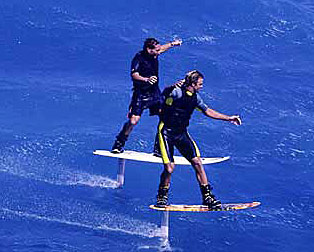
The real eye-opener, to me, was the foil board. Laird and other surfing revolutionaries attached a foil to the bottom of a board, strapped themselves on as if snowboarding, and invented a board that elevates the boarder up above the water. I had never seen this before and it blew my mind. I can't even surf normally and already I want to try foilboarding or hydrofoilboarding or whatever they call it. It's so new it doesn't have an established name yet.


Sorkin still working

Aaron Sorkin lives. He's writing and producing The Farnsworth Invention, a movie about the battle between Philo Farnsworth and Vladimir Zworykin to claim credit for the invention of a little something called the television. Sorkin's pal Thomas Schlamme will co-produce and direct.
I'm not sure, but I'm guessing both Farnsworth and Zworykin will talk very quickly and argue while walking through long corridors.

Review: The Return

It's difficult to imagine Andrey Zvyagintsev's remarkable debut movie The Return springing from a country other than Russia. It contains that spare yet bewildering psychological and spiritual depth that is a hallmark of Russian mysticism and which uniquely identifies their literature (e.g. any novel by Dostoyevsky) and film.
After over eleven years, a father returns to his wife and two sons, Andrey and Vanya. He immediately takes his boys on a fishing trip, giving the boys the opportunity to meet the father figure they never had. The journey they take across the sparse Russian landscape is symbolic, of course, and the entire movie has a mythic feel, yet the performances by each actor create characters that feel specific and real. The long continuous shots and iconic framing of images such as the son's first view of their father asleep in bed bestows upon the movie the elusive and haunting quality of a Biblical fable rendered in human terms. The Russians have always found in their daily lives a spiritual significance foreign to those like myself who have grown up with a more secular worldview.
The movie is layered with mystery. On one level, his sons wonder why their father is taking them on this long fishing trip, and the intentions of his quest are hidden from the audience as well. At another level, Andrey and Vanya wonder why he left in the first place, why he returned, and whether he truly loves them. This is not a Hollywood movie, so the answers to each are not clear cut, though the ending is stunning.
I missed The Return at Sundance and was glad to catch it in its penultimate day on screen in Seattle. Recommended if it is available on a screen near you.
Footnote: Tragically, a few weeks after the movie wrapped filming, 15 year old actor Vladimir Garin, who plays Andrey, drowned while swimming across the lake where much of the movie was shot.

Invincible Pole Fighter

After hosting a Kill Bill movie fest this weekend, I had to go back and revisit the Shaw Brothers' Invincible Pole Fighter, starring Gordon Liu (who plays Johnny Mo in Kill Bill, Vol. 1 and Pai Mei in Vol. 2). The movie is dated, without a doubt, but the fight choreography, especially in the last two fight scenes, is remarkably exciting. Gordon Liu was the man.
I had forgotten about the attack technique in which the Shaolin monks in the movie use their poles to forcibly remove the teeth of their opponents. Very strange and amusing.