Talladega Nights: The Ballad of Ricky Bobby


Usually, when a majority of critics embrace a comedy starring a funny guy I worship, that's a bad sign. It's usually a sign that someone has sold out and watered down the product. The trailer didn't seem that funny to me, and for a chunk of Talladega Nights: The Ballad of Ricky Bobby, as 17 year old boys in the theater around me snickered and guffawed, I wondered if Will Ferrell and company were suffering from overuse. NASCAR is such an obvious target, and this movie makes all the obvious if loving jabs at the expense of the sport.


But with every Will Ferrell movie, there are quotes I can recycle for years and years to my sisters' annoyance, and this movie contains more than a handful, including many that were obscured by the laughter of the packed house. Sascha Baron Cohen is magnifique as "Formula Un" racer Jean Girard, the racing footage is surprisingly good (like ice hockey, I suspect NASCAR is several magnitudes more exciting when watched live instead of on television), and Amy Adams is a scene stealer yet again.


SUSAN (Amy Adams) to RICKY BOBBY'S DAD (Gary Cole):

"Hi, I'm Susan. I'm his lady. I painted the cougar on his car."

[beat]

"We had sex."


RICKY BOBBY'S DAD:

"I wish I was there for that."


My appreciation for movies like Anchorman - The Legend Of Ron Burgundy and other frat pack flicks seems to rise over time. I suspect it has to do with how they're filmed. As the outtakes reveal, Ferrell and company shoot dozens of different jokes for every scene and then sift through all the material to stitch together the best comedic exchanges in post-production (half the jokes and shots in the trailer didn't even make the final movie; they probably have enough material to do an entirely different version of the entire movie, much of which we're certain to see on the DVD). The choppy editing is perhaps an inevitable product of the shooting style. A lot of cuts in this movie are obvious leaps to different takes, and not only do characters jump around on screen, but conversations have a Frankensteinian rhythm to them. They throw everything at the wall in these productions, and they stitch together anything that sticks.


The first time watching a movie like this, some of the jokes work, some don't. By the second or third or fourth viewing, my mind just filters out the jokes that don't work, while seeing Ferrell deliver a ridiculous joke with absolute commitment for the tenth time seems to magnify its power.


Will Ferrell's comedic talents work best when he's in a movie or sketch. His genius is remaining absolutely in character, no matter how absurd the situation. When he's being interviewed on a talk show or on the red carpet, he's never quite as funny. Like Phil Hartman, he's funniest when he's in character, which happens to be all the time when he's on camera. Outside a fictional setting, his commitment can seem forced, as when he guest-hosted for Letterman. Ferrell has throttled any semblance of self for the comedic benefit of the rest of us, bless his soul.


[By the way, the reverse is true, too: real-life people rarely seem as charismatic when put in front of the camera. All the real-life NASCAR drivers in Talladega Nights? Dull. The same with any real-life television broadcaster who appears in a movie, something that happens with alarming frequency these days. Off the top of my head, I can think of only a few sports stars who were funny on camera. Kareem in Airplane, maybe Brett Favre in There's Something More About Mary because his acting was so bad it became a spoof of itself. "Oh Mary, I've missed you so much."]


Not surprisingly, Ferrell's funniest characters are those who take themselves too seriously to begin with. Of those, few are funnier than pairs figure skaters, especially in that moment when, just before the music starts, they get into character in a melodramatic pose. I look forward to seeing Ferrell and Jon Heder when they bring that moment to life in Blades of Glory.


"Are we gonna get it on?! Cuz I am harder than a diamond in a snow storm!"


A/C, Tenacious D, Rainier C


Finally, I have air conditioning in my apartment again, and all is good again. A handy phrase to learn, one I learned from my sister, who is a lawyer, is "warrant of habitability."


Trailer for the upcoming Tenacious D movie The Pick of Destiny.


I found Rainier cherries for $2 a pound in Chinatown. They're my favorite, the queen of cherries, but seemingly not as widely known here on the East coast. Some people I've spoken to here think they're discolored Bing cherries.


Sometimes, mainstream media is late to cover topics, like the NYTimes here on HDR photography.


Lowest common denominator


YouTube has the selection lead, and that has led it to a huge lead in the online video clip library space. It did the smart thing and went with a video format that almost anyone on any platform can play, and that is Flash video (.flv files).


But here's the thing: Flash video looks like crap. It is the Ford Escort of video formats. On many YouTube videos I feel like I'm trying to watch a 12-inch black-and-white television through the wrong end of binoculars. If you were to start a competitor to YouTube, and it would be silly to do so at this point, one thing you could do to win my allegiance is to use Quicktime as your default codec. Doesn't have to be HD. It doesn't even have to be another company; YouTube could offer Quicktime as the Lexus to its own Toyota.


If I want to watch a blank white screen with no sound (oh, how modern), I want to see it in quality.


A couple Sundance babies


A few movies I caught at Sundance in January hit theaters this week.


For those who enjoy the narrow but uncomplicated communal thrill of a good horror flick, The Descent delivers. Every bit of marketing for the movie, from the poster to the trailer to pictures and advance reviews, diminishes the fun. Don't read or look at any of it. The less you know about the movie, the greater the rush. Just grab some fellow horror movie fans and wear blinders until the lights go down. Do know, however, that the movie includes some attractive girls who, like Buffy, aren't afraid to muss their hair when push comes to shove.


I knew little to nothing about the movie when I caught it at Sundance. It played at midnight at the Egyptian Theatre, however, always an omen of disturbing fare. Past movies I've caught at that series include Wolf Creek, Three Extremes, and Oldboy. I walked in sleep-deprived, drowsy, and half-frozen by the Park City winter. I walked out of the theater with palms sweating and heart racing.


There was some controversy after the screening because the ending of the cut we saw at Sundance differed from the ending of the original that showed in the UK. Whenever something like this happens, horror fans lament that studios water down movies for American audiences because of their preference for happy endings. Director Neil Marshall said that was not the case, that he had always wanted to try two different endings. I believed him, and at any rate, the American ending works just fine. You could, in fact, interpret them the same way if you wanted, and at any rate, I'm sure the special edition DVD will include both. You can also look up a description of the UK ending in IMDb's news forums after the fact, as I did after Sundance.


In a somewhat disappointing lineup of movies at Sundance this year, Quinceañera was the big winner, capturing both the audience and jury award for narrative film. It is a movie with a strong sense of place, set in Echo Park, a Latino neighborhood in Los Angeles that is a layer cake of conflict between the generations, classes, and sexes.


A girl prepares the traditional celebration of her 15th birthday, her Quinceañera, but when she discovers she's pregnant, her strict and traditional father reacts as you'd predict. She and her friend's brother Carlos, also a pariah from his own family because of his sexuality, find refuge at their great uncle Tomas's house.


This feels like a Sundance movie to me. The writer, director, and actors were all unknown to me. It is not a genre film, and though so many pieces of the story are familiar, the movie moves with an organic energy. I did not anticipate Tomas becoming the wheel on which the movie pivots back on itself. The film has a warm spirit and no desire to shock or awe, a rarity in these times. Though it sometimes feels rough around the edges and never lifted me out of my seat, Quinceañerais the right movie for the type of person who wants a movie at the far opposite spectrum from The Descent.


Write my lips


IBM's ViaVoice Toolkit for Animation, when it's finally perfected, will vastly simplify the process of synchronizing an animated character's mouth with speech. If you have IBM ViaVoice R10 for Windows, you can download the toolkit.


Someday, this will revolutionize Conan O'Brien's "lip-synched interviews with famous people" segments, as well as spawn hundreds of amateur Pixar-like shorts on YouTube.


No curse words? What the @$#!*?


You can send a little ad message in Sam Jackson's voice via cell phone or e-mail to one of your friends from the official website for Snakes on a Plane. You have to choose from a few dropdowns to produce a canned message, though the engine can pronounce some common names to give the message a bit of a personal touch (including Eugene, hallelujah).


Too bad that even for an R-rated movie, they didn't remove the censor muzzle from Samuel L. If so, I'd be sending one of these to my landlord right now for not having fixed my air conditioner yet. It would be the next best thing to sending Jules himself over to pay a visit and collect my briefcase full of freon.


"The path of the righteous man..."


The black box that is the Netflix similarity score


Note: I'm no statistics major, so if I'm completely missing the boat here, I hope some of you stats geeks will correct me.


Netflix's Friends page changed sometime in the past few days, perhaps over the weekend. I noticed it yesterday. The most curious new feature is that all of my friends are given a % similarity score relative to me. For example, under Robert's name, I see: 86% similarity to you.


My inclination was at once to believe that Robert had pretty decent taste, but perusing the similarity scores of my friends, I found some of them to be somewhat odd. Of all my friends, Eleanor ranked lowest in similarity to me, at 54%. I may not be a fan of Grey's Anatomy, but anecdotally, that seemed low to me.


I searched the site to see if there was an explanation of how this similarity score was calculated, but I couldn't find anything, not even an explanation of how to interpret the score. If the score is 54%, does that mean that if we both watched a movie, there's a 54% chance we'd both rate the movie exactly the same? Or does that mean that 46% of the time, one of us would like the movie and the other person would dislike the movie? Or something else entirely?


If you click on the similarity score, the site displays a list of all movies you've seen in common with that friend and how you each rated the movie. Thankfully, the overlapping data between Eleanor and I was only 38 movies, so I put our ratings into a spreadsheet. Of those 38, Eleanor hadn't rated 8 of the movies yet, so I dumped those out of the data and looked at the remaining 30.


Of those, we had the exact same rating for 19 of the movies. So of the 30 movies we'd both seen, we had the same rating for 63.3% of them (Netflix allows you to rate a movie on a 5 point scale, from 1 through 5 stars). Of all the movies we'd seen in common, including those Eleanor had not yet rated, we had the exact same score for 50% of them.


Of the 11 movies we differed on, Eleanor gave 1 additional star on 8 of them, I gave 1 additional star on 2 movies and 2 additional stars on 1 movie. At any rate, that information didn't help me to understand the 54% similarity score. On the 30 movies we'd both rated, Eleanor's mean rating was 3.53 stars, mine was 3.40 stars, and the mean of the difference between our ratings on the movies was .13.


Netflix assigns a textual description to each of its 5 star rankings:


  • 1 star equals "You hated it"

  • 2 stars equals "You didn't like it"

  • 3 stars equals "You liked it"

  • 4 stars equals "You really liked it"

  • 5 stars equals "You loved it"


By that system, a rating of 1 or 2 stars was a negative review, and 3 stars up equated to a positive review. If Eleanor and I differed on our ratings but both assigned a movie a negative or positive review, then in my mind our ratings were not as different as if one of us had assigned the movie a negative review while the other assigned it a positive review.


Of the 11 movies we differed on, in only 3 cases did one of us assign a positive review when the other assigned a negative review. So of 30 movies we'd seen, we had both given the movie a thumbs up or thumbs down in 27 of them, or 90% of the movies we'd both rated. This rendered the 54% similarity score even more peculiar to me.


I looked up some collaborative filtering papers online, and it seemed that the Pearson linear correlation coefficient and cosine similarity were two popular methods for calculating user or item similarity in collaborative filtering online. I couldn't do cosine similarity in Excel (at least not easily), but Excel did offer a formula for calculating the Pearson coefficient of two arrays, so I calculated that for Eleanor and my ratings. Our Pearson coefficient was .564 (correlation coefficients range from -1 to 1). Close, but it didn't match up to the 54% similarity score.


I decided to look at relative similarity scores to see if they meant more. Audrey had a 75% similarity score to me according to Netflix, so by any number of measures, we should be more similar in our movie tastes than Eleanor. But a quick look at the facts didn't support that.


Of the 103 movies Audrey and I both rated, we had the same rating on 38 of them, or 36.9%. Audrey's average rating was 3.75, while mine was 3.36, and the average of the difference of our ratings was .39. Our Pearson coefficient was .454, or lower than the Pearson coefficient between Eleanor and me.


I don't expect Netflix to reveal its methodology for calculating similarity scores. Most companies are protective of their personalization algorithms. Even if I knew how Netflix calculated its similarity scores, I'm not sure it's much more than a minor curiosity. If you knew some people were similar to me in our film ratings, the way that would help me on a movie site is to use those people's ratings to predict which other movies I'd rate highly. Netflix probably already does that. If Netflix explained how the figure was calculated, or even how to interpret the figure, it might be more meaningful.


Having used the personalization features of lots of sites, I find the most useful personalization feature to be item similarities, e.g. Amazon's "Customers who bought this item also bought" feature. Attempts to use similar people to predict my tastes has always yielded mediocre results. I haven't encountered any sites that have really cracked that nut, and that's not surprising. There's no accounting for taste, especially those of creatures as complex as human beings.


Still, if someone out there can explain the similarity scores, drop me an e-mail (commenting doesn't work right now; my e-mail address is on my homepage). I'm curious.


UPDATE: Eleanor wrote to tell me that I show up as 85% similar to her in her Friends page, even though she's only 54% similar to me in my Friends page. Audrey says I show up as 80% similar to her on her end, or 5% lower than she shows up on my end. I'm guessing that even movies we haven't rated must factor into the similarity equation.


Okay, one more trailer, for The Departed


The Departed is Martin Scorsese's adaptation of Infernal Affairs, the first chapter in my favorite Hong Kong cops and robbers trilogy. Here's the trailer for the American remake, here's the trailer for the original.


The Hong Kong original included a star-studded cast, and Scorsese's version is no less loaded. Here's the key, as far as I can tell from the trailer:

Andy Lau --> Matt Damon

Tony Leung (Chiu Wai) --> Leonardo DiCaprio

Eric Tsang --> Jack Nicholson

Anthony Wong --> Martin Sheen


That's not even mentioning Mark Wahlberg, Alec Baldwin, and Ray Winstone, who are in the cast, and Robert De Niro, who was in the cast but had to drop out. It's good to be Marty.


You can find the DVD box set for the original Hong Kong Infernal Affairs trilogy at various Asian DVD sites (you will likely need a region-free DVD player) and even eBay (which includes many non-region-encoded copies). I would urge caution on eBay DVDs that seem too cheap to be true. Many are just mass copies of low quality, and many of my old eBay DVDs of Asian movies no longer play properly. If you want what amounts to a disposable play-once copy, go to eBay. If you want a copy for your collection, spend a bit more for a high quality version.


Friday movie quiz, part III


The third in a series of movie quizzes is online. The other two were mentioned here previously. 28 frames, each from a different movie. As always, a mix of the really easy and the ridiculously obscure.


Thanks to some of my uber-movie-geek pals for the answers to 7, 8, 15, and 25. Answers below in white text (run your cursor across them to see them):

1. Cube

2. Citizen Kane

3. Casablanca

4. Casanova

5. Titan AE

6. Groundhog Day

7. Bloodrayne

8. The Street Fighter

9. Dogma

10. Raiders of the Lost Ark

11. To Kill a Mockingbird

12. Life of Brian

13. Platoon

14. Dog Day Afternoon

15. Taxi

16. Heat

17. Lock, Stock and Two Smoking Barrels

18. The Insider

19. Total Recall

20. Tom Yum Goong

21. Kiss Kiss Bang Bang

22. Wag the Dog

23. Bulletproof Monk

24. No Man’s Land

25. Kopps

26. Y Tu Mama Tambien

27. Phone Booth

28. Scary Movie 2


What really used to impress me was a feature on IMDb in which people would write in with the vaguest descriptions of some scene they had stuck in their head.


"I remember a man walking down a hall, the lights flickering, and then a drop of water lands on his head." Or something like that. 9 times out of 10, one of the IMDb'ers could identify the movie. Amazing recall.


Nowadays, I think that letter column has been retired, but it appears that users are helping each other out with such questions on the IMDb message board I Need to Know.


To terrorize or not to terrorize


Two Tuesdays ago, I attended the NY premiere of the opera "Grendel." Elliot Goldenthal was the composer, and his partner Julie Taymor (seemingly most well-known for Broadway's musical "The Lion King" and for directing Titus and Frida and for her acclaimed production of Die Zauberflöte at the Met last year...my review of that here) was director, co-librettist, and puppet designer. George Tsypin, who collaborated with Taymor on Die Zauberflöte, reunited with her as set designer.


This was an adaptation of the novel by John Gardner that retells the story of Beowulf from the monster Grendel's perspective. I've not read the novel, but if the Goldenthal-Taymor adaptation was faithful, then both transform Grendel from a mindless beast into a Hamlet-esque brooder, an introverted philosopher wearied by the weight of his own thoughts. As with the revisionist musical Wicked, the opera traces his monstrous soul to mistreatment at the hands of cruel children in his youth because of his physical appearance.


I enjoy opera, but most are a bit long for me. It would be a lie to say I've survived all three hours of any German opera without my eyes and ears and mind wandering around the theater more than a few times. "Grendel," an English (of the new and Old variety) opera, is no exception, but a few things helped to focus my attention. Taymor/Tsypin always provide a dazzling palette for the eyes, and by the oohs and aahs of the opening night crowd, that might be enough in and of itself to earn a checkmark. Tsypin's main contribution is a gigantic, rotating wall with a pivoting cutout in the center that swings back and forth like a drawbridge. Taymor's puppets include those with her trademark geometric grandeur, including a massive dragon head. Constance Hoffman's costumes supply a pleasing contrast to the puppets, some of the other monsters in Grendel's cave looking like some first grader's terrifying crayon scrawls come to life.


I enjoy me some Taymor puppets dancing around Tsypin sets as much as the next guy, but the music is what stays with you. Goldenthal is most known to me for his film score work, and "Grendel" reminded me at moments of a Stravinsky-influenced film score. Much of the vocal line given to Grendel (hard-working bass Eric Owens, looking from my cheap seats like a man in a slate-colored body cast) reverberated past me, literally and figuratively, and I had to read the notes to the opera to catch all the nuances of the story.


At times, the opera includes a bit of welcome post-modern humor. I recall one scene, or perhaps it was the first act, ending with Grendel shouting, "Bullshit!" His first line upon appearing on stage: "And so begins the twelfth year of my idiotic war."


At the opera's conclusion, the crowd gave an enthusiastic ovation, and the snippets of conversation I heard in the mass exodus all concerned Taymor's puppets, Hoffman's costumes, and Tsypin's monolithic wall.


"Just beautiful, wasn't it?"


"Oh, it was just so gorgeous. Just wonderful to look at."


I won't go so far as to refer to "Grendel" as "The Lion King" for adults or with loftier aspirations, but sometimes I think you could set Taymor puppets on a Tsypin set to music from a CD and people would turn out eagerly, so visually starved are opera fans.


One benefit of attending opera (and theater) is that it's one of the few remaining social outings that makes me feel young, the average age of the audience at the Met skewing into another generation. One of the countless reasons I'm so depressed to be leaving NYC is that the Met's upcoming season includes more than one show I'd love to see: Anthony Minghella's interpretation of "Madame Butterfly," Tan Dun's "The First Emperor" starring Placido Domingo (with help on the libretto from novelist Ha Jin and some production assistance from Zhang Yimou), and Franco Zeffirelli's production of "La Boheme."


Opening shots


Jim Emerson is compiling a list of the most famous opening shots in movies. You can read some reader and Emerson nominations on his blog. If you're a movie buff, you can try your hand at Emerson's opening shot quizzes one and two (the answers are here and here, respectively). The second quiz is much much easier than the first and is a good test of your classic movie familiarity quotient.


I look forward to the companion piece, Parting Shots. Famous pening and closing shots are like opening and closing lines in books. Good ones condense the essence of the entire work into very little.


Last year I saw Antonioni's The Passenger at the New York Film Festival, just prior to its re-release on DVD. It contains what would be one of the top 5 spots on my list of best parting shots. In one, long, unbroken shot of some seven minutes, Antonioni reprises the entire movie. The shot is mysterious from a literal perspective: what happens, and how did they shoot it?


But it is also symbolically elegant. As the camera escapes through the "prison" bars of the room, we revisit reporter David Locke's (Jack Nicholson) escape into another man's identity, that of a dead gun-runner. But as the camera glides towards freedom, it is pulled back around and re-enters the hotel, bringing us back into the room. Some things you just can't escape, and one can read that final shot in numerous ways. It is pregnant with meaning.


The new DVD release contains a 126 minute version of the film, longer than the 118 minute version on an earlier MGM cut. Antonioni has described an even longer cut of two hours and a half that he prefers, but that may never see the light of day.


Chuck Klosterman on SOAP


Chuck Klosterman writes in Esquire about the potential downside to Snakes on a Plane. I don't think it's as tragic as he makes it out to be. Hollywood already cranks out cookie cutter movies all the time, chasing after past successes as if buying last week's winning lottery number will improve one's chance of winning the next lottery. If Snakes on a Plane is a commercial success, we'll probably get an awful sequel or two regardless of whether or not the first was any good, but that's no different than plenty of other film franchises. Hell, we're about to get another Rocky movie in which an aging Sylvester Stallone goes up against Antonio Tarver. Snakes on a Plane is just business as usual, albeit with a new trigger, that being the plain yet descriptive title.


Or perhaps it's more than the title. The novelty of that wore off for me a while ago. I think the magic ingredient here is the promised presence of the foul-mouthed, indignant Samuel L. Jackson persona. If, in SOAP, he suddenly screams, "Yes, they deserve to die and I HOPE THEY BURN IN HELL!" then you'll see entire theaters erupt in applause.


It must be fantastic being able to entertain people by ranting and raving and cussing like a sailor. I wish I had that power. Then, when a waiter angered me, I could just scream at them and yet bring them some small measure of joy to them at the same time.


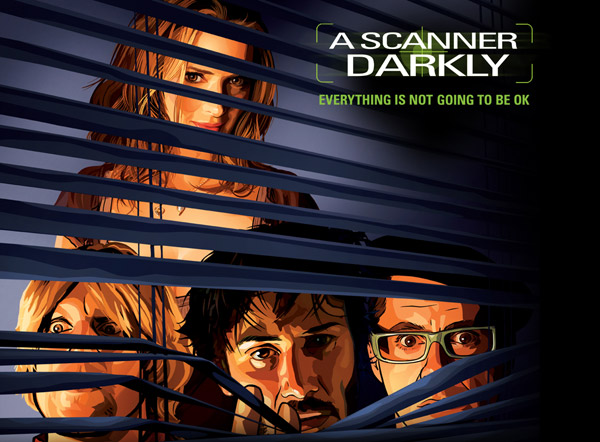
A Scanner Darkly


[SPOILER ALERT: Contains a spoiler or two, especially if you have not read the book, though the movie isn't really plot-twist-driven. It's not as if I'm going to reveal that Rosebud was a sled or that he's a ghost or anything of that magnitude.]


Wednesday night, I attended a preview screening of A Scanner Darkly at the Lincoln Center. After the movie, Robert Downey Jr. and Richard Linklater were to host a discussion about the movie.


Lingering jetlag zonked me out in the afternoon, and by the time I awoke from a long, long nap and rushed up to Lincoln Center on the subway, I was late for the event. Fortunately, these things never start on time, and I found a decent seat on the aisle. Ethan Hawks was directly ahead of me, two rows up. While catching my breath, I felt someone hovering over me in the aisle. I looked up and it was Keanu Reeves, chatting with someone who knew Rory Cochrane, one of the other actors in the movie.


I've heard Keanu speak a handful of times in person now, and he is an enigma with that awed surfer voice wrapping itself around such a wide range of ideas. I caught snippets, "So he can read Proust and Goethe in the original languages? That's fantastic." Seems like a nice guy.


Linklater was caught on an airplane so he missed the introduction which Robert Downey Jr. and Reeves provided instead. Downey Jr. is a huge talent, with boundless supplies of charisma, and the two of them warmed up the crowd with some improvised comic banter.


I have read some Philip K. Dick, but not A Scanner Darkly, so I can't comment on the faithfulness of the adaptation, but some of the guests addressed the issue in Q&A.


Notes from the Q&A, with guests Richard Linklater, Robert Downey Jr., Keanu Reeves, Jonathan Lethem, and PKD's daughter Isa:


  • The first PKD novel Linklater ever read was Valis.

  • After Waking Life and post 9/11, Linklater was searching for another use for the rotoscoping, and this PKD novel just felt timely.

  • Though they used the same software as for Waking Life, they were able to generate more detail this time. Linklater noted that what they did was not pure rotoscoping; he refers to their process as interpolated rotoscoping.

  • They use style sheets to maintain some consistency. As Linklater put it, style sheets told the animators, "This is how you draw Keanu's beard. This is how you draw Winona's..." [when he paused here, the crowd laughed, because Winona is topless, albeit in animated form, in some of the movie] "...jaw."

  • Keanu was the one person on the set who had his nose in the book the whole time (Downey Jr. did not read the novel).

  • Linklater wrote and rewrote as they went along, always trying to maintain the spirit of the book. Someone, I think it was Lethem, mentioned that when PKD first saw Blade Runner, he said that the movie was okay, but he wished that someone would make a movie that honored the ideas in his books. Lethem felt that A Scanner Darkly is the most faithful PKD adaptation ever, the only movie that honors the ambiguity and indeterminacy of PKD's work.

  • Jonathan Lethem, a PKD expert, was consulted upon before production to help the cast and crew to understand PKD's vision.

  • A Scanner Darkly is the most autobiographical of PKD's novels, a cautionary tale. PKD was addicted to amphetamines and saw many loved ones submit to drug addictions of one form or another. "If it wasn't for drugs, our dad would still be writing," said Isa. She found the end dedications to be the most moving part of the film because she knew the people referenced.

  • With an $8 million budget, Linklater had to get Isa and the rest of PKD's family to agree to a lower option fee.

  • Linklater screened the movie for Radiohead, and they liked it, so they allowed some of their music to be used in the soundtrack, including a single from Thom Yorke's new solo album The Eraser to run over the end credits.

  • Downey Jr., jokingly, I think, on Linklater, "He's a monster. I know you're thinking he's such a nice guy, softspoken, sitting here, but he works you like a rib. 'You want lunch?! This is for PKD! His daughter is sitting right there!'"

  • The biggest change they made in the movie versus the book is a twist in which Winona Ryder emerges from the second scramble suit, worn by Fred's superior on the force. It was an added twist, but one Linklater and others felt was still faithful to the spirit of the novel.

  • Where did the title A Scanner Darkly come from? Isa thought it was from Biblical scripture, while Linklater thought it might refer back to the Bergman film (I assume he meant Through a Glass Darkly.

  • The look of the movie was intended to be that of a graphic novel.

  • Linklater never thought to do a live action version of the movie. "Someone could pull that off," said Linklater, "but I couldn't."

  • Lethem liked the use of animation because "animation gives a more seamless division between reality and hallucination." Prose can do that better than most any medium. Photography is too literal. Animation helps moving pictures to capture language's potential for metaphor.

  • A lot of famous faces were used as models for images on the scramble suits, including PKD. Something to play around with once the DVD comes out.

  • The advantage of rotoscoping was that they could stick things in the scene that could just be ignored during animation, like microphones. It allowed Linklater and crew to focus on the scene as a whole while ignoring random details about getting the shot perfect, things which often consume so much time on set.

  • The shoot itself, a 25 day shoot, went smoothly. Once they shifted to animation, they hit some snags. It took longer than expected to finish.


This is about as far from a popcorn movie as you'll find in theaters this summer, a departure since most PKD novels have been transformed into sci-fi action flicks. The movie is challenging in a way that other PKD film adaptations have not been. In making the central character an addict whose personality has been splintered by drug use, and in nesting one conspiracy inside another in a Russian doll of dark forces (government, pharma, the police, among others), Linklater and company have left the movie bereft of any easy emotional handle for the audience, no one character to identify with. The dialogue-to-action ratio might frustrate the average filmgoer. On the other hand, this movie stands as a testament to the idea that Hollywood can turn out animation for adults, animation about ideas.


If you've ever sat around listening to the seemingly meaningless babble of a group of stoned buddies, you have a sense of what it feels like to listen to watch much of this movie. It's occasionally hilarious, especially the verbal parrying between Downey Jr. and Woody Harrelson, but often maddening and obtuse. The rotoscoping is effective at heightening the sense of reality's dissolution. Every moment on screen looks the same, whether it's a hallucination, a flashback, video on a surveillance screen, or reality. You can't tell one from the other. On the other hand, I occasionally wished I could see Downey Jr.'s character in live action. His face operates on a frequency that rotoscoping can't capture.


So finally, a most faithful PKD adaptation to the silver screen. PKD fans will rejoice, but the studio, I'm guessing, may not when box office receipts come in. I, for one, am glad we don't have another PKD story pillaged for an action dud like Paycheck.


Swimmin' with Dylan


Download the instrumental version of "Crazy" by Gnarls Barkley, as well as "Nel Cimitero di Tucson," the spaghetti western track Danger Mouse sampled for Crazy. Something to tide us over while we wait for Paris Hilton's cover.


True height measures the effective height of a basketball player. Good news! Tyrus Thomas measures out as nearly a 7-footer in true height. I'm pumped up for the Bulls upcoming season, though it will still be ugly on offense.


Shina Tsukamoto's horror film novella Haze on Region 2 DVD.


Soundtrack.net has a sneak preview of James Newton Howard's score for Lady in the Water. Oddly enough, the soundtrack includes a bunch of Bob Dylan covers.


Wired Magazine has a profile of banned Tour de France technology. Most are just bikes that fall under the UCI minimum weight limit, though, and for a recreational cyclist that's nothing to get excited about. A few ounces here or there isn't going to turn the average club cyclist into a champ, and trying to descend a long, steep mountain on a featherweight bike is terrifying.


A long-standing conspiracy theory holds that the moon landing was staged, perhaps by Stanley Kubrick. The moon hoax is so popular that NASA had to address it.


Clemens-Liriano


On tap for tonight: Roger Clemens vs. Francisco Liriano, aging vs. young gunslinger.


The trailer for Borat.


Stream clips from Thom Yorke's upcoming album The Eraser, which releases July 11 in the US.


The White Sox are a good team, but Ozzie Guillen is a punk. Someone put a pacifier in his mouth. Can we get Jack Nicholson to order the code red? Of course, his efforts to defend his use of a homosexual slur have the entertainment value of a car accident:


[Guillen] also said that he has gay friends, goes to WNBA games, went to the Madonna concert and plans to attend the Gay Games in Chicago.


WNBA games and a Madonna concert! Gay friends! Pin a rainbow medal on him. Of course, no one really likes Jay Mariotti, either, so this is either a win-win or a lose-lose situation, I can't tell which.


Doubt, the movie


After the performance of Neil Labute's Some Girl(s) at the Lucille Lortel Theatre last night, John Patrick Shanley came on-stage for a talkback (fancy word for mini-interview and Q&A) with one of the MCC Theater's resident playwrights. I didn't realize Shanley had won the lifetime triple crown: an Oscar for best screenplay Moonstruck, a Tony and a Pulitzer, both for Doubt. He also wrote and directed Joe Versus the Volcano. Shanley mentioned that just yesterday, he closed a deal to adapt and direct Doubt as a movie.


"People who are utterly certain are vulnerable to a brand of foolishness that people who maintain a level of doubt are not," Shanley has said. It's clear that he was referring in part to a certain sitting President, especially as compared to said President's most recent electoral opponent who was crucified for changing his mind about the Iraq war.