
The Departed


Scorsese did not see Infernal Affairs before finishing The Departed; he'd only read the script by Bill Monahan (this and lots of other good tidbits from this interview with Thelma Schoonmaker). As voracious a film buff as he is, I just assumed he'd seen the original, but this makes much more sense to me. Scorsese has never seemed like the type who'd want to remake anything (he did Cape Fear mainly because De Niro pushed him so hard for so long to do it).


Scorsese had to fight to keep the script's conclusion; can you imagine if The Departed was given a Hollywood happy ending? Instead, it has a Scorsese happy ending, one I didn't expect.


After Goodfellas, this seems to be the most well-received, broad appeal Scorsese movie ever. I saw it a few weeks ago now, I can't remember when exactly, but it was odd to see so many young people in the theater for a Scorsese movie. Was it the casting of Matt Damon and Leonardo Dicaprio?


Whoever had to choose how to cast Damon and Dicaprio chose well. It's hard to imagine the movie working as well if they'd played each others parts. Jack Nicholson nearly goes too big with his Frank Costello; at times he almost hijacks the movie the way he did Batman, but how can you begrudge Jack his fun, or Scorsese for making something that feels a bit like a genre pic? If it were a statement to the Academy from Scorsese, this movie might say, "Oh, you just want a fun crime pic? I can turn that out, no problem. See?"


Infernal Affairs had that HK, Tony Leung/Anthony Wong/Eric Tsang cool. The Departed has a manic energy that emanates from Scorsese, the cast, and the new setting. It's not a remake as much as an alternative vision built on that same, wonderful script idea: cat and mouse game between an undercover cop and an undercover mobster who've taken each other's jobs. The Departed shouldn't offend any fans of the original; it may offend some Scorsese purists. It won't force Taxi Driver or Raging Bull or Goodfellas out of the way in the hearts of Scorsese devotees (me: guilty); it doesn't have the psychological heft of those movies.


That same restless camera is here, but many of the moves feel as if they're intended to be sexy (and they are) rather than revealing. Perhaps because of that, occasional continuity problems caught my attention in this movie more than in other Scorsese movies (he's always assembled scenes from such a complex mixture of shots that some continuity jaggedness is to be expected, but his shots are so interesting and the rhythm so swift that those issues never even register on the brain).


We had to watch Goodfellas in a class the other week, and so both movies sat next to each other in my brain. That's a tough comparison for not just The Departed but for any movie, like trying to see which of your selves can stay out later on a Friday night, your 23 year old self or your 32 year old self. But now that most my waking hours are occupied struggling to see my own ideas survive the long, sometimes grueling journey to celluloid, my heart is on the side of the filmmaker. Writing a book, composing a song, making a movie, or critiquing one of those pieces of work...one of those is much easier than the other three. If you're not sure which, count the number of people in the world who do each of those well.


Footnote: I've seen Goodfellas probably about 6 times now. We watched a film print in class in the school theater a week or so ago, and it had been a year and a half since I watched it for my editing class in NYC. I had a lot of schoolwork last week, and I told myself I'd just sit down and watch the beginning before heading home to finish a bunch of work. As soon as the opening credits appeared on screen, zipping from left to right, I was done for. That movie is like heroin. It doesn't let go until the end credits, and though many people refer to DVDs as film school in a box, that movie really does show you another few cards up its sleeve every time.

Stay the, uh, course


On the way to class this morning, I heard the following sound clip (it comes at the end of that minute and a half clip) from White House Press Secretary Tony Snow, relaying President Bush's intention to retire the phrase "stay the course" when describing his Iraq policy.


Because it let the wrong impression about what was going on. And it allowed critics to say well here's an administration that's embarked a policy of not looking at what the situation is, when in fact, it's just the opposite. The president is determined not to leave Iraq short of victory but he also understands that it's important to capture the dynamism of the efforts that have been ongoing to make Iraq more secure and therefore enhance, uh, the clarification, or the greater precision.


It's more amusing when heard live. I wonder if Snow cries in front of his mirror every morning.


The rise of YouTube allows everyone to post their own Daily Show-esque comedic video montages: stay the course. Continuity is not necessarily some virtue; politicians should change their minds and messages as their understanding of situations changes. But to say "we never said that" when people can so easily pull footage of you saying exactly that just makes you look like an ass. In the last election the Bush team nailed Kerry on his flip-flop on the Iraq vote, so seeing them sweat and squirm while issuing all these false denials feels like the proper circle of hell for them to stew in.


P.S.: Firefox 2.0 has been released officially.


"The Hardest Button to Button"


Michel Gondry's video for the White Stripes' "The Hardest Button to Button" (Quicktime) was, as is par in Gondry's world, brilliant. The Simpsons' tribute to said video? Pretty damn good, too.


A team of Italians calling themselves HAL9000 has created an 8.6 gigapixel photograph of an Italian fresco by stitching together 1,145 pictures from a Nikon D2X. At 96,679 x 89,000 pixels, it's likely the largest digital image in the world, and on their website you can browse and zoom in on the image.


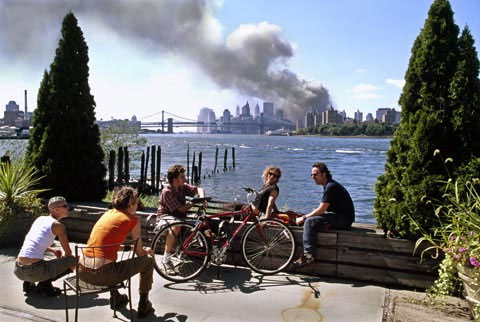
I know I'm late with this, but such is my school workload that I'm really out of it these days.: here's that controversial photo taken on 9/11 by Thomas Hoepker of Magnum Photos. Frank Rich wrote about it in the Times, then on Slate David Platz disagreed with Rich's interpretation, then two of the people in the photo wrote in to defend themselves against Rich and Hoepker's reading of the photo, and finally Hoepker himself weighed in. So in this case, a picture really was worth a thousand words or so.


1001 books you must read before you die--the list. Note that the book that the list is pulled from is not on the list itself, so it's a good thing the list is published on the web.


Hallelujah! Undercover Economist articles are finally available for free on the Financial Times website as of late September. Tim Harford is part of the transformation of economics into a sexy field.


How to turn your photos into Lichtenstein-esque pop art.


Halloween for mature audiences


Ah, Halloween. When you're a child, it's the night of endless teeth-rotting bounty. Princess Leia with the earmuff hairdo and white cloak. At some point, though, perhaps once you reach a certain age, Halloween changes. Suddenly you're Princess Leia circa Return of the Jedi, girded in a metal bikini and studded dog collar, and you're not out trolling for candy corn.


It's time to fall in love with Halloween all over again.


In her thigh-highs and ruby miniskirt, Little Red Riding Hood does not appear to be en route to her grandmother’s house.

The Formula


In this week's New Yorker, Malcolm Gladwell writes about a company which has devised a formula to predict a movie's box office success (also available as a PDF). This company, Epagogix, has a proprietary formula that relies on grading the movie along a huge variety of script or narrative elements (themes, characters, locales, costumes, and on and on), then runs them through a neural network which spits out a predicted box office take.


It sounds like some holy grail for the movie industry, but many caveats apply, as you'd expect. The script has to be graded on those script elements by human beings who read the script. They say the process takes their team a day to do, but if the formula relies on people with particular aesthetic tastes or training, that isn't scalable.


Another issue is that the neural network can only be trained based on past results, by feeding it old screenplays and their box office results. If the public's tastes change, the network has to be retrained, though I wouldn't expect this to be a huge problem.


Finally, if the formula works purely off of scripts, a lousy production might still torpedo the box office. Again, this isn't a problem for Epagogix since it sounds like they're being paid for pre-production script consulting.


I'd be curious to see them use the network to put together an ideal script, a Frankensteinian list of what narrative elements would go into a movie with the highest potential box office. The idea of storytelling being reduced to some formula spit out by a computer is repulsive to the artistic side in me but thrilling to my contrarian, scientific half.


Da beers


My dad stayed over last night because he had a morning flight out of LAX today. He wanted to see the Bears game, and since f****** DirecTV is incompetent, I'm still without any television programming. So I took him to Over/Under, the closest sports bar that Dave and I have been able to locate near our apartment.


Neither my dad nor I have seen a single Bears game this season. Going to see a game with him brought me back to my childhood. My dad became a sports fan in the early 80's, when he and I followed the Cubs, and we became Bears fans in 84, a year before they became Super Bowl champs. It's still one of those pieces of Americana which we can bond over, and that's one of the reasons I took him to a dive of a sports bar, the first time I've ever taken him to one, and probably the first time he's ever set foot in one.


Being with my dad must have accentuated my youth, because I was carded there for the first time. My dad asked how this all worked.


"Do we have to buy a beer?"


"Yeah, we probably should," I replied. He ordered a Bud Light, and I ordered a Red Hook. After a few sips of his Bud Light, I asked if he wanted to try a different beer.


"No," he said, "I can't really drink. After just this little bit, I already feel a bit..." [he pointed at his head and drew a few circles in the air]. That's the thing about me versus my dad. Relative to him, I'm always going to be an idiot (I can't decipher a single line of his PhD thesis) and a drunkard.


By the time we sat down, the Bears were already down 7-0. Several Cardinals fans (or they may have just been general underdog supporters) crowded the bar.


First half of Bears football I saw all season, and wouldn't you know it, they played their worst half of the year. The difference between football and baseball, for example, is that a football box score can be much more deceptive than a baseball box score. I can generally envision how a baseball game unfolded by the box score, what with its series of discrete confrontations between batter and pitcher/defense, but a football box score can only summarize with very broad brush strokes the quality of a game.


Some things I saw in the first half reminded me of the nightmare that was the last Bears game I watched, the loss to Carolina in the playoffs last year. Rex Grossman still makes terrible risk/reward decisions when under pressure. He just plain wilts and throws terrible passes and interceptions. The Bears offensive line is just average. I suspect one main reason the Bears haven't run the ball all that well this year is that their O-line is not as good as it was last year. They also let the Cardinals' ends through with regularity, leading directly to the two Grossman fumbles.


Lastly, and this still haunts me from that playoff game against the Panthers, the Bears defense doesn't seem to be able to adjust mid-game when the opposing team uncovers a hole in its Cover-2. Last year it was Steve Smith continuing to beat the Bears all game because he was either single-covered or the over the top help was soft. The next game, the Seahawks double or triple-covered Smith all game and contained the Panthers offense. In this game, the Cardinals receivers kept running to seams in the zone defense and sitting there, giving Leinart stationary targets to hit. It happened all half, and the Bears defense would not change. It drove me nuts.


At halftime, I left for my evening class, and my dad, disgusted, went back to my apartment. Of course, the Bears came back and won, and my dad and I missed it all. But we shared a beer together, happy hour pricing, and so the night wasn't a total loss.


Word...DirecTV is the devil


My sister Joannie also suffered an awful experience with DirecTV. She forwarded her thoughts to me to share:


I could not agree with you more. DirecTV is absolutely HORRIBLE. I have never had a worse customer service experience with any other company. I took off from work at 12:30pm this afternoon for an installation appointment that's been set for 2 weeks. At 2:00, some local technician calls to cancel b/c "they don't have any dishes in stock." If I had not been so furious, I would've started laughing that the installation service for satellite TV had run out of satellite dishes. And, for some reason could not give me any advance notice whatsoever. At 5:00pm, I was still on the phone trying to find someone that would give me any acceptable explanation without leaving me on hold for 20 minutes or hanging up on me. It was unbelievable. I would recommend that anyone considering DirecTV (even if it is a few dollars cheaper) reconsider.


That's pretty much how it works with DirecTV. They get your money, then they lock themselves in a fortress surrounded by a moat that can only be crossed by waiting on hold for about an hour, or in one case for me, two hours and eleven minutes. Then you yell at some people who transfer you to other people, again putting you on hold for a half hour at a time. And then, if they're sick of you, they just hang up on you and force you to start over, waiting on hold for an eternity to speak to an entirely different customer service rep.


Here's the trick. They never give you a direct line to anyone you speak to, so every time you call back you're starting from scratch. Every time you have to wait on hold and listen to cloying pop music for an hour, and punch in your phone number, then repeat that same phone number to the rep, then start your story over from the beginning...every time the cycle repeats, you feel yourself one circle deeper into Hell, your blood temperature rising accordingly. Dealing with DirecTV is like trying to play that Whack-a-Mole game, one that can't be beat. I managed to get a supervisor on the line just once, and he was an ass, threatening me with in a condescending tone before hanging up on me.


Having worked at Amazon.com, one of the most customer-friendly companies in the world, dealing with a company like DirecTV, which couldn't care less what their customers experience, is shocking. The Better Business Bureau rates DirecTV a CCC, translated as a "good" rating, but based on my experience with them this time I rate them as a D at best.


Mulligan?


BFI has a book series titled Modern Classics which highlights important modern films. A classmate of mine was reading a copy of the Eyes Wide Shut volume. On the back cover was a list of the other books in the series.


"Which one does not fit?" asked my classmate. It wasn't difficult to spot.


Curious, I looked up that aberrant volume on Amazon, and there it was: Independence Day (BFI Modern Classics).


But on the BFI website? That volume is, oddly enough, missing. A bit of revisionist publishing?


The odd thing is that the one Amazon review for the Independence Day volume sells the book very well.


The game


The trials and tribulations of the independent filmmaker. Everyone works with constraints in filmmaking. It's part of the process. But it's no fun to cling to your principles if it means you're too poor to feed your children (in this case, your movies). I'm hard pressed to think of another group of artists more beat up for selling out than filmmakers, but often they have no choice if they ever want to pay the bills and finance their own projects, the ones they really want to bring to life.


It's tough to face down Tiger head to head, even if it is in videogame golf (as Bill Simmons found out).


Wrecks


Klara designed the set for the new Neil Labute play Wrecks which just crossed over from London to New York City, and she scores some nice mentions in the NYTimes review. Neil Labute is surely the most interesting converted Mormon alive.


Oh, that I could be in NYC to catch this show in previews. For depth and breadth of theater, there is London and there is New York City, and the rest of us are on the outside looking in on the Thankgiving feast, hoping to salvage something out of the recycling bins in the alleyway.


Bit by bit, the inevitable


David Lynch shot his latest feature, Inland Empire, on DV, and not on one of the new HD camcorders but a plain old Sony PD-150. He chatted with the NYTimes about this foray into DV (you need to be a TimesSelect subscriber to access the article, well worth it for Lynch fans*).


I'm still partial to the look of film, but I also recognize that in my lifetime, I'm going to shoot more digitally than on film. The mistake is assuming that digital has to surpass film in quality to win out. That's just not true. Digital cameras dominate film camera sales today, but they didn't win out based on quality. They seized the majority of the market share first, and the quality has slowly improved (whether it has caught up to or passed film is not the issue at debate here).


Digital just has to be good enough. For many movie applications, especially documentary filmmaking, it has been good enough for a long time now. The economic advantages of digital are so overwhelming that market forces will drag artists, some of them kicking and screaming, into the next age.


*Lynch's latest passion, besides DV, is consciousness-based education, derived from his longtime devotion to transcendental meditation. His website homepage links to the Maharishi University of Management, a school built for consciousness-based education. He has a book coming out this holiday season called Catching the Big Fish: Meditation, Consciousness, and Creativity.


Now that I live in LA, I'm excited to listen to the daily weather reports that Lynch reads out on his website. They are on hiatus for now. I am a sucker for Lynch films, but I suppose that is not unusual for film school students. The adjective "Lynchian" is tossed around so frequently it's almost an accepted part of the cinema lexicon.


Free international calls?


Via David Pogue in the NYTimes, news of a company called Futurephone that allows users to dial a domestic number and use it as a gateway to dial over 50 international countries for free. Many people can dial domestically for free in the evenings or on weekends via their cell carrier, so this is a sweet deal.


Will it last? I doubt it. But when the occasional crazy company comes along and burns cash in an effort to buy market share or build brand recognition, don't ask questions, just join the looters on the street and grab as much as you can carry.