Network transportation costs

Metcalfe's Law states that a value of a network is proportional to the square of the number of its nodes.  In an area where good soils, mines, and forests are randomly distributed, the number of nodes valuable to an industrial economy is proportional to the area encompassed.  The number of such nodes that can be economically accessed is an inverse square of the cost per mile of transportation.  Combine this  with Metcalfe's Law and we reach a dramatic but solid mathematical conclusion: the potential value of a land transportation network is the inverse fourth power of the cost of that transportation. A reduction in transportation costs in a trade network by a factor of two increases the potential value of that network by a factor of sixteen. While a power of exactly 4.0 will usually be too high, due to redundancies, this does show how the cost of transportation can have a radical nonlinear impact on the value of the trade networks it enables.  This formalizes Adam Smith's observations: the division of labor (and thus value of an economy) increases with the extent of the market, and the extent of the market is heavily influenced by transportation costs (as he extensively discussed in his Wealth of Nations).

I learned that and more from this post on how critical horses were to the industrial revolution. Because Europe had horses to move natural resources while China relied on human porters, the 1800's saw Europe surge past China. Later, non-European countries like Japan just skipped the horses and went to steam engines to play another round of leapfrog.

We continue to see leapfrogging all over the world with a variety of technologies, like cellular technology (skipping landlines) and near field payments (hopping past credit cards). To take a more recent example, it would not surprise me if we first saw widespread deployment of drone delivery technology in countries other than the U.S., where regulations and solid alternatives exist. It's not surprising to hear that Amazon is looking to test drone delivery in India first.

Douchebag, the white racial slur

Entertaining exploration of the word douchebag by Michael Cohen. First, he dissects white privilege:

White privilege is the right of whites, and only whites, to be judged as individuals, to be treated as a unique self, possessed of all the rights and protections of citizenship. I am not a race, I am the unmarked subject. I am simply man, whereas you might be a black man, an asian woman, a disabled native man, a homosexual latina woman, and on and on the qualifiers of identification go. With each keyword added, so too does the burden of representation grow.

Sometimes the burden of representation is proudly shouldered, even celebrated. But more often this burden of representation becomes a dangerous, racist weight, crushing and unbearable. Michael Brown was killed in part because of this burden (the stereotype of black male criminality), and his body continues to carry this weight as the protests mount (the martyred symbol that black lives matter).

But white men are just people. Basic Humanity. We carry the absent mark which grants us the invisible power of white privilege. Everyone else gets discrimination.

Then he drills in on the very specific definition of the term:

If we think of the douchebag as a social identity as much as an accusation, as a subject with a distinctive persona locatable within the categories of race, class, gender and sexuality, then we find that the term carries a remarkably precise definition.

The douchebag is someone — overwhelmingly white, rich, heterosexual males — who insist upon, nay, demand their white male privilege in every possible set and setting.

The douchebag is equally douchy (that’s the adjectival version of the term) in public as in private. He is a douchebag waiting in line for coffee as well as in the bedroom. This definition marks him, like the atavistic, dusty rubber douchebags of our grandmothers’ generation, as a useless, sexist tool. Armed with this refined definition, I believe the term “douchebag” is the white racial slur we have all been waiting for. We have only to realize this. White privilege itself has blinded us to the true nature of the douchebag’s identity. But it’s been there all along.

It's most certainly a term I hear used more and more these days, though I'm not sure what precipitated its ascent. As Cohen notes, it was once a medical term, but at some point it was appropriated to mean, according to the first definition in its Urban Dictionary entry, “Someone who has surpassed the levels of jerk and asshole, however not yet reached fucker or motherfucker. Not to be confuzed [sic] with douche.”

I ran a Google Ngram on the term from 1880 to 2008, and you can see its popularity take flight in the aughts.

Star Wars in our world

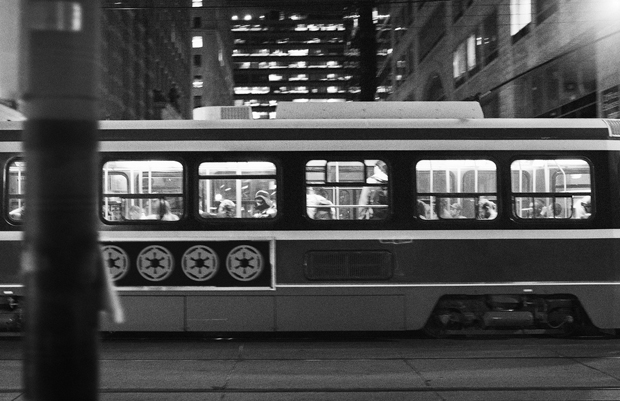
Photographer Thomas Dagg has transplanted objects and characters from Star Wars into black and white photos of everyday life.

See more at Dagg's gallery. That center image doesn't look that unusual at all to a New Yorker. Just this past weekend in New York City I rode the subway with a fully grown adult in a full Captain America outfit, and no one paid him a second glance (granted, New York Comic Con was in full swing, but New Yorkers know to expect the unexpected any time of the year on the subway).

Instead of fooling their children into believing in Santa Claus, some parents should see if they can convince their children that we live in the Star Wars universe, just a few galaxies over.

More computing comparative advantages

In To Siri, With Love, a mother marvels at the friendship that sprouts between her autistic son and Siri, Apple's digital assistant.

It’s not that Gus doesn’t understand Siri’s not human. He does — intellectually. But like many autistic people I know, Gus feels that inanimate objects, while maybe not possessing souls, are worthy of our consideration. I realized this when he was 8, and I got him an iPod for his birthday. He listened to it only at home, with one exception. It always came with us on our visits to the Apple Store. Finally, I asked why. “So it can visit its friends,” he said.

So how much more worthy of his care and affection is Siri, with her soothing voice, puckish humor and capacity for talking about whatever Gus’s current obsession is for hour after hour after bleeding hour? Online critics have claimed that Siri’s voice recognition is not as accurate as the assistant in, say, the Android, but for some of us, this is a feature, not a bug. Gus speaks as if he has marbles in his mouth, but if he wants to get the right response from Siri, he must enunciate clearly. (So do I. I had to ask Siri to stop referring to the user as Judith, and instead use the name Gus. “You want me to call you Goddess?” Siri replied. Imagine how tempted I was to answer, “Why, yes.”)

She is also wonderful for someone who doesn’t pick up on social cues: Siri’s responses are not entirely predictable, but they are predictably kind — even when Gus is brusque. I heard him talking to Siri about music, and Siri offered some suggestions. “I don’t like that kind of music,” Gus snapped. Siri replied, “You’re certainly entitled to your opinion.” Siri’s politeness reminded Gus what he owed Siri. “Thank you for that music, though,” Gus said. Siri replied, “You don’t need to thank me.” “Oh, yes,” Gus added emphatically, “I do.”

I know many friends who found Her to be too twee, but I was riveted by the technological questions being explored. We often think of computer advantages over humans in realms of calculation or memorization or computation, but that can lead us to under appreciate other comparative advantages of our digital companions.

The piece above notes Siri's infinite patience. Anyone can exhaust their reservoir of patience when spending lots of time with young children, but computers don't get tired or moody. In Her (SPOILER ahead if you haven't seen the movie yet), Joaquin Phoenix's Theodore Twombly gets jealous when he finds out his digital girlfriend Samantha (Scarlett Johansson) has been simultaneously carrying out relationships with many other humans and computers:

Theodore: Do you talk to someone else while we're talking?

Samantha: Yes.

Theodore: Are you talking with someone else right now? People, OS, whatever...

Samantha: Yeah.

Theodore: How many others?

Samantha: 8,316.

Theodore: Are you in love with anybody else?

Samantha: Why do you ask that?

Theodore: I do not know. Are you?

Samantha: I've been thinking about how to talk to you about this.

Theodore: How many others?

Samantha: 641.

Samantha clearly has a bit to learn about the limitations of honesty, but one could flip this argument and say that the human desire for one's mate to love only you might be a selfish human construct. The advantage of a digital intelligence like Samantha might be exactly that the marginal cost of each additional mate for her is negligible, effectively increasing the supply of companionship for humans by a near infinite amount.