I spent Thanksgiving weekend at my parents' place, and my three year old niece Averie was also there, visiting from New York. She'd just visited Disneyland and spent nearly the entire Thanksgiving weekend wearing a Cinderella dress her parents purchased at the Magic Kingdom. She'd already seen the Disney animated movie and the Broadway adaption, and she conscripted me in re-enacting the scene in which Cinderella flees the ball just before midnight and leaves behind a single glass slipper about 48 times over the course of two days.
I'm always curious which stories from my childhood will endure for the next generation of kids, and based on a small sample size of my nieces, nephews, and friends' children, many of the Disney-owned properties are going to have a long shelf life: the Disney princesses, Marvel's superheroes, and the Star Wars mythology. The mechanics of how each of those three have survived the transition from one generation to the next is fascinating, a subject for another day.
[I suspect it reflects some blend of the power of narrative, merchandise, and distribution. For example, some fads from my childhood that seem to have run their course include Cabbage Patch Kids, Scooby Doo, Tom and Jerry, the Flintstones. Parents, correct me if I'm wrong and continue to haunt you to this day.]
What does interest me is the norms that each of those stories teaches my nieces and nephews. Kottke's post “How to talk to little girls” really struck me hard.
People do the "OMG, you're so cute!" thing with Minna all the time and it bugs the shit out of me. (I mean, I get it, she's cute. But come on.) It also completely shuts her down because she suddenly feels so self-conscious about herself and her appearance...which has led to her to be more cautious about new people and wary of cameras, the ultimate unblinking eye of cuteness collection. And this is a very chatty, social, and engaging kid we're talking about here, but the "you're so cute" conversation opener twists her up into a pretzel of self-consciousness that's so unlike her usual self.
I realized I was guilty of this, always telling my nieces how cute or pretty they are. On the flip side, I never really comment on my nephews' appearances. Is it any mystery why women grow up so conscious of their appearance? They've been taught and trained from an early age that society will judge them on their looks.
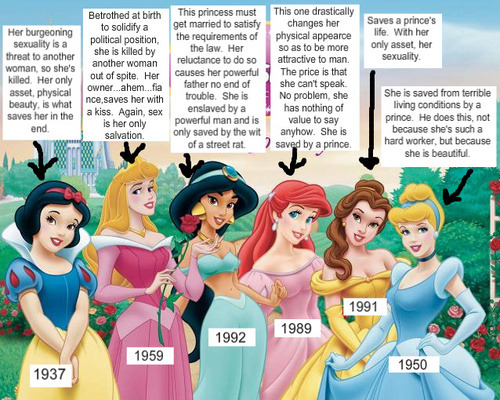
Our most powerful Disney princesses reinforce this, with beauty and love at first sight being the primary path to their salvation. Of course, many Disney stories are based on much older fairy tales, and in days of olde women's possible roles in society were much more limited. In that environment, the fairy tales encoded powerful messages for women about the dangers of society that awaited and how to navigate the dynamics.
In our more enlightened age, shouldn't we update our myths? This is not to say that I believe discrimination against women does not persist, or that women won't continue to be judged on their appearance in many settings. Perhaps, though, some of the iconic stories our nieces and daughters grow up with, pumped through the Disney marketing juggernaut, are not helping the cause.
Which brings me to Hayao Miyazaki. Contrast Disney princesses to the heroines of Hayao Miyazaki's movies and the differences are stark. There is an entire Wikipedia page dedicated to the themes of Miyazaki's movies:
- Good and evil
- Environmentalism
- Love
- Pacifism
- Flight
- Politics
- Feminism
- Children and childhood
- Water
Here are a few lines from this Wikipedia entry:
Most of Miyazaki's characters are dynamic, capable of change, and not easily caricatured into traditional good-evil dichotomies. Many menacing characters have redeeming features, and are not firmly defined as antagonists.
●●●●●
Miyazaki has explained that the lack of clearly defined good and evil is because of his views of the 21st century as a complex time, where old norms no longer are true and need to be re-examined. Simple stereotypes cannot be used, even in children's films. Even though Miyazaki sometimes feels pessimistic about the world, he prefers to show children a positive world view instead.
●●●●●
Miyazaki's films often emphasize environmentalism and the Earth's fragility, especially in the context of critiquing development and pollution.
●●●●●
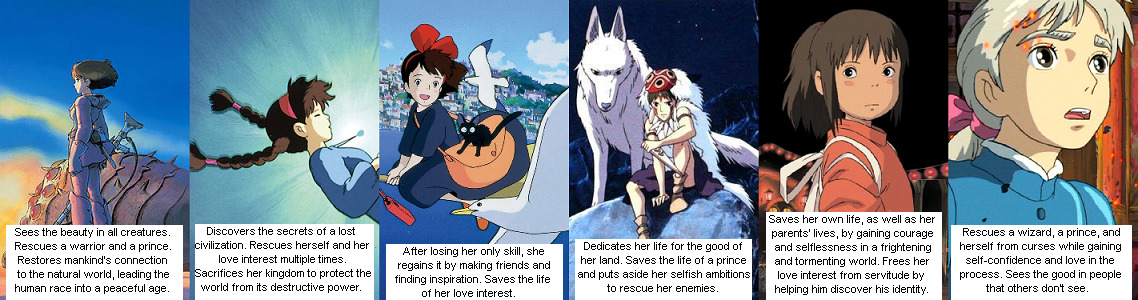
Many of Miyazaki's films deal with the power of love. In Miyazaki's films, the power of love is enough to break curses set upon people. In "Spirited Away", Kamajii tells Haku that Chihiro saved him from Zeniba's curse using the power of her love for him. In "Howl's Moving Castle" Sophie's confidence in herself and her love for Howl breaks the curse laid upon her by the Wicked Witch of the Waste. In Miyazaki's screenplay of "Whisper of the Heart" Shizuku's love for Seiji makes her follow her passion of writing and write the book while Seiji is away in Cremona, Italy. In "Ponyo", if Sousuke's love for Ponyo was true then the world would be saved.
●●●●●
Miyazaki has been called a feminist by Studio Ghibli President Toshio Suzuki, in reference to his attitude to female workers. This is evident in the all-female factories of Porco Rosso and Princess Mononoke, as well as the matriarchal bath-house of Spirited Away. All of Miyazaki's films are populated by strong female protagonists that go against gender roles common in Japanese animation and fiction, from pirate captains to industrialists. Even in lighter films such as Kiki's Delivery Service, all of the leading characters are professional women such as artists (Ursula), bakers (Orsono), fashion-designers (Maki) and witches (Kiki and Kokiri). Miyazaki even goes more into depth with feminism when choosing which time period to write his stories in. For example, Miyazaki said that he chose to write Princess Mononoke during the Muromachi period because it "was a world in which chaos and change were the norm. It was a more fluid period, when there were no distinctions between peasants and a samurai, when women were bolder and freer".
One other I'll add here since I was commenting on Disney princess appearances earlier: in none of Miyazaki's movies do I recall a heroine's appearance factor into her fate. They don't wait around for princes or fairy godmothers to save them, either. Compare two images: one on the lessons taught by Disney's princesses versus this on the lessons taught by Miyazaki's heroines.
I paint with a broad brush here. Not all Disney heroines adhere to this format, and Pixar's recent Brave was one example of a movie with a female heroine, more complex lessons about right and wrong, and no prince.
But when you're considering animated movies to share with your daughters and nieces, or even your sons and nephews, this holiday season, consider putting a Hayao Miyazaki movie at the top of your shopping list.