Hayao Miyazaki vs the Disney princesses

I spent Thanksgiving weekend at my parents' place, and my three year old niece Averie was also there, visiting from New York. She'd just visited Disneyland and spent nearly the entire Thanksgiving weekend wearing a Cinderella dress her parents purchased at the Magic Kingdom. She'd already seen the Disney animated movie and the Broadway adaption, and she conscripted me in re-enacting the scene in which Cinderella flees the ball just before midnight and leaves behind a single glass slipper about 48 times over the course of two days.

I'm always curious which stories from my childhood will endure for the next generation of kids, and based on a small sample size of my nieces, nephews, and friends' children, many of the Disney-owned properties are going to have a long shelf life: the Disney princesses, Marvel's superheroes, and the Star Wars mythology. The mechanics of how each of those three have survived the transition from one generation to the next is fascinating, a subject for another day.

[I suspect it reflects some blend of the power of narrative, merchandise, and distribution. For example, some fads from my childhood that seem to have run their course include Cabbage Patch Kids, Scooby Doo, Tom and Jerry, the Flintstones. Parents, correct me if I'm wrong and continue to haunt you to this day.]

What does interest me is the norms that each of those stories teaches my nieces and nephews. Kottke's post “How to talk to little girls” really struck me hard.

People do the "OMG, you're so cute!" thing with Minna all the time and it bugs the shit out of me. (I mean, I get it, she's cute. But come on.) It also completely shuts her down because she suddenly feels so self-conscious about herself and her appearance...which has led to her to be more cautious about new people and wary of cameras, the ultimate unblinking eye of cuteness collection. And this is a very chatty, social, and engaging kid we're talking about here, but the "you're so cute" conversation opener twists her up into a pretzel of self-consciousness that's so unlike her usual self.

I realized I was guilty of this, always telling my nieces how cute or pretty they are. On the flip side, I never really comment on my nephews' appearances. Is it any mystery why women grow up so conscious of their appearance? They've been taught and trained from an early age that society will judge them on their looks.

Our most powerful Disney princesses reinforce this, with beauty and love at first sight being the primary path to their salvation. Of course, many Disney stories are based on much older fairy tales, and in days of olde women's possible roles in society were much more limited. In that environment, the fairy tales encoded powerful messages for women about the dangers of society that awaited and how to navigate the dynamics.

In our more enlightened age, shouldn't we update our myths? This is not to say that I believe discrimination against women does not persist, or that women won't continue to be judged on their appearance in many settings. Perhaps, though, some of the iconic stories our nieces and daughters grow up with, pumped through the Disney marketing juggernaut, are not helping the cause.

Which brings me to Hayao Miyazaki. Contrast Disney princesses to the heroines of Hayao Miyazaki's movies and the differences are stark. There is an entire Wikipedia page dedicated to the themes of Miyazaki's movies:

  1. Good and evil
  2. Environmentalism
  3. Love
  4. Pacifism
  5. Flight
  6. Politics
  7. Feminism
  8. Children and childhood
  9. Water

Here are a few lines from this Wikipedia entry:

Most of Miyazaki's characters are dynamic, capable of change, and not easily caricatured into traditional good-evil dichotomies. Many menacing characters have redeeming features, and are not firmly defined as antagonists.

●●●●●

Miyazaki has explained that the lack of clearly defined good and evil is because of his views of the 21st century as a complex time, where old norms no longer are true and need to be re-examined. Simple stereotypes cannot be used, even in children's films. Even though Miyazaki sometimes feels pessimistic about the world, he prefers to show children a positive world view instead.

●●●●●

Miyazaki's films often emphasize environmentalism and the Earth's fragility, especially in the context of critiquing development and pollution.

●●●●●

Many of Miyazaki's films deal with the power of love. In Miyazaki's films, the power of love is enough to break curses set upon people. In "Spirited Away", Kamajii tells Haku that Chihiro saved him from Zeniba's curse using the power of her love for him. In "Howl's Moving Castle" Sophie's confidence in herself and her love for Howl breaks the curse laid upon her by the Wicked Witch of the Waste. In Miyazaki's screenplay of "Whisper of the Heart" Shizuku's love for Seiji makes her follow her passion of writing and write the book while Seiji is away in Cremona, Italy. In "Ponyo", if Sousuke's love for Ponyo was true then the world would be saved.

●●●●●

Miyazaki has been called a feminist by Studio Ghibli President Toshio Suzuki, in reference to his attitude to female workers. This is evident in the all-female factories of Porco Rosso and Princess Mononoke, as well as the matriarchal bath-house of Spirited Away. All of Miyazaki's films are populated by strong female protagonists that go against gender roles common in Japanese animation and fiction, from pirate captains to industrialists. Even in lighter films such as Kiki's Delivery Service, all of the leading characters are professional women such as artists (Ursula), bakers (Orsono), fashion-designers (Maki) and witches (Kiki and Kokiri). Miyazaki even goes more into depth with feminism when choosing which time period to write his stories in. For example, Miyazaki said that he chose to write Princess Mononoke during the Muromachi period because it "was a world in which chaos and change were the norm. It was a more fluid period, when there were no distinctions between peasants and a samurai, when women were bolder and freer".

One other I'll add here since I was commenting on Disney princess appearances earlier: in none of Miyazaki's movies do I recall a heroine's appearance factor into her fate. They don't wait around for princes or fairy godmothers to save them, either. Compare two images: one on the lessons taught by Disney's princesses versus this on the lessons taught by Miyazaki's heroines.
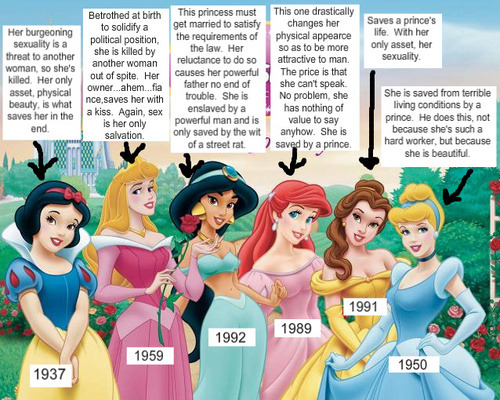
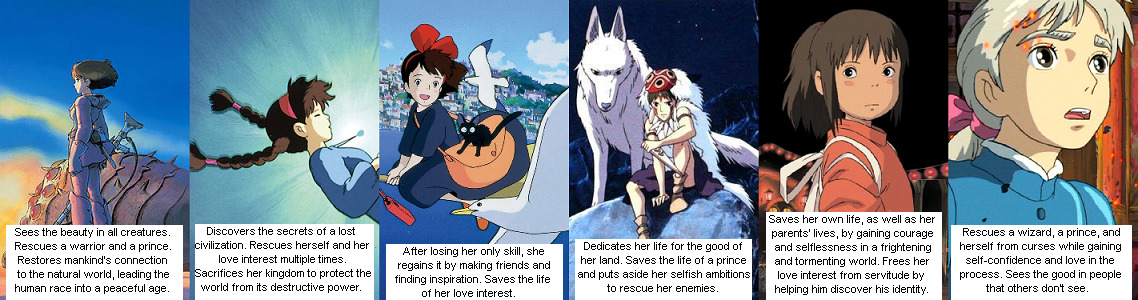
I paint with a broad brush here. Not all Disney heroines adhere to this format, and Pixar's recent Brave was one example of a movie with a female heroine, more complex lessons about right and wrong, and no prince.

But when you're considering animated movies to share with your daughters and nieces, or even your sons and nephews, this holiday season, consider putting a Hayao Miyazaki movie at the top of your shopping list.

Optimal blog post lengths

Related to my note the other day on the ideal length of various pieces of art, a post on Medium reveals that the optimal post length there (if your criteria is what length Medium post entices readers to spend the most time on it) is 7 minutes.

The post revealing this was, appropriately, 7 minutes in reading time.

[Somewhat related: I don't ever find myself glancing at the estimated time to read figure on any of Medium's posts. I'm not sure if it's because I am time insensitive or that my sense of time is so subjective that I just ignore the numbers, or if it's something else. Do others find reading time estimates for content useful?]

Why we love lists

The article-as-numbered-list has several features that make it inherently captivating: the headline catches our eye in a stream of content; it positions its subject within a pre-existing category and classification system, like “talented animals”; it spatially organizes the information; and it promises a story that’s finite, whose length has been quantified upfront. Together, these create an easy reading experience, in which the mental heavy lifting of conceptualization, categorization, and analysis is completed well in advance of actual consumption—a bit like sipping green juice instead of munching on a bundle of kale. And there’s little that our brains crave more than effortlessly acquired data.

Whenever we encounter new information, our brains immediately try to make sense of it. Once they figure out what we’re seeing in a physical sense, they work to provide personal context and decide if it’s relevant enough to focus on further. The process is instantaneous: we don’t even realize we’ve made a choice in the time our minds have selected one path or another. Our gaze either stops, or we simply keep scanning. Recall a time when you were spacing out while skimming a stream of content and then, without quite knowing why, found yourself pausing to actually process the words. What made you stop and focus? On a physical level, the answer is often simple: difference. Whenever we’re scanning the environment for nothing in particular, our visual system is arrested by the things that don’t fit—features that suddenly change or somehow stand out from the background. A headline that is graphically salient in some way has a greater chance of capturing our eye, and in an environment where dozens of headlines and stories vie for attention, numerals break up the visual field. Consider the contexts in which we’re most likely to debate which article to read: a publication’s home page, a Twitter feed, or a Facebook feed. Most of what we see is words and images (even though it often seems like Web pages or streams are composed of nothing but lists). In that context, numbers pop.

From Maria Konnikova at The New Yorker. In other words, why is Buzzfeed so popular. At a more general level, it speaks to the power of structuring large blocks of information. An alternative memorable way of implanting information in people's heads is through narrative, but it is not as compact as the list.

One of the dangers of the list is that forcing information to conform to that rigid format can influence how we both perceive and receive it. It's the reason Edward Tufte preaches the dangers of Powerpoint, which can “weaken verbal and spatial reasoning, and almost always corrupt statistical analysis.

At Amazon, Jeff Bezos hated when folks would bring giant Powerpoint decks to present to him. While you'd be speaking to your first slide he'd already flipped to the end of the deck, having absorbed it all, and would start firing questions at you about slide 27. After a while he was so sick of the whole charade he banned Powerpoints and forced everyone to start bringing ideas to him in prose form.

Painful for some, but I love writing and dislike making presentations (usually) so I thought it was a great change. Writing is, to me, still generally the most efficient way to communicate ideas in all their complexity. Of course, for some forms of information, like data, nothing beats a well-constructed chart. But most great thinking is stripped of all substance when compressed into a few bullet points, and the time spent formatting slides for a deck is wasted time that few busy professionals can afford.

From a glass half empty perspective, it's alarming how much of the list's appeal lies in our brain's inherent laziness.

In the current media environment, a list is perfectly designed for our brain. We are drawn to it intuitively, we process it more efficiently, and we retain it with little effort. Faced with a detailed discussion of policies toward China or five insane buildings under construction in Shanghai, we tend to choose the latter bite-sized option, even when we know we will not be entirely satisfied by it. And that’s just fine, as long as we realize that our fast-food information diet is necessarily limited in content and nuance, and thus unlikely to contain the nutritional value of the more in-depth analysis of traditional articles that rely on paragraphs, not bullet points.

Still, this list at Buzzfeed of the 25 best Taylor Swift Audience-Dancing Moments of All Time is undeniably great. Tay-tay be rocking out, yo. Looking forward to Konnikova analyzing the brain appeal of the animated GIF in a future post. [I'm only half joking; the hypnotic looped visual imagery of animated GIFs have a hypnotic effect that must trigger something in our animalistic brain wiring]

Guy Walks Into a Bar

So a guy walks into a bar one day and he can't believe his eyes. There, in the corner, there's this one-foot-tall man, in a little tuxedo, playing a tiny grand piano.

So the guy asks the bartender, “Where'd he come from?”

And the bartender's, like, “There's a genie in the men's room who grants wishes.”

So the guy runs into the men's room and, sure enough, there's this genie. And the genie's, like, “Your wish is my command.” So the guy's, like, “O.K., I wish for world peace.” And there's this big cloud of smoke—and then the room fills up with geese.

So the guy walks out of the men's room and he's, like, “Hey, bartender, I think your genie might be hard of hearing.”

And the bartender's, like, “No kidding. You think I wished for a twelve-inch pianist?”

This piece by Simon Rich is behind the New Yorker paywall, but many of you probably have a subscription, right? The opening excerpt above works as a stand-alone joke, but the piece goes on from there to places unanticipated.

I don't often read the humor pieces in The New Yorker, but when I do, I read the ones by Simon Rich.

How stereotypes persist

Martin and his family may be what politicians and teachers say is the American ideal, but the actual rewards -- the acting jobs, the record deals, the social acceptance, the money -- largely go to the African-Americans who exemplify the N-word, who embrace the suffocating, limiting image of male blackness. The decision to perpetuate this image isn't made solely by the black community but by the white suits who decided long ago how the part is supposed to look and what black behavior they will compensate; think of that LeBron cover again. Corporations seem to doubt the authenticity and marketability of black men who live outside the primal construct.

This represents the ultimate victory of racism: the belief that exists among both whites and blacks that being educated, being articulate, having manners, is the sole province of being white. It is why Jonathan Martin appears so foreign, so threatening, to his teammates, and why a nothing like Richie Incognito makes them feel right at home.

Howard Bryant on how powerfully the stereotype of the angry and primal black man persists, aided by an entertainment industry that packages and resells it.